Monthly Archives: April 2013

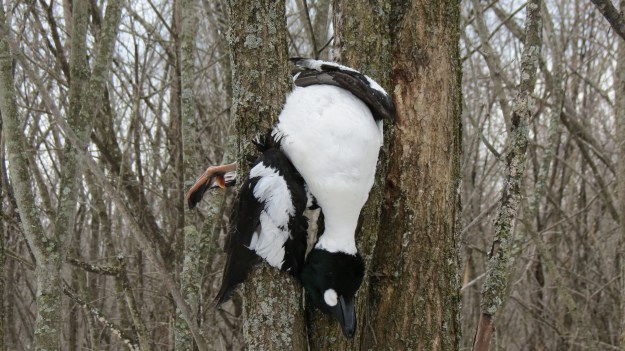
Drake goldeney--post mortem

Drake goldeneye killed when he flew into Ontario Hydro power lines spanning the Rideau River, April 2013. One of the hazards facing wild birds, man made structures like power lines and office buildings built on migration paths.

Photographed and posted by Geoffrey

Sparrow

What I think is a song sparrow perched in a tree next to the Rideau River, April 6, 2013.

Photographed and posted by Geoffrey

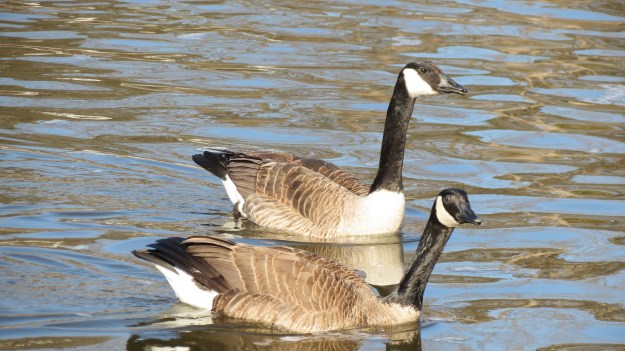
Canada geese

Pair of Canada geese swimming on the Rideau River, April 6, 2013.

Photographed and posted by Geoffrey

Sapientia et Doctrina Stabilitas = Wisdom and knowledge shall be the stability of thy times–Queen’s University Motto

522085_528346907180414_1651874656_nqueen's free speech wall5

Mika and I are Queen’s grads. I graduated in 1986 with a B.A. in sociology. Mika graduated in 1996 with a B.Sc. in mathematics and computer science. The years I spent at Queen’s were a lot of fun for the most part. Political correctness was yet to take hold. Frosh week, was a drunken and ribald festival in which we were expected to use vulgarity liberally. I remember suffering quite a culture shock when my mother and father left me on campus. I have never cared for vulgarity personally and until I met with my Gael group later that day I was on the brink of calling and asking them to take me home. Once I was settled into my Gael group, no. 9–our group chant was “Number Nine is doing fine, the rest of you are fucking swine”–I began to feel better and joined in the ribald fun that continued for the rest of the week. Early into my first year at Queen’s, some students organized a game they called “Kill.” The game consisted of players who had completed an entry form giving their address on campus or in the student ghetto. Players were given an information sheet indicating where their victim might be found and to make a kill you used a toy pistol that fired plastic projectiles. To authenticate the kill there had to be a 2-3 witnesses who were acquainted with the victim. I made my first kill before I was gunned down outside my drama class. When you were killed, you gave the information form of the victim you were stalking to your assassin and the game continued. Somehow, in the current climate across college and university campuses, I do not think this game is played anymore. Continue reading

Jack Miner

IMG_0608

The newest addition to our library collection is a copy of Jack Miner on Current Topics (first published in 1929). Mika found a copy in the Ex Libris book store at the Ottawa Public Library and thoughtfully purchased it, knowing I would like it. Jack Miner (1865-1944), born in Ohio, but settled in Canada in 1878, was a deeply religious man and pioneering conservationist. Miner was not a trained biologist, he had no formal education and was illiterate until he was in his thirties. He was Christian and subscribed to a literal interpretation of Scripture, believing “God put birds and animals here for man’s use and for man to control.” He founded a bird sanctuary on his farm in 1904, which exists to this day, and contributed to the effort to determine the migratory paths of wild ducks and geese in live trapping and banding them. He manufactured his own hand-stamped aluminum bands adding with his address Bible passages: “Keep yourselves in the love of God—Jude 1-21” and “With God all things are possible—Mark 10-27”. Bands recovered from birds after they were shot by hunters indicated where the birds had traveled.

In this book he discusses the Migratory Bird Treaty Act of 1918 (MBTA) which was signed between the United States and Great Britain (acting on behalf of the Dominion of Canada), which effectively ended market hunting, but allows for the hunting of game species for private consumption. He puts forward his case for the conservation of wildlife resources through education and wise use. He includes two chapters detailing his admiration for the Canada goose, proposing it be designated as Canada’s national bird. That he was not a trained biologist shows through in the chapter in which he shares his dislike of crows, referring to them as “cannibals” and “murderers.” He trapped and killed them in droves, believing he was protecting more “desirable” species of birds and mammals. In keeping with his religious beliefs he tended to anthropomorphize wildlife in ascribing human morality to animal behaviour, noting, for example, that Canada geese mate for life and never seeing a pair divorce.

He is remembered for banding wild ducks and geese, having banded over 50,000 wild ducks and 40,000 Canada geese. His efforts in banding waterfowl popularized the procedure leading to its standardization and is still in use as a tool for wildlife biologists today. After his death, the Government of Canada enacted the National Wildlife Week Act to be observed the week of Jack Miner’s birth, April 10 each year. He was a simple and pious man whose passion for migratory birds inspired him to help lay the foundation of the modern conservation movement and for those who love the natural world he is worth remembering.

Posted by Geoffrey and Mika

When truth is stranger than fiction

IMG_0603Molasses_Flood_Historical_Marker

Molasses, what comes to mind when you hear someone mention molasses? “Slow as molasses in January” is an idiom, sometimes shortened to “slow as molasses” as its viscosity makes it pour slowly from a container. However, on January 15, 1919 in Boston, Massachusetts this idiom did not apply. A molasses tank measuring 50 ft tall, 90 ft in diameter and containing as much as 2,300,000 US gallons ruptured unleashing a flood of molasses between 8 and 15 ft high, moving at 35 mph, and exerting a pressure of 2 ton/ft². You may think this is an urban legend, but it really happened. That such a thing could happen seems absurd to the point of being comical, except 21 people lost their lives in the flood along with horses, dogs and other animals. Approximately 150 people were injured. Stephen Puleo documents this disaster in Dark tide: the great Boston molasses flood of 1919. Puleo describes the scene in the aftermath of the flood:

Molasses, waist deep, covered the street and swirled and bubbled about the wreckage. Here and there struggled a form — whether it was animal or human being was impossible to tell. Only an upheaval, a thrashing about in the sticky mass, showed where any life was… Horses died like so many flies on sticky fly-paper. The more they struggled, the deeper in the mess they were ensnared. Human beings — men and women — suffered likewise.

Portions of a residential neighbourhood adjacent to the ruptured molasses tank were flattened or damaged in the flood. Following the cleanup an inquiry into the disaster found poor construction, negligence in maintaining safety standards and higher than normal temperatures for January led to the disaster. The owners of the molasses tank, United States Industrial Alcohol Company (USIA), were found liable for the disaster and paid out $600,000 in out-of-court settlements. Today a small plaque stands as a monument to the incident, quite probably the most unusual thing to happen in the history of Boston.

Posted by Geoffrey