Tag Archives: conservation

The joy of killing! the joy of seeing killing done – these are traits of the human race at large. ― Mark Twain, Following the Equator: A Journey Around the World

quote2 teddybear

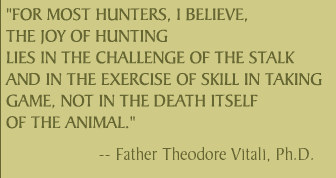
The killing of Cecil the lion in Zimbabwe by an American trophy hunter has fanned the flames of  the controversy surrounding sport hunting. A familiar claim made by people opposed to sport hunting is that sport hunters “like killing things,” that is to say they enjoy killing for the sake of killing. This claim typically leaves me at a loss for words as it is so egregiously wrong. Yes, I enjoy hunting, but no, as hard as it is for you to believe, I do not like killing things. While most of my hunting expeditions are in pursuit of game birds I enjoy big game hunting too. To date my big game hunting experience is in the pursuit of the whitetail deer. My introduction to the sport of whitetail deer hunting was by Jason, one of my hunting buddies and a seasoned deer hunter, in 2011. It was not until my second season in November 2012 that I shot my first whitetail deer. It was a happy and exciting moment for me; the successful conclusion of the hunt with a whitetail deer harvested and secure in the knowledge it was a fair chase as the deer we hunt are wild, not the least bit habituated to humans. Continue reading

Mallard hen with duckling

Sole survivor

By mid-July on the Rideau River this mallard hen has only one of her brood left. She will have started out with a brood of six to eight newly hatched ducklings in May-June, but ducklings fall prey to seagulls, snapping turtles and other predators very easily. Chances are the surviving duckling will not survive its first year of life. This is the reality in the natural world: 85% of the birds and animals born in spring do not last a year, but enough do last long enough to breed the following spring and perpetuate their species.

Photographed and posted by Geoffrey

Eastern kingbird

Eastern kingbird

Eastern kingbird keeping a wary eye on us as we passed by its nesting site in a shrub next to the Rideau River, July 1, 2013.

Photographed and posted by Geoffrey

Brown-headed cowbird

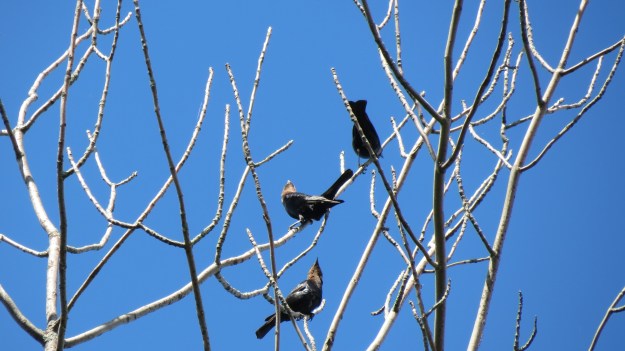
Trio of male brown-headed cowbirds

Three male brown-headed cowbirds perched in the treetops next to the Rideau River, June 30, 2013. The brown-headed cowbird is unusual in that it practices nest parasitism. Cowbirds do not rear their own young. The female lays an egg in another bird’s nest and the cowbird chick hatches and is reared by the other birds. It pushes the chicks of the host birds out of the nest so it does not compete for food. Some species of songbird have adapted to this threat in building dummy nests to lure the cowbird to leave its eggs, leaving them free to rear their own broods.

Photographed and posted by Geoffrey

Gray catbird

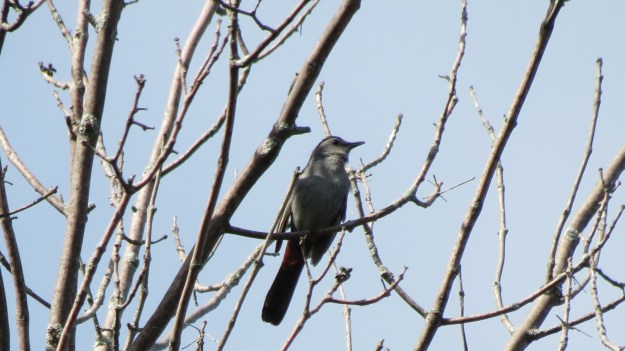
Gray catbird

Gray catbird perched in the treetops at the edge of the Rideau River, June 30, 2013. The gray catbird is so named because of its call that sounds like a cat meowing. You can usually hear the call of the gray catbird in shrubs and wooded areas near bodies of water. If you meow back at a catbird, often it will respond and show itself.

Photographed and posted by Geoffrey

Eastern phoebe

Phoebe on a wire

Eastern phoebe perched on a wire and good enough to pose for me while out on a run with Hera and my friend Jason Quinn and his dog Nos, June 21, 2013.

Mallard hen with ducklings

Mallard ducklings

Hen mallard with a brood of newly hatched ducklings on the pond next to the Rideau River, June 20, 2013.

Photographed and posted by Geoffrey

Green heron

Green heron

After seeing a pair of green herons on the pond next to the Rideau River where I photographed ducks, turtles, red-winged blackbirds over the past several weeks, one of the herons was good enough to pose for me at last on June 18, 2013.

Photographed and posted by Geoffrey

Eastern kingbird

Eastern kingbird viewed while out for a run with Hera, my friend Jason Quinn and his dog Nos, June 17, 2013. The eastern kingbird is a plucky species of flycatcher common in the area. I see a few mated pairs every spring nesting in shrubs along the Rideau River. They are usually successful at rearing their broods as they mount a spirited defense of their nest and young, driving away crows especially. The often perch on the wires in the background, watching for the insects on which they prey, snatching them out of the air.

Photographed and posted by Geoffrey

Vireo

Vireo, possibly a warbling vireo seen and photographed June 15, 2013 in a wooded area next to the Rideau River.

Photographed and posted by Geoffrey