
Tag Archives: Heated Rivalry

OH! The good ol’ Hockey game, is the best game you can name. And the best game you can name, is the good ol’ Hockey game. — Stompin Tom Connors

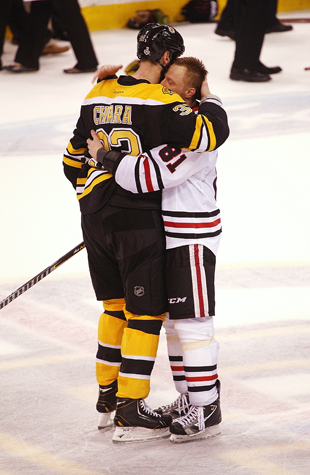
BOSTON, MA – JUNE 24: Zdeno Chara #33 of the Boston Bruins congratulates Marian Hossa #81 of the Chicago Blackhawks on winning the Stanley Cup in Game Six of the Stanley Cup Final at the TD Garden on June 24, 2013 in Boston, Massachusetts. The Blackhawks defeated the Boston Bruins 3-2. (Photo by Gail Oskin/Getty Images)
Ice hockey is a rough-and-tumble sport, whether it is men or women who play. Yes, ice hockey requires a plurality of skills to play. Skating is first and foremost what a successful hockey player needs to master, along with stick handling and teamwork. Hockey is a contact sport. Players wear pads, helmets, and eye protection when they go on the ice. Checking is a part of the game, and sometimes fights break out. When I was in high school, I refereed house league hockey, including girls’ hockey. The girls were as tough as the boys on the ice. I remember hearing the girls calling to their teammates from the bench, “Cream the bitch!” I played house league hockey as a boy. In my last year in the Midget-level (15-17 years old) hockey league, the girls’ team goalie in our village often practiced with us. My brother and one of my sisters played hockey growing up, too. My brother was the athlete in the family. He started in the house league and eventually played in a competitive league and on our high school hockey team. He suffered a fractured collarbone in a game when he played on the high school team. I remember it well as I picked him up at the hospital, where the technician showed me how to tighten the harness he put on my brother to set the fracture. So, yes, ice hockey is a rough-and-tumble sport, and players are sometimes injured. The checking and competition between the opposing teams on the ice is the appeal for the fans. Having watched many amateur hockey games as a spectator and as a referee, I can assure you that the crowd loves it when a player makes a hit on the ice. Watching the crowd’s reaction made me think of what it must have been like in the Roman Coliseum when fans went to watch the gladiatorial games. Elite-level amateur and professional hockey are immensely popular worldwide, and many people, children and adults alike, have fun playing at the house league level.
 
I remember in the 1990s, I was acquainted with a man at the gym where we worked out. He told me that he played in a gay men’s hockey league. I do not know the details of the gay men’s hockey league in Ottawa in the 1990s, but since 2020, Ottawa has had a “queer and trans friendly team,” called Ottawa Pride Hockey. The Ottawa Senators, the NHL team in Ottawa, is among the team’s sponsors. Ottawa Pride Hockey hosts an annual tournament called the Queer Capital Cup. The team’s rules specify, “Overly competitive or aggressive play is not tolerated.” (Ottawa Pride Hockey) Similarly, in Toronto, there is the Toronto Gay Hockey Association, which was founded in 1994. The mission statement states, in part, “To create an LGBTQ+ and allied positive space where people enjoy the game of hockey in an environment free from all forms of harassment or discrimination, which encourages fair play, openness and friendship.” (TGHA) A key feature of the Toronto Gay Hockey Association is that the rules do not allow body checking. So, there are “queer and trans friendly” spaces for those so inclined to play hockey and for any spectators who would watch them play. Somehow, I doubt that most hockey fans would be interested. Furthermore, if they demand that the NHL become “queer and trans friendly” in the manner that Ottawa Pride Hockey and the Toronto Gay Hockey Association play, they are going to be disappointed. No, ice hockey is a rough-and-tumble sport in which body checking is integral. True, in minor hockey, body checking is regulated by age groups, with Hockey Canada stating, “While positioning, angling, stick-checking and body contact is taught in the younger age divisions, full body-checking is not permitted until U15 at most intermediate and competitive levels. Some community (house) leagues will offer a non-body-checking option for all age divisions, including U15 and U18.” (Hockey Canada) The fact remains, however, that hockey is a contact sport, and body checking is a major appeal for the fans.
 
What made me think of this was the release of the Crave series, Heated Rivalry, a story about two professional hockey players, one bisexual and the other gay, who strike up an intimate relationship. The series became an overnight sensation. It has generated discussion and has the approval of the National Hockey League, as a representative for the NHL praised the show as, “The most unique driver for creating new fans.” (New York Times) The success of Heated Rivalry has some people discussing male homosexuality and professional hockey. Currently, there are no known openly gay players in the National Hockey League. There may be closeted players. Personally, I do not see why it matters. There are many thousands of young men who rise through the ranks of competitive junior and minor hockey, dreaming of making it to the NHL. A lucky few succeed. What does their sexual orientation have to do with any of it? Sure, fans are interested in players’ personal lives. I remember watching Hockey Night in Canada on Saturday nights in the early 1970s on the Canadian Broadcasting Corporation (CBC). Sometimes, in the segments between periods, segments featured a look into the players’ personal lives. They were either single or family men. Whether there were any gay players then is anyone’s guess, and, yes, they would have been wise to stay closeted. In the present, I doubt that most hockey fans would care if an NHL player came out as gay. For others, it is important that there is gay representation in professional sports. Again, I think it is irrelevant. The fans are there to watch a hockey game in all its rough-and-tumble glory. All they care about is the players’ skill.
 
Posted by Geoffrey

 

I was raised in a household where being gay was like, the most normal thing. My brother is gay, all of my best friends are gay. When my brother came out of the closet, it wasn’t a big deal for my family. — Ariana Grande

Gay men have long been seen as a novelty, a standard deviation in the demographic where most of humanity is heterosexual. Attitudes toward male homosexuality varied throughout history. In Antiquity, for the Etruscans, Greeks, and Romans, it was a part of life. They understood that people were sexual, so same-sex liaisons were common and depicted in their artwork. With the development of the Abrahamic faiths, Judaism, Christianity, and Islam, male homosexuality was viewed in a critical light. Eventually, it was condemned in the Abrahamic faiths and in the wider society. Gay men lived and died through centuries where, at best, they were tolerated, sometimes, and at worst, persecuted and imprisoned. By the eighteenth century in England, the argument was advanced by the British philosopher, Jeremy Bentham, for the decriminalisation of homosexual behaviour between consenting adults in private, in his essay Offences Against Oneself. He wrote the essay around 1785, but it was published posthumously in 1931. Bentham thought homosexuality, as Jeffrey Weeks notes, “an ‘imaginary offence’ dependent on changing concepts of taste and morality.” (Wolfenden and beyond: the remaking of homosexual history) Bentham thought through the issue and reasoned:

To what class of offences shall we refer these irregularities of the venereal appetite which are stiled [sic] unnatural? When hidden from the public eye there could be no colour for placing them any where else: could they find a place any where it would be here. I have been tormenting myself for years to find if possible a sufficient ground for treating them with the severity with which they are treated at this time of day by all European nations: but upon the principle utility I can find none. (Offences Against Oneself)

However, in England and Wales, the passage of the Criminal Law Amendment Act 1885 (48 & 49 Vict. c.69) included Section 11, in particular the clause known as the Labouchere Amendment, which applied to male homosexuality. In short, the clause provided for a term of imprisonment “not exceeding two years”, with or without hard labour, for any man found guilty of “gross indecency” with another male, whether “in public or in private”.  The Labouchere Amendment was enforced sparingly and selectively. However, the consequences of arrest and conviction could be devastating. John Gielgud very nearly saw his career as an actor come to an abrupt end in 1953 when a scandal arose over his arrest for ‘persistently importuning male persons for immoral purposes’ (he was caught trying to pick up a man in a public washroom). He was fined £10, and news of the arrest reached the press, causing him a most personal humiliation and the refusal of a visa to travel to the United States with his company to perform Shakespeare’s The Tempest. Gielgud was fortunate that the theatre-going public forgave his momentary indiscretion, and he continued his acting career both in the United Kingdom and the United States. Also, in 1953, the Home Secretary, David Maxwell Fyffe, referred to male homosexuality as a “plague over England,” and vowed to wipe it out. The Labouchere Amendment was repealed in English law in 1967—interestingly, a backbench Conservative Member of Parliament, Margaret Thatcher, broke ranks with the party to vote for its repeal. Since the decriminalisation of male homosexuality in England and Wales in 1967, many countries followed. It was decriminalised in Canada in 1969.
 
Now, in the twenty-first century, male homosexuality is seen by most as inconsequential. It is a natural expression of human sexuality. True, gay men remain a minority, but are free to take their place in society and live openly. Gay men marry and have families. They are represented in all occupations, and take part in a plurality of pastimes like anyone else. Unfortunately, for some, gay men remain a novelty. The series, Heated Rivalry, released by Crave, a Canadian streaming service, has become a worldwide hit with viewers. The series is based on novels by Rachel Reid, a Canadian author. I do not begrudge her success or the television series’s success, but what concerns me is that the story is pure fantasy. Yes, it is good writing and acting, absolutely, only it made me think of a quotation by Maria Von Trapp. When she saw the first production of The Sound of Music, she said, “That’s a nice story, but it’s not my story.” The story of two professional hockey players, one bisexual and the other gay, came from the imagination of a heterosexual woman. I am not saying there is anything wrong with that. Hardly, she is free to write stories about any characters she chooses. Though they say, “Art imitates life,” sometimes, particularly in romance novels, the lives of the characters are idealised beyond belief. The reality is that there is nothing novel about gay men living in the twenty-first century in most Western jurisdictions. There is no need to fashion romantic fantasies about how you imagine gay men live, how they feel, and what they think. The truth is, we are like everybody else, despite being a minority. There are plenty of openly gay professional athletes, including Jason Collins (an NBA player), Robbie Rogers (an NFL player), Tom Daley (a diver for the British Olympic team), Gus Kenworthy (a skier for the U.S. Olympic team), and Carl Nassib (an NFL player). I do not know much about the personal lives of these men, except for Tom Daley, whose private life is on the public record. Daley is married to his husband, Dustin Lance Black, and has two sons. They lead a conventional life like any other married couple. So, why are people so agog over a fantasy television series that treats the ordinary lives of gay men as something new and unusual?
 
Posted by Geoffrey
 

Love him and let him love you. Do you think anything else under heaven really matters? — James Baldwin

Connor Storrie and Hudson Williams as Ilya Rozanov and Shane Hollander.

I noticed the sensation generated by the release of the series Heated Rivalry on Crave. It piqued my interest. I subscribed to Crave and settled in to watch the first episode of the series. Based on the first episode of the series, I expected the rest to be decidedly underwhelming. Thankfully, I found the following episodes much improved. I get what the storyline is about; at least I think so. The story is about two young men, one from Canada — his name is Shane Hollander — and the other from Russia — his name is Ilya Rozanov — who are rising stars in elite-level Junior Hockey and fierce competitors. They go on to become professional hockey players and captains of their respective teams. Each one has issues with his family and feels the pressures of navigating the byzantine world of professional hockey. Their story progresses through several years; along the way, they found they had a mutual sexual attraction. That further complicated things for them.

Continue reading