
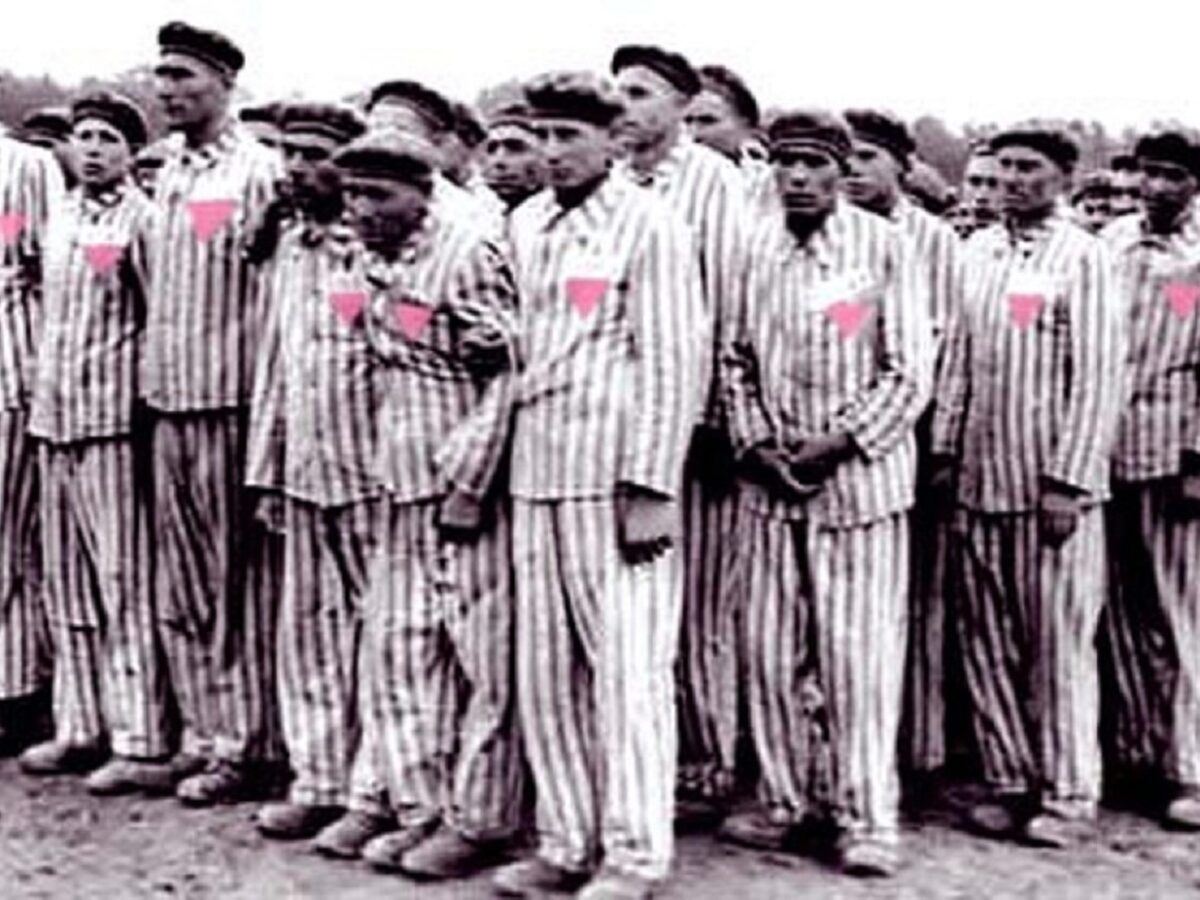

The persecution of gay men in Germany goes back to the 1794 and 1851 Prussian legal codes. In 1871, Paragraph 175 of the German Empire’s criminal code was enacted, based on the Prussian legal codes.
The 1871 version of Paragraph 175 read:
Unnatural sexual acts (widernäturliche Unzucht) committed between persons of the male sex, or by humans with animals, is punishable with imprisonment; a loss of civil rights may also be sentenced. (Holocaust Encyclopedia)
Yes, it criminalized sex acts between men; it did not criminalize men for having a homosexual orientation. Also, it did not apply to lesbians. The law was enforced sparingly during the Imperial and Weimar eras, as a conviction required that two men be caught in the act of having sex. When the Nazi Party took power in Germany in 1933, Paragraph 175 was revised to read:
A man who commits sexual acts (Unzucht) with another man, or allows himself to be misused for sexual acts by a man, will be punished with prison. (Holocaust Encyclopedia)
There was opposition to Paragraph 175. Notably, it was a German physician and gay rights advocate, Magnus Hirschfeld, who first conducted experiments in hormone therapy and sex reassignment surgeries at his clinic, the Institute for Sexual Science in Berlin. No, there was nothing in German law that prohibited his experiments. It was Hirschfeld who coined the term, transvestite in 1910. He founded the clinic in 1919. Before his trials in hormone therapy and sex reassignment surgeries, he established the Scientific-Humanitarian Committee in 1897 with Max Spohr, Franz Josef von Bülow, and Eduard Oberg. Its primary aim was to fight for the abolition of Paragraph 175 of the German Imperial Penal Code, which criminalized sexual contact between men. Then as now, experiments in hormone therapy and sex reassignment surgeries carried risks, as Fara Naz Khan noted in 2016, In 1922, Hirschfeld performed castration on Dora Richter, one of the institute’s employees who later went on to complete her sex reassignment in 1931 with further surgeries at the institute. The institute’s most famous patient was arguably Danish painter Lili Elbe (born Einar Wegener) whose life story has been fictionalized in the popular film The Danish Girl. Starting in 1930, Elbe had five surgeries performed as part of her male-to-female transition. Unfortunately, Elbe died from infection-related complications of her final surgery in 1931. (Scientific American)
Hirschfeld’s trials stopped when the Nazis rose to power in Germany, as Hirschfeld was Jewish. He lived out the last years of his life in exile. The Nazis destroyed his papers–those in which he documented his research and experiments in hormone therapy and sex reassignment in the burning of “non-German” texts beginning in 1933. By 1936, it was Heinrich Himmler, the head of the SS and the Criminal Police (Kripo), who founded the Reich Central Office for the Combating of Homosexuality and Abortion (Reichszentrale zur Bekämpfung der Homosexualität und der Abtreibung). In doing so, he called male homosexuality a “public scourge.” Interestingly, men who cross-dressed and were caught having sex with men were convicted under Paragraph 175. They were prosecuted for sexual offences, not for cross-dressing or pretending that they were women. So the treatment of some cross-dressers or transvestites by the Nazis was peripheral in relation to the stated aim of hunting down male homosexuals. The rate of convictions of homosexual men under Nazi rule increased significantly, as the following data show:
Additionally, two sections were added to Paragraph 175: Paragraph 175a and Paragraph 175b, which read:
coercing another man to have sex;
initiating sexual relations with a male subordinate or employee;
having sexual relations with a male minor (under the age of 21);
engaging in prostitution with another man. (Holocaust Museum)
In 1934, there were 948 convictions for violating Paragraph 175. This number is comparable to conviction rates during the Weimar Republic, albeit on the high end.
In 1936, there were 5,320 convictions.
In 1938, the number of convictions increased to approximately 8,500. (Holocaust Encyclopedia)
Also, of the homosexual men convicted under Paragraph 175, most received prison sentences and were not sent to concentration camps. Those who were sent to the concentration camps were made to wear the pink triangle on their clothing. They suffered extreme abuse and had a low chance of survival. By contrast, lesbianism was never criminalized under German law. That does not mean that lesbians did not suffer under Nazi rule. There were lesbians who were sent to the concentration camps, but it was because of membership in the following categories: Jews, Roma, asocials, political prisoners, and professional criminals. (Holocaust Encyclopedia) They never wore the pink triangle. There is the Memorial to the Persecuted Homosexuals under National Socialism in Berlin. The memorial was designed by Michael Elmgreen and Ingar Dragset, a homosexual couple who live in Berlin. The memorial was dedicated in 2008. From the website Foundation Memorial to the Murdered Jews of Europe, “the memorial is intended to honour the homosexual victims of National Socialism and at the same time ‘set a constant sign against intolerance, hostility and exclusion towards gays and lesbians’”. That is a noble sentiment and good that the record of the persecution of gay men and lesbians under Nazi rule is preserved for posterity.
Unfortunately, in the present, there is a concerted effort underway to overlay a narrative that what happened to gays and lesbians under the Nazi regime was a part of “queer history.” “Queer,” meaning the 2SLGBTQIA+ community. Recently, I viewed a video produced by Amanda W. Timpson, a “queer public historian,” who runs the website Yesterqueers. I stumbled upon a video she produced about the Memorial to the Persecuted Homosexuals under National Socialism, where she called it a “queer” monument. No, gay men were the primary target of the Nazis, who persecuted them in line with existing German law. Lesbians were affected, too, but not directly targeted by the Nazis or in German law for being lesbians. Experiments in sex reassignment got underway before the rise of Nazism, and there was nothing in German law that prohibited it. As noted above, there were cross-dressing men who were prosecuted under German law for homosexual offences. They were singled out for being homosexuals, not cross-dressers. Absolutely, many people suffered at the hands of the Nazis, but this insipid effort to rewrite gay and lesbian history, diluting it with “queer” gender identity politics, is beyond the pale.
Posted by Geoffrey
 Geoffrey & Mika