Tag Archives: movies

Waste no more time arguing what a good man should be. Be one. – Marcus Aurelius

The Cambridge Dictionary defines masculinity as “the characteristics that are traditionally thought to be typical of or suitable for men.” (Cambridge Dictionary) The Collins Dictionary elaborates on the definition of masculinity, stating, “There are many positive qualities that have historically been defined as either masculine (leadership, strength, courage) or feminine (nurturing, compassion, caring). In reality, people are individuals with a unique combination of attributes.” (Collins Dictionary) Fair enough, it is possible for men and women to have both masculine and feminine qualities, or you can be a masculine woman or a feminine man. Either way, it is fine. Personally, I think people who know me would say I blend masculine and feminine qualities. Although the Canadian Army did not think I had the qualities of leadership they wanted, in civilian life, I have exercised leadership, strength, and courage numerous times in emergencies. I have given emergency first aid to strangers at car accident scenes, to a man who suffered a grand mal seizure, and put out a fire that broke out in my house—a candle ignited a curtain that a stray gust of wind blew into the flame. By the time I retrieved the fire extinguisher, the flames had consumed the curtains in the front window of the house and were spreading across the ceiling. By the time the fire department arrived, the fire was out. The firefighters told me I had done a good job putting out the fire, and the insurance company was happy with me, because, as a friend said, “You saved them a piss pot full of money.” Interestingly, it was my military service where I learned to keep my cool in a crisis, to exercise leadership, to give emergency first aid, and to fight fires. In those situations, when I took the lead, those around me followed, and the crisis was brought to a successful conclusion. People who know me also tell me I have the gift of wisdom. They tell me I always know what to say when they are stressed or hurting. I offer more than banalities and platitudes in a difficult situation. They refer to this as an innate gentleness I possess. Yes, it puzzles them that I am a keen hunter. How can someone so gentle make the choice to go hunting and kill game birds and animals?
 
I am reminded of the “unique combination of attributes” from a documentary on hunting I watched many years ago. The film is called “In the Blood.” The film, made in 1989 by George Butler, documents the safari that descendants of Theodore Roosevelt retraced—the one he took with his son Kermit in 1909. The film provides insight into hunting in general and African big-game hunting in particular. The safari was led by a professional hunter, Robin Hurt, a man’s man and dedicated conservationist. In one segment, Butler’s thirteen-year-old son is taken on a hunt for a cape buffalo. Robin Hurt guided the boy on the hunt across the savanna and wetlands as they closed in on a herd of cape buffalo. When a buffalo was selected, the boy placed two shots into the animal, killing it cleanly. As he walked up to the carcass, tears welled up in his eyes, and he tried to fight them back. Robin Hurt, the great white hunter, seeing this, told the boy, “Don’t hold back. Let them flow; it’s a natural reaction.” Yes, I know how the boy felt. When you make the choice to kill a game animal or bird, the natural reaction is a feeling of triumph and sorrow. Hurt understood that and told the boy there was nothing shameful or unmanly in his reaction.
 
I am a keen hunter, but I am an actor, too. I have performed roles on stage and screen. Acting requires the ability to connect with your emotions and express them genuinely. It is challenging for me as I am not overly emotional. I do not frighten easily, and have the restraint to keep stupid people from baiting me. I tend to be stoic in my expression of grief, though there are notable exceptions. My maternal grandmother died two weeks after my thirtieth birthday. I had a close relationship with her. My family was surprised at how composed I was. I wrote and delivered the eulogy at her funeral. It was not until two years passed that I finally shed a few tears for her in the cathedral in Lyon, France. On the other hand, when I held my first dog, Christie, as she was euthanized, I cried harder than ever before in my life. For years, following Christie’s death, on the anniversary of her passing, I could not hold back my tears. I loved my grandmother and my dog, Christie, dearly, and I can not explain how I remained so calm and reserved when my grandmother died, and how I went to pieces when I lost Christie. I think my friends are correct. I am a “unique combination of attributes.” As I go through life, I apply these attributes the best I can. I am a man, and I have nothing to be ashamed of about my blend of masculine and feminine qualities.
 
Posted by Geoffrey
 

I was raised in a household where being gay was like, the most normal thing. My brother is gay, all of my best friends are gay. When my brother came out of the closet, it wasn’t a big deal for my family. — Ariana Grande

Gay men have long been seen as a novelty, a standard deviation in the demographic where most of humanity is heterosexual. Attitudes toward male homosexuality varied throughout history. In Antiquity, for the Etruscans, Greeks, and Romans, it was a part of life. They understood that people were sexual, so same-sex liaisons were common and depicted in their artwork. With the development of the Abrahamic faiths, Judaism, Christianity, and Islam, male homosexuality was viewed in a critical light. Eventually, it was condemned in the Abrahamic faiths and in the wider society. Gay men lived and died through centuries where, at best, they were tolerated, sometimes, and at worst, persecuted and imprisoned. By the eighteenth century in England, the argument was advanced by the British philosopher, Jeremy Bentham, for the decriminalisation of homosexual behaviour between consenting adults in private, in his essay Offences Against Oneself. He wrote the essay around 1785, but it was published posthumously in 1931. Bentham thought homosexuality, as Jeffrey Weeks notes, “an ‘imaginary offence’ dependent on changing concepts of taste and morality.” (Wolfenden and beyond: the remaking of homosexual history) Bentham thought through the issue and reasoned:

To what class of offences shall we refer these irregularities of the venereal appetite which are stiled [sic] unnatural? When hidden from the public eye there could be no colour for placing them any where else: could they find a place any where it would be here. I have been tormenting myself for years to find if possible a sufficient ground for treating them with the severity with which they are treated at this time of day by all European nations: but upon the principle utility I can find none. (Offences Against Oneself)

However, in England and Wales, the passage of the Criminal Law Amendment Act 1885 (48 & 49 Vict. c.69) included Section 11, in particular the clause known as the Labouchere Amendment, which applied to male homosexuality. In short, the clause provided for a term of imprisonment “not exceeding two years”, with or without hard labour, for any man found guilty of “gross indecency” with another male, whether “in public or in private”.  The Labouchere Amendment was enforced sparingly and selectively. However, the consequences of arrest and conviction could be devastating. John Gielgud very nearly saw his career as an actor come to an abrupt end in 1953 when a scandal arose over his arrest for ‘persistently importuning male persons for immoral purposes’ (he was caught trying to pick up a man in a public washroom). He was fined £10, and news of the arrest reached the press, causing him a most personal humiliation and the refusal of a visa to travel to the United States with his company to perform Shakespeare’s The Tempest. Gielgud was fortunate that the theatre-going public forgave his momentary indiscretion, and he continued his acting career both in the United Kingdom and the United States. Also, in 1953, the Home Secretary, David Maxwell Fyffe, referred to male homosexuality as a “plague over England,” and vowed to wipe it out. The Labouchere Amendment was repealed in English law in 1967—interestingly, a backbench Conservative Member of Parliament, Margaret Thatcher, broke ranks with the party to vote for its repeal. Since the decriminalisation of male homosexuality in England and Wales in 1967, many countries followed. It was decriminalised in Canada in 1969.
 
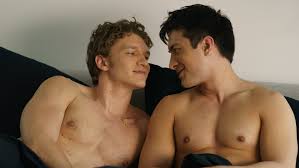
Now, in the twenty-first century, male homosexuality is seen by most as inconsequential. It is a natural expression of human sexuality. True, gay men remain a minority, but are free to take their place in society and live openly. Gay men marry and have families. They are represented in all occupations, and take part in a plurality of pastimes like anyone else. Unfortunately, for some, gay men remain a novelty. The series, Heated Rivalry, released by Crave, a Canadian streaming service, has become a worldwide hit with viewers. The series is based on novels by Rachel Reid, a Canadian author. I do not begrudge her success or the television series’s success, but what concerns me is that the story is pure fantasy. Yes, it is good writing and acting, absolutely, only it made me think of a quotation by Maria Von Trapp. When she saw the first production of The Sound of Music, she said, “That’s a nice story, but it’s not my story.” The story of two professional hockey players, one bisexual and the other gay, came from the imagination of a heterosexual woman. I am not saying there is anything wrong with that. Hardly, she is free to write stories about any characters she chooses. Though they say, “Art imitates life,” sometimes, particularly in romance novels, the lives of the characters are idealised beyond belief. The reality is that there is nothing novel about gay men living in the twenty-first century in most Western jurisdictions. There is no need to fashion romantic fantasies about how you imagine gay men live, how they feel, and what they think. The truth is, we are like everybody else, despite being a minority. There are plenty of openly gay professional athletes, including Jason Collins (an NBA player), Robbie Rogers (an NFL player), Tom Daley (a diver for the British Olympic team), Gus Kenworthy (a skier for the U.S. Olympic team), and Carl Nassib (an NFL player). I do not know much about the personal lives of these men, except for Tom Daley, whose private life is on the public record. Daley is married to his husband, Dustin Lance Black, and has two sons. They lead a conventional life like any other married couple. So, why are people so agog over a fantasy television series that treats the ordinary lives of gay men as something new and unusual?
 
Posted by Geoffrey