

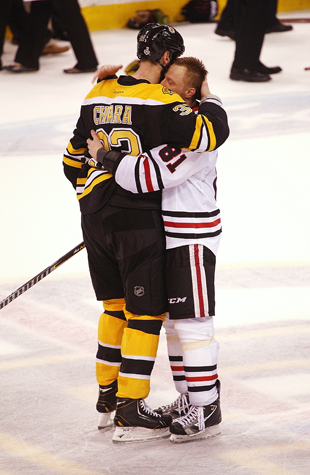
Ice hockey is a rough-and-tumble sport, whether it is men or women who play. Yes, ice hockey requires a plurality of skills to play. Skating is first and foremost what a successful hockey player needs to master, along with stick handling and teamwork. Hockey is a contact sport. Players wear pads, helmets, and eye protection when they go on the ice. Checking is a part of the game, and sometimes fights break out. When I was in high school, I refereed house league hockey, including girls’ hockey. The girls were as tough as the boys on the ice. I remember hearing the girls calling to their teammates from the bench, “Cream the bitch!” I played house league hockey as a boy. In my last year in the Midget-level (15-17 years old) hockey league, the girls’ team goalie in our village often practiced with us. My brother and one of my sisters played hockey growing up, too. My brother was the athlete in the family. He started in the house league and eventually played in a competitive league and on our high school hockey team. He suffered a fractured collarbone in a game when he played on the high school team. I remember it well as I picked him up at the hospital, where the technician showed me how to tighten the harness he put on my brother to set the fracture. So, yes, ice hockey is a rough-and-tumble sport, and players are sometimes injured. The checking and competition between the opposing teams on the ice is the appeal for the fans. Having watched many amateur hockey games as a spectator and as a referee, I can assure you that the crowd loves it when a player makes a hit on the ice. Watching the crowd’s reaction made me think of what it must have been like in the Roman Coliseum when fans went to watch the gladiatorial games. Elite-level amateur and professional hockey are immensely popular worldwide, and many people, children and adults alike, have fun playing at the house league level.
I remember in the 1990s, I was acquainted with a man at the gym where we worked out. He told me that he played in a gay men’s hockey league. I do not know the details of the gay men’s hockey league in Ottawa in the 1990s, but since 2020, Ottawa has had a “queer and trans friendly team,” called Ottawa Pride Hockey. The Ottawa Senators, the NHL team in Ottawa, is among the team’s sponsors. Ottawa Pride Hockey hosts an annual tournament called the Queer Capital Cup. The team’s rules specify, “Overly competitive or aggressive play is not tolerated.” (Ottawa Pride Hockey) Similarly, in Toronto, there is the Toronto Gay Hockey Association, which was founded in 1994. The mission statement states, in part, “To create an LGBTQ+ and allied positive space where people enjoy the game of hockey in an environment free from all forms of harassment or discrimination, which encourages fair play, openness and friendship.” (TGHA) A key feature of the Toronto Gay Hockey Association is that the rules do not allow body checking. So, there are “queer and trans friendly” spaces for those so inclined to play hockey and for any spectators who would watch them play. Somehow, I doubt that most hockey fans would be interested. Furthermore, if they demand that the NHL become “queer and trans friendly” in the manner that Ottawa Pride Hockey and the Toronto Gay Hockey Association play, they are going to be disappointed. No, ice hockey is a rough-and-tumble sport in which body checking is integral. True, in minor hockey, body checking is regulated by age groups, with Hockey Canada stating, “While positioning, angling, stick-checking and body contact is taught in the younger age divisions, full body-checking is not permitted until U15 at most intermediate and competitive levels. Some community (house) leagues will offer a non-body-checking option for all age divisions, including U15 and U18.” (Hockey Canada) The fact remains, however, that hockey is a contact sport, and body checking is a major appeal for the fans.
What made me think of this was the release of the Crave series, Heated Rivalry, a story about two professional hockey players, one bisexual and the other gay, who strike up an intimate relationship. The series became an overnight sensation. It has generated discussion and has the approval of the National Hockey League, as a representative for the NHL praised the show as, “The most unique driver for creating new fans.” (New York Times) The success of Heated Rivalry has some people discussing male homosexuality and professional hockey. Currently, there are no known openly gay players in the National Hockey League. There may be closeted players. Personally, I do not see why it matters. There are many thousands of young men who rise through the ranks of competitive junior and minor hockey, dreaming of making it to the NHL. A lucky few succeed. What does their sexual orientation have to do with any of it? Sure, fans are interested in players’ personal lives. I remember watching Hockey Night in Canada on Saturday nights in the early 1970s on the Canadian Broadcasting Corporation (CBC). Sometimes, in the segments between periods, segments featured a look into the players’ personal lives. They were either single or family men. Whether there were any gay players then is anyone’s guess, and, yes, they would have been wise to stay closeted. In the present, I doubt that most hockey fans would care if an NHL player came out as gay. For others, it is important that there is gay representation in professional sports. Again, I think it is irrelevant. The fans are there to watch a hockey game in all its rough-and-tumble glory. All they care about is the players’ skill.
Posted by Geoffrey
 Geoffrey & Mika