Tag Archives: Ontario

It is a great plague to be too handsome a man. — Plautus

When I first viewed the photo, the portrait of the two young men struck me. Initially, I could not quite place why, but then it dawned on me. In the summer of 1980, I was a reservist in the Canadian Army. I served in the 30th Field Artillery Regiment based in Ottawa. It was the summer following my graduation from high school and before my enrollment at Queen’s University in Kingston. I went to Canadian Forces Base Petawawa to work as a driver in a transportation company through July and August. I worked with young men from other regiments who were posted there, too–we were in our late teens and early twenties.

Continue reading

A sound discretion is not so much indicated by never making a mistake as by never repeating it. — Christian Nestell Bovee

Life for gay youth in the Heartstopper universe is generally reasonable. The protagonists, Nick Nelson and Charlie Spring—Nick is bisexual, and Charlie is gay—find each other and become boyfriends despite elements of antigay prejudice that linger. They initially feel the need for discretion in their relationship. Naturally, they yearn for privacy also. The scene where Nick’s mum walked in on them as they got close and personal in Nick’s room illustrated the point. It made me think of what life was like for me as a young gay man in the 1980s. I was a student at Queen’s University in Kingston, Ontario, Canada, in the first half of the 1980s. It was the height of the AIDS crisis, and gay men were the most affected. There was a moral panic; people did not know for sure how HIV was transmitted and feared exposure to the virus. It was seen as a gay plague, something that gay men brought on themselves for their unprincipled ways. Trust me, it was not a good time to be a gay man. Discretion was necessary because the consequences would be dire if you were outed.

Continue reading

Politics is just like show business. You have a hell of an opening, coast for a while, and then have a hell of a close. — Ronald Reagan

mcpherson_ormiston200-ab72c2b3f36c4abd5f445045134658a87b6914f9-s800-c15anitasarkeesian1

There’s no business like show business, least of all in the United States. Americans love celebrity, flamboyance, sensationalism and showmanship whether it is in the entertainment industry, politics, business, journalism or religion. I am reminded of this in looking at the careers of  Aimee Semple McPherson and Anita Sarkeesian, two women from Canada, who found fame and fortune in the United States by means of shameless self-promotion, partnership with men endowed with shrewd business acumen, and through a masterful use of electronic media to broadcast their simplified and sensationalized messages to a wide and receptive audience. How they differ is that Aimee Semple McPherson found fame as a prominent Pentecostal evangelist in the first half of the 20th century; whereas, Anita Sarkeesian thrives in the present, promoting herself as a “pop culture critic.” Sarkeesian’s message is aimed at people who subscribe to the temporal ideologies of feminism and social justice. Despite these differences, if you look closely at the career of Aimee Semple McPherson and compare it to that of Anita Sarkeesian you will notice there are striking similarities, particularly as to the question of the character of both Aimee Semple McPherson and Anita Sarkeesian. Continue reading

As long as teachers give tests, there will always be prayer in schools. — Unknown

9jMzRN92011-08-02_prayer-in-school

The issue of the practice of religion and religious education in Ontario schools has been a contentious issue throughout their history. The first Board of Education was established in Upper Canada (what became the Province of Ontario) in 1823. In 1824 the Board of Education was allotted funds to provide  for the “moral and religious instruction of the more indigent and remote settlements.” (The school system of Ontario) While Christianity was the dominant religion in Ontario in the 19th century there were sectarian divisions, notably those between Protestant and Roman Catholic, but there was also division between the various Protestant denominations, Anglican, Methodist, Presbyterian, for example. These divisions created strife and hard feelings regarding the provision of moral and religious instruction in Ontario schools. By the 1840s Egerton Ryerson (1803-1882), a Methodist clergyman and champion of public education, proposed “common schools” to educate children of all faiths. This was really quite forward thinking of Ryerson, but the divisions in Christendom at the time were so pronounced this was not possible. Continue reading

Mallard hen with duckling

Sole survivor

By mid-July on the Rideau River this mallard hen has only one of her brood left. She will have started out with a brood of six to eight newly hatched ducklings in May-June, but ducklings fall prey to seagulls, snapping turtles and other predators very easily. Chances are the surviving duckling will not survive its first year of life. This is the reality in the natural world: 85% of the birds and animals born in spring do not last a year, but enough do last long enough to breed the following spring and perpetuate their species.

Photographed and posted by Geoffrey

Hera at nine months

Hera wallowing in a muddy puddle

Hera after a run on a hot, humid afternoon saw fit to plop down in a muddy puddle rather than kennel up when we returned to the car. She had cooled off in the Rideau River during the run. She looks quite pleased with herself.

Photographed and posted by Geoffrey

Eastern kingbird

Eastern kingbird

Eastern kingbird keeping a wary eye on us as we passed by its nesting site in a shrub next to the Rideau River, July 1, 2013.

Photographed and posted by Geoffrey

Brown-headed cowbird

Trio of male brown-headed cowbirds

Three male brown-headed cowbirds perched in the treetops next to the Rideau River, June 30, 2013. The brown-headed cowbird is unusual in that it practices nest parasitism. Cowbirds do not rear their own young. The female lays an egg in another bird’s nest and the cowbird chick hatches and is reared by the other birds. It pushes the chicks of the host birds out of the nest so it does not compete for food. Some species of songbird have adapted to this threat in building dummy nests to lure the cowbird to leave its eggs, leaving them free to rear their own broods.

Photographed and posted by Geoffrey

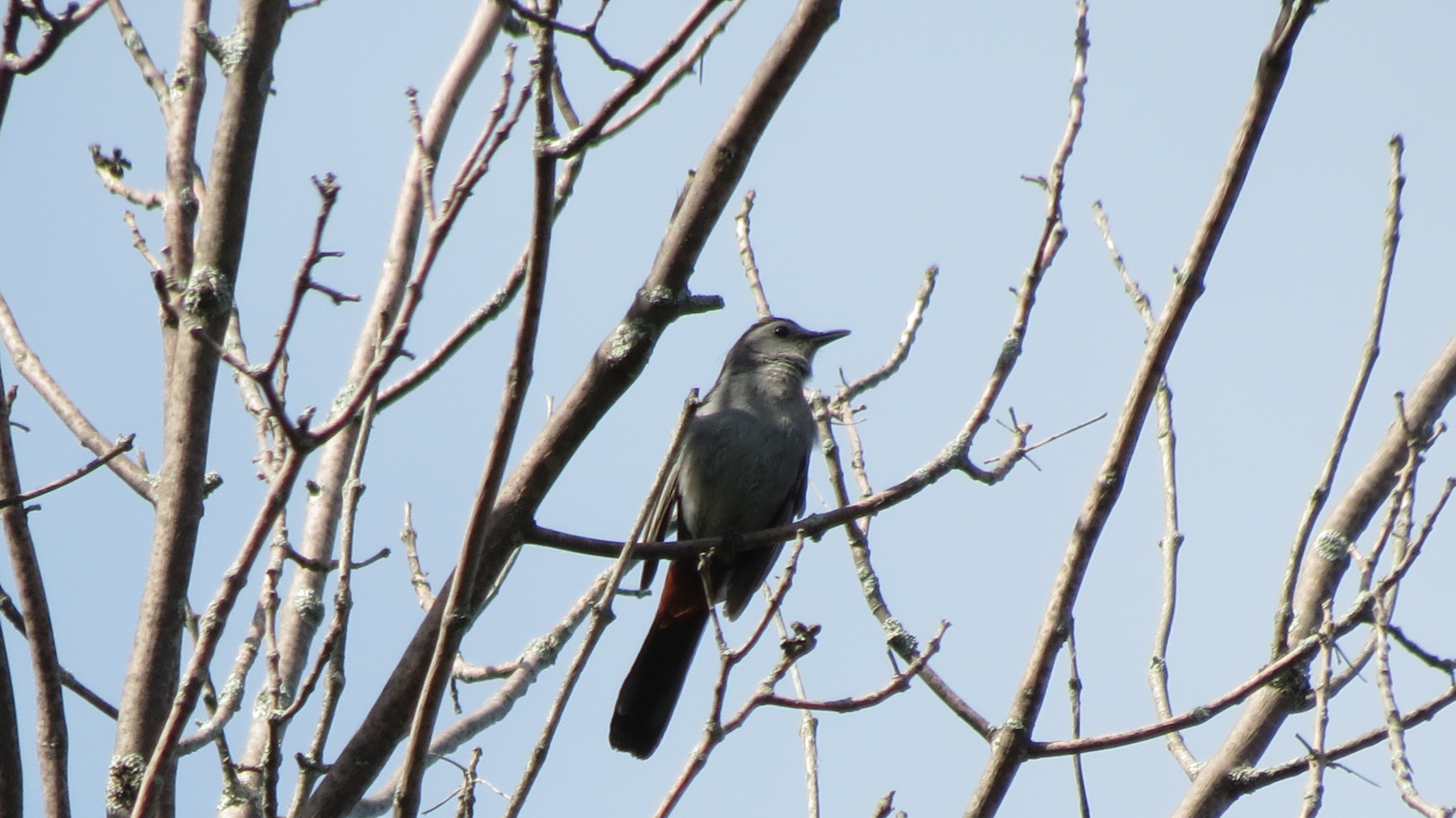
Gray catbird

Gray catbird

Gray catbird perched in the treetops at the edge of the Rideau River, June 30, 2013. The gray catbird is so named because of its call that sounds like a cat meowing. You can usually hear the call of the gray catbird in shrubs and wooded areas near bodies of water. If you meow back at a catbird, often it will respond and show itself.

Photographed and posted by Geoffrey

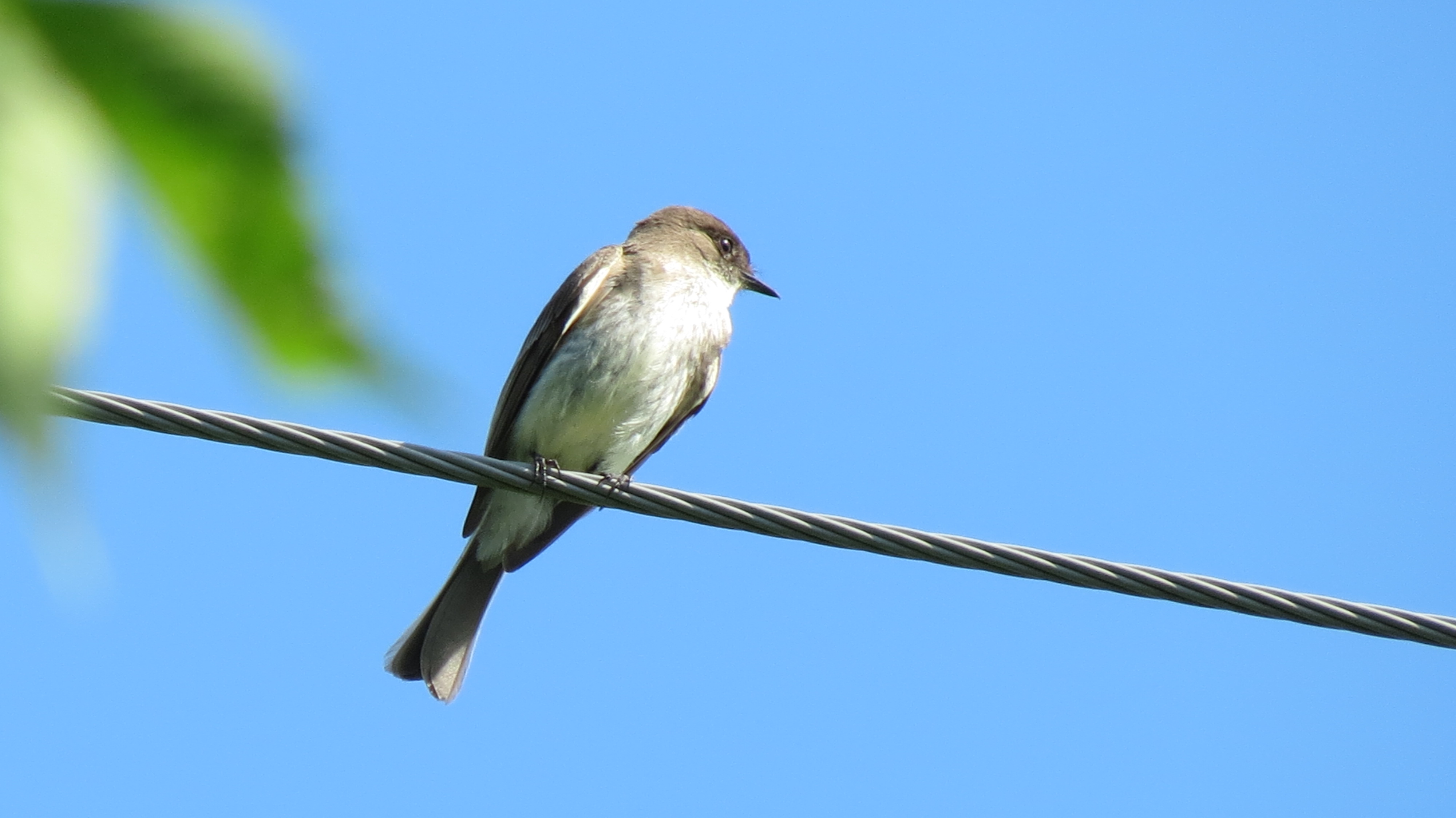
Eastern phoebe

Phoebe on a wire

Eastern phoebe perched on a wire and good enough to pose for me while out on a run with Hera and my friend Jason Quinn and his dog Nos, June 21, 2013.