Tag Archives: Richard Attenborough

Gentlemen, you may include me out. — Samuel Goldwyn

I declined an audition recently. The audition call was for an actor to play a senior gay man, a closeted gay man married to a lesbian who had children and grandchildren. They enthusiastically come out late in life, embracing their “queerness” in all its grotesque flamboyance. The role is a lead for a series of ten episodes. I am okay with playing a gay man on screen, provided I can play him straight. By that, I mean playing a man who is gay. I am uncomfortable playing a gay man as a caricature, even in jest. That resembles a black actor playing a minstrel show role in jest. Mainly as I am on record for criticism of queer culture, I think that queer culture is demeaning and detrimental to the well-being and happiness of gay men and boys. I said in the note explaining my decision to drop the audition that the role was outside my character type. My character type is the mature father figure. As an older gay man, I do not want to risk being typecast as an older, flamboyant homosexual. 

Continue reading

I get stage fright and gremlins in my head saying: ‘You’re going to forget your lines’. — Alan Rickman

stagefrightstage-fright

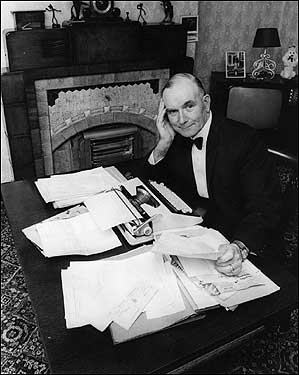
I remember listening to a recording of a very interesting interview Richard Attenborough gave on a radio program back in the 1970s. He discussed his role, that of John Christie, in the motion picture “10 Rillington Place.” John Christie was an English serial killer who was hanged for his crimes in 1953. In particular, Attenborough discussed how he went about inhabiting the character of Christie. What struck me in the interview was his opening comment (offered in a lighthearted tone),  something to the effect that “actors are dramatic people.” I chuckled when I heard his comment. “How true this is,” I thought. He continued the interview explaining that he needed a very deep level of concentration to inhabit the character of John Christie. In addition, in a subsequent interview Attenborough credited the director, Richard Fleischer, who instilled in him the confidence he needed to successfully inhabit the character of John Christie. I understand the need for a deep level of concentration and confidence to successfully inhabit a character. This comes as no surprise, but listening to Attenborough discuss acting technique made me think of stage fright, the actor’s nightmare. Continue reading

I believe the fear of the rope, as it is generally called among certain classes, is a very great deterrent. — Rayner Goddard, Baron Goddard (10 April 1877 – 29 May 1971)

PierrepointWands3

Mika and I are celebrating our fifteenth year together this month, August 2013. In all these years as a couple, we have never gone away together for a holiday. At long last, we are taking a holiday next month, a trip to England for two weeks. This will be Mika’s first visit to England. I lived in England from 1968-1970. I remember upon learning I would be travelling to England with my family imagining England was a land with castles where kings and queens resided and frequently ordered that people’s heads be chopped off. While this was true in the past, it happily was no longer the case by the late 1960s. In fact, capital punishment was no longer in use when I arrived in England with my family. Still, this is one facet of English history and law I find fascinating: the application of capital punishment. Judicial hanging was by far the most common form of execution in English history, although the cruel punishments of hanging, drawing and quartering, burning at the stake and beheading were practiced for centuries also. By the 20th century judicial hanging was the only method of execution (outside of the military where one could be shot at dawn) employed and the English had perfected its practice applying it liberally in executing people convicted of murder and high treason. Continue reading