Tag Archives: sexuality

There’s this illusion that homosexuals have sex and heterosexuals fall in love. That’s completely untrue. Everybody wants to be loved. — Boy George

I recall when I was in university in 1982. I enrolled in a film studies class, and one of the films we watched was Pagan Rhapsody. There is a scene in the film where two men play a sex scene. Though the scene was as vanilla as possible–there was kissing and a little friendly groping (nothing graphic)–the student audience’s vocal expressions of disgust were notable. In 2024, male homosexuality was generally accepted as a natural expression of human intimacy and treated with sensitivity in film and television. Netflix series such as Young Royals and Heartstopper feature a gay romance and intimacy between high school boys in a way that leaves something to the viewers’ imagination. Both series are immensely popular with younger viewers. Things have changed since the screening of Pagan Rhapsody in 1982. Still, when it comes to public perceptions of intimacy between gay men, there are a lot of people who have an unsavoury fixation on what they imagine goes on when two men are intimate. I get expressions of disgust in the comments on blog posts I write on gay rights advocacy, where people say things like, “There’s nothing more disgusting than two men fucking each other in the ass,” and “Cocksucking is not a men’s issue.” I mean, that is beyond the pale.

Continue reading

I consider promiscuity immoral. Not because sex is evil, but because sex is too good and too important. — Ayn Rand

In the summer of 1987, I lived with my boyfriend Fabio in a two-bedroom apartment in Kingston, Ontario. We met as students at Queen’s University and secretly carried on our love affair before moving in together. We became boyfriends during the burgeoning AIDS crisis. One evening, we sat in bed and watched a panel discussion held by one of the American News Networks–I cannot remember which one. What struck me was the inflammatory opening remark made by a conservative Congressman, whose name I do not remember, who asserted that “perversion and promiscuity” were to blame for the AIDS crisis. That sentiment was shared through the 1980s. I remember the stand-up comic Sam Kinison, who screamed in one of his routines that AIDS became an epidemic “because a few fags fuck some monkeys; they got tired of their own assholes.” Jerry Falwell claimed it was God’s judgement on homosexuals and blamed the spread of the disease into the innocent heterosexual population on bisexual men. Yes, AIDS was seen as a gay plague. Fabio and I, like countless gay men in the 1980s, were concerned. There was uncertainty about how easily the virus was transmitted. Before the dawn of the AIDS crisis, our biggest concern as students in the 1980s was the risk of an unwanted pregnancy or getting herpes.

Continue reading

The emphasis must be not on the right to abortion but on the right to privacy and reproductive control. — Ruth Bader Ginsburg

hobby-lobby_zps8425ff5a2RNS-HOBBY-LOBBY-SCOTUS

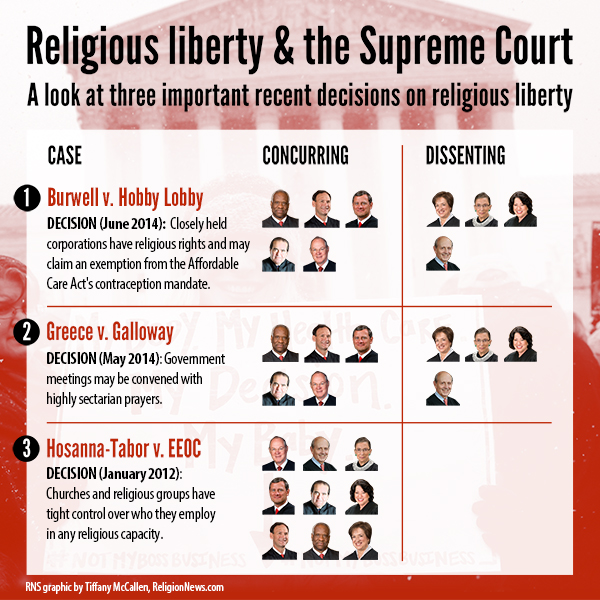
Controversy rages on in U. S. society over the issues of religious liberty and sexuality. The right to marry, the destigmatization of homosexuality and reproductive freedom are issues that, historically and in the present, conflict with deep-seated religious beliefs and traditions in U.S. society. While the U.S. Congress and State Legislatures addressed these issues, especially in passing legislation to guarantee religious liberty, disputes concerning religious freedom and sexuality more often are settled by the courts. In 1967 the Supreme Court of the United States (SCOTUS) ruled state bans on interracial marriage were unconstitutional in Loving v. Virginia. In 2013, SCOTUS struck down the Defense of Marriage Act (DOMA) and refused to hear the appeal of Proposition 8 in California. This removed legal barriers to same-sex marriage. Homosexuality was decriminalized in the U.S. in 2003 when SCOTUS ruled on Lawrence v. Texas. Most recently, the decision handed down by SCOTUS in Burwell v. Hobby Lobby is generating heated discussion in the media and blogosphere. In this instance, SCOTUS ruled on a dispute between the issues of religious liberty and reproductive rights. Continue reading