
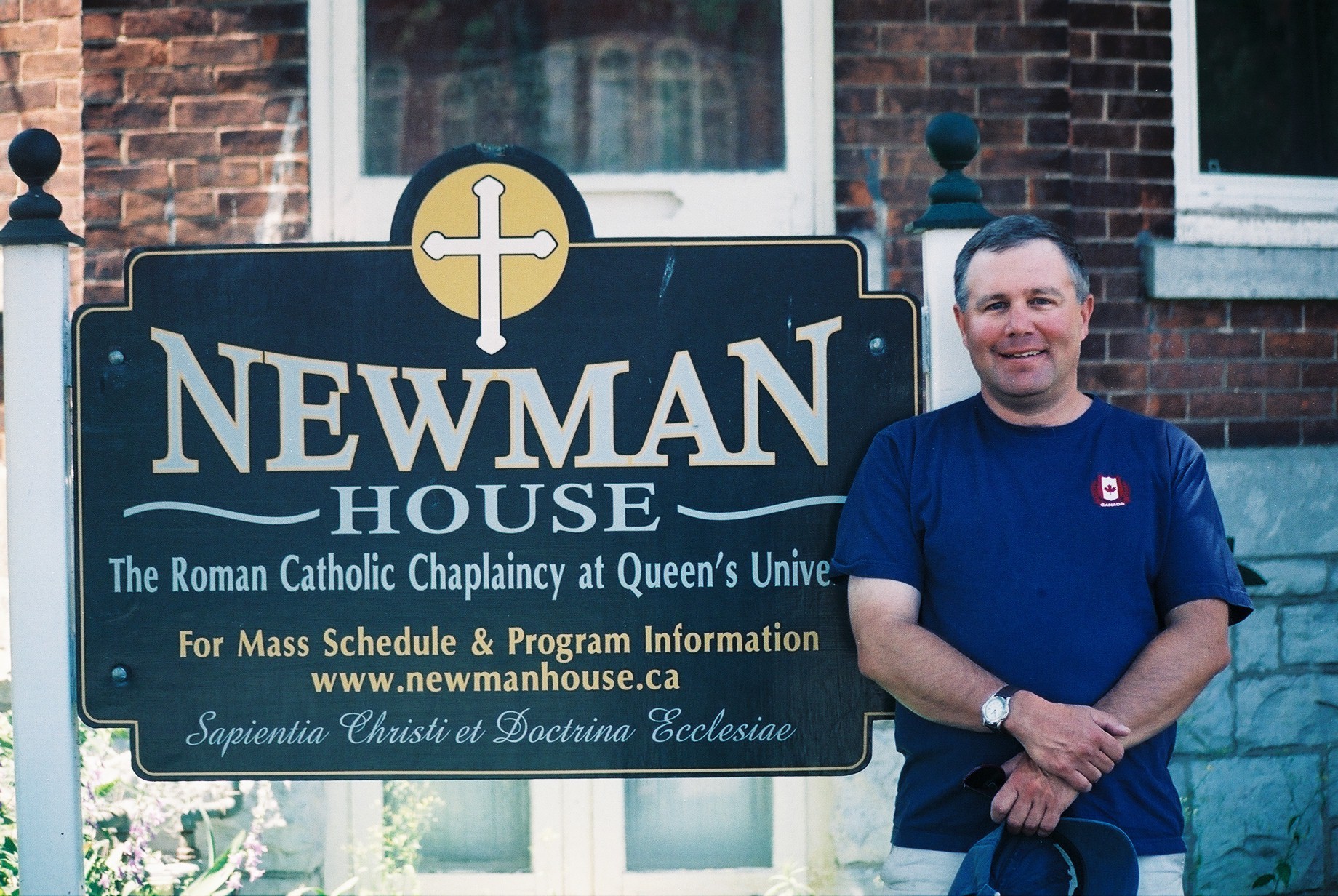
The thing to remember is that gay is a demographic, not a coherent community. I am a gay man, a free thinker and a skeptic. I am proudly Anglo-Saxon; both sides of my family came from the British Isles, my father’s family from England and my mother’s from Ireland. Short of taking a DNA test, it is anyone’s guess what blend of ethnicities may be in my ancestry. However, that is neither here nor there. The fact remains that I am a middle-aged, gay white man. That said, those characteristics are irrelevant. Above all else, I am an individual. I am the man I am today because of my childhood and adolescence circumstances. I grew up in Canada in the latter half of the 20th century. I remember the Centennial celebrations in 1967 on Canada’s 100th birthday. I learned to take pride in my heritage, and the freedoms and opportunities afforded me as a Canadian. Still, growing up gay in my generation had its challenges.
In my lifetime, I saw male homosexuality decriminalized in 1969 and the stigma of being a gay man ebb away in the following decades. The legalization of same-sex marriage came in 2005. Things are much easier for gay boys and men in the present in Canada, thanks mainly to the efforts of the efforts of the generation of gay men who came before me. Despite that, I knew men who died from AIDS and two who were murdered because they were gay. I saw men who strangers beat for being gay. I remember one of my exes’ harrowing telephone conversations with his father, who confronted him about his homosexuality and the shame it brought to their family. I have befriended on social media younger men from religious backgrounds whose families ostracized them for being gay. Despite the gains of the gay rights movement, being gay has its hardships.
Of the challenges gay men face currently is the idea that they are obligated to think or believe in specific ways and support the agendas of various ideologies. Worse, they are expected to believe they owe their civil rights gains to others. One tiresome narrative is that women’s lib paved the way for gay rights. I found that narrative articulated in a Los Angeles Times op-ed by Benjamin Rich published in 2019. He asserted in part, “Feminists, from the Daughters of Bilitis to the Notorious RBG (Ruth Bader Ginsburg), helped pave the way for gay male liberation. Women cared for a previous generation of gay men suffering from AIDS.” (Los Angeles Times) Granted, some lesbians cared for gay men who had AIDS at the peak of the crisis in the 1980s and blessed may they be for their charity and humanity. Interestingly, Catholics, individuals, and institutions opened hospices and social service agencies in the 1980s and 1990s. They organized to care for people (men and women) who had AIDS, and they did not judge or expect anything in return.
The first Catholic hospice for AIDS patients opened in the United States in 1985 in New Orleans. Father Paul Desrosiers opened it with the blessing and financial support of New Orleans Archbishop Philip M. Hannan. Father Desrosiers converted an unused convent and the rectory where he lived into a hospice called Lazarus House with 24 beds. Steve Rivera, the director of Project Lazarus in 2019, said, “Father Paul broached a very unpopular topic that was full of fear and he addressed it head-on,” Rivera said. “All he could see was beautiful people with beautiful souls. He saw the face of Jesus in every person. He just trusted. Every time we expanded for more space, he would have to move to a different place. He was more concerned about the mission.” (Crux)
In addition, a group of nuns from the Sisters of Charity of Nazareth founded the House of Ruth in Louisville, Kentucky, in 1992. Sister Julie Driscoll was the executive director from 1993 to 2003. Looking back, she observed, “People often asked me, what should I do if you know someone who has H.I.V.?” […] Her response was: “Touch them please. Hug them if you can.” (America: The Jesuit Review) As Michael J. O’Loughlin noted in 2019,
In its earliest days, the House of Ruth was not so much a “house” as it was two rooms nestled inside a parish rectory. People managing H.I.V. and AIDS, mostly women and their children, stopped by the House of Ruth for assistance. Sometimes they needed help finding a doctor willing to treat them—this was a time when even some health care professionals would not touch patients with H.I.V. or AIDS—or needed just for few dollars for bus fare so they could run errands. They also sought assurances that they were not alone. (America: The Jesuit Review)
Personally, Roman Catholicism appealed to me when I was younger. I was nominally Roman Catholic, baptized in infancy. I undertook preparation for First Communion on my initiative when I was sixteen. In my early twenties in the early 1980s, I was accepted as a young gay man by the Roman Catholic community at Queen’s University. Under their tutelage, I underwent a program offered by the Church called Rite of Christian Initiation for Adults. I was confirmed at the Easter Vigil held in Saint Thomas More Parish in Kingston, Ontario 1986. For many years after that, I continued to attend Mass regularly, say my prayers and try to remain true to myself as a gay man and a practicing Roman Catholic. Over time, however, I became disillusioned with the Church as an institution. Still, l have a soft spot for Catholics. They were kind to me at a time in my life when I struggled to accept my homosexuality. They convinced me that being gay is nothing to be ashamed of, that God loves me and that I am a loveable person capable of loving in return. Though I can no longer, in good conscience, practice Roman Catholicism, I like to discuss theology and philosophy with people still practicing the faith.
As for the Daughters of Bilitis and gay rights, the Daughters of Bilitis was a lesbian social club founded by Del Martin, Phyllis Lyon, and others in San Francisco in 1955. It quickly became a political organization advocating lesbian rights. The Daughters of Bilitis collapsed in the early 1970s under the weight of its division between members who disagreed on the organization’s direction. Some wanted to ally the organization with the Mattachine Society, a gay rights group founded in Los Angeles in 1950 by Harry Hay, among others. Opponents objected to the alliance of a lesbian rights organization with a “male-dominated” gay rights organization. They favoured the path of lesbian separatism and feminism.
Yet the narrative spelled out by Benjamin Rich asserted that gay men owe their civil rights to the efforts of lesbians and feminists who “helped pave the way for gay male liberation,” and cared for gay men who had AIDS during the AIDS crisis of the 1980s so much so that the current generation of gay men must side with feminists in their quarrels over gender ideology and controversies over abortion and artificial contraception. I am unconvinced. If anything, I am grateful to the Catholics I knew during the AIDS crisis, who helped me accept who I am, and to those Catholics in the United States who stepped up to care for people afflicted with AIDS at a time when people with AIDS were at best ignored and at worst, shunned. The difference between the Catholics who counselled me and took up the care of people with AIDS and the feminists that Benjamin Rich credits for gay men’s civil rights is that the Catholics do not claim any credit for gay liberation, and neither do they expect the current generation of gay men to side with them in the prolonged debate over abortion and artificial contraception.
Posted by Geoffrey
 Geoffrey & Mika