Category Archives: Nature

Waste no more time arguing what a good man should be. Be one. – Marcus Aurelius

The Cambridge Dictionary defines masculinity as “the characteristics that are traditionally thought to be typical of or suitable for men.” (Cambridge Dictionary) The Collins Dictionary elaborates on the definition of masculinity, stating, “There are many positive qualities that have historically been defined as either masculine (leadership, strength, courage) or feminine (nurturing, compassion, caring). In reality, people are individuals with a unique combination of attributes.” (Collins Dictionary) Fair enough, it is possible for men and women to have both masculine and feminine qualities, or you can be a masculine woman or a feminine man. Either way, it is fine. Personally, I think people who know me would say I blend masculine and feminine qualities. Although the Canadian Army did not think I had the qualities of leadership they wanted, in civilian life, I have exercised leadership, strength, and courage numerous times in emergencies. I have given emergency first aid to strangers at car accident scenes, to a man who suffered a grand mal seizure, and put out a fire that broke out in my house—a candle ignited a curtain that a stray gust of wind blew into the flame. By the time I retrieved the fire extinguisher, the flames had consumed the curtains in the front window of the house and were spreading across the ceiling. By the time the fire department arrived, the fire was out. The firefighters told me I had done a good job putting out the fire, and the insurance company was happy with me, because, as a friend said, “You saved them a piss pot full of money.” Interestingly, it was my military service where I learned to keep my cool in a crisis, to exercise leadership, to give emergency first aid, and to fight fires. In those situations, when I took the lead, those around me followed, and the crisis was brought to a successful conclusion. People who know me also tell me I have the gift of wisdom. They tell me I always know what to say when they are stressed or hurting. I offer more than banalities and platitudes in a difficult situation. They refer to this as an innate gentleness I possess. Yes, it puzzles them that I am a keen hunter. How can someone so gentle make the choice to go hunting and kill game birds and animals?
 
I am reminded of the “unique combination of attributes” from a documentary on hunting I watched many years ago. The film is called “In the Blood.” The film, made in 1989 by George Butler, documents the safari that descendants of Theodore Roosevelt retraced—the one he took with his son Kermit in 1909. The film provides insight into hunting in general and African big-game hunting in particular. The safari was led by a professional hunter, Robin Hurt, a man’s man and dedicated conservationist. In one segment, Butler’s thirteen-year-old son is taken on a hunt for a cape buffalo. Robin Hurt guided the boy on the hunt across the savanna and wetlands as they closed in on a herd of cape buffalo. When a buffalo was selected, the boy placed two shots into the animal, killing it cleanly. As he walked up to the carcass, tears welled up in his eyes, and he tried to fight them back. Robin Hurt, the great white hunter, seeing this, told the boy, “Don’t hold back. Let them flow; it’s a natural reaction.” Yes, I know how the boy felt. When you make the choice to kill a game animal or bird, the natural reaction is a feeling of triumph and sorrow. Hurt understood that and told the boy there was nothing shameful or unmanly in his reaction.
 
I am a keen hunter, but I am an actor, too. I have performed roles on stage and screen. Acting requires the ability to connect with your emotions and express them genuinely. It is challenging for me as I am not overly emotional. I do not frighten easily, and have the restraint to keep stupid people from baiting me. I tend to be stoic in my expression of grief, though there are notable exceptions. My maternal grandmother died two weeks after my thirtieth birthday. I had a close relationship with her. My family was surprised at how composed I was. I wrote and delivered the eulogy at her funeral. It was not until two years passed that I finally shed a few tears for her in the cathedral in Lyon, France. On the other hand, when I held my first dog, Christie, as she was euthanized, I cried harder than ever before in my life. For years, following Christie’s death, on the anniversary of her passing, I could not hold back my tears. I loved my grandmother and my dog, Christie, dearly, and I can not explain how I remained so calm and reserved when my grandmother died, and how I went to pieces when I lost Christie. I think my friends are correct. I am a “unique combination of attributes.” As I go through life, I apply these attributes the best I can. I am a man, and I have nothing to be ashamed of about my blend of masculine and feminine qualities.
 
Posted by Geoffrey
 

I also survived circumcision, a barbaric practice designed to remind you as early as possible that your genitals are not your own. — George Carlin

*

I learned what male genital cutting was in high school in health class. The teacher handed out mimeographed copies of pages from a textbook that had crude illustrations. He did this by mistake and hurriedly told us to ignore them, but the cat was out of the bag. Once I knew what it was, I began to think about it. I finally understood why other boys I knew over the years, particularly when I lived in England in the late 1960s with my family, looked different. A couple of years later, while one of my aunts visited, a news story came on the television about male genital cutting. She spoke up about how it could not be done to her firstborn son at birth because of complications following his birth, and that they never saw the need for it later. She had a second son years later, and he was left intact. I remember how pained my father looked when she related that to us. My mother was absent from the conversation, leaving the impression that she was behind it for my brother and me. As I grew older, I came to deeply resent what was done to me.

Continue reading

Accept the things to which fate binds you, and love the people with whom fate brings you together, but do so with all your heart. — Marcus Aurelius

A recurring theme in ancient Greek mythology is that you cannot outrun your fate. I think about that idea when I look back on my life and how, throughout it, people assumed that I was a homosexual. In grade school, a woman who lived across the street from my family was hired by my parents to prepare lunch for my siblings and me when we came home from school. I recall how she said that I would end up a confirmed bachelor. A confirmed bachelor was code for a homosexual historically. In middle school, I had a fleeting romance with a girl. When my seventh-grade teacher learned of our liaison, she expressed surprise; she never imagined me being interested in girls. In high school, I asked my brother if he would sound out a girl I fancied to see if she was interested in me. He reported that when the girl realized what he was up to, she retorted, “He’s a fairy!” When I joined the Canadian Army as a Reservist at eighteen, I entered the classroom one day at the Armoury and found a caricature of me as a pink bunny drawn on the blackboard captioned with anti-gay slurs. To their credit, the other recruits told me it was intended as a joke–that they liked me. Still, I wondered why people thought I was a homosexual.

Continue reading

The joy of killing! the joy of seeing killing done – these are traits of the human race at large. ― Mark Twain, Following the Equator: A Journey Around the World

quote2 teddybear

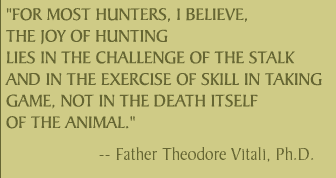
The killing of Cecil the lion in Zimbabwe by an American trophy hunter has fanned the flames of  the controversy surrounding sport hunting. A familiar claim made by people opposed to sport hunting is that sport hunters “like killing things,” that is to say they enjoy killing for the sake of killing. This claim typically leaves me at a loss for words as it is so egregiously wrong. Yes, I enjoy hunting, but no, as hard as it is for you to believe, I do not like killing things. While most of my hunting expeditions are in pursuit of game birds I enjoy big game hunting too. To date my big game hunting experience is in the pursuit of the whitetail deer. My introduction to the sport of whitetail deer hunting was by Jason, one of my hunting buddies and a seasoned deer hunter, in 2011. It was not until my second season in November 2012 that I shot my first whitetail deer. It was a happy and exciting moment for me; the successful conclusion of the hunt with a whitetail deer harvested and secure in the knowledge it was a fair chase as the deer we hunt are wild, not the least bit habituated to humans. Continue reading

I love to be individual, to step beyond gender. — Annie Lennox

a2-psych-gender-dysphoria-5-638joshua-alcorn

The suicide of Joshua Alcorn on December 28, 2014, marked the tragic end of his young life. He was seventeen years old. His death attracted worldwide attention as he published a suicide note on Tumblr in which he related the stress of suffering from gender dysphoria. This stress was too much for him to bear, so he opted for suicide. He adopted the name Leelah in his suicide note. He leaves behind his grieving parents, younger siblings and the rest of those who knew and loved him. Details are emerging as to the stress he endured and the degree of dysfunction in his family. He came from a Christian family. His parents (Doug and Carla Alcorn) did not understand what he was experiencing and essentially told him to “pray it away.” He said in his suicide note that his parents sent him to conversion therapy for treatment. Compounding this tragedy was the lynch mob mentality that took hold. Doug and Carla Alcorn experienced harassment, even a call from activist Dan Savage that they face prosecution. Is this warranted? Continue reading

“After all, what’s a life, anyway? We’re born, we live a little while, we die.” ― E.B. White, Charlotte’s Web

66506_483152090378_1731430_nJuno1

In memory of my beloved Juno (May 21, 2008 – August 15, 2012)

“Each of us owes God a death.” So I heard Gwynne Dyer proclaim in an episode of his television series War. Death is a reality; it comes for us all. When I was a small boy I did not understand the reality of death. I remember, I must have been three years old and seeing my grandmother with some old baby clothes and toys she said were my aunt Lonny’s. My impression in seeing this was to imagine that people must grow up, then grow back down to being babies again. I asked my mother if this was so and she corrected me, telling me no, people grow, then they grow old and die. She added that nobody wants to die, but everyone has to. I did not really understand what it meant to die and did not give it much thought until I was a little older, maybe five years old when I asked my mother and father “what happens when you die?” They told me “your spirit goes up,” presumably to heaven. I still did not understand and was a little frightened by the prospect, but decided that must be a long way off so I would not worry about it. Continue reading

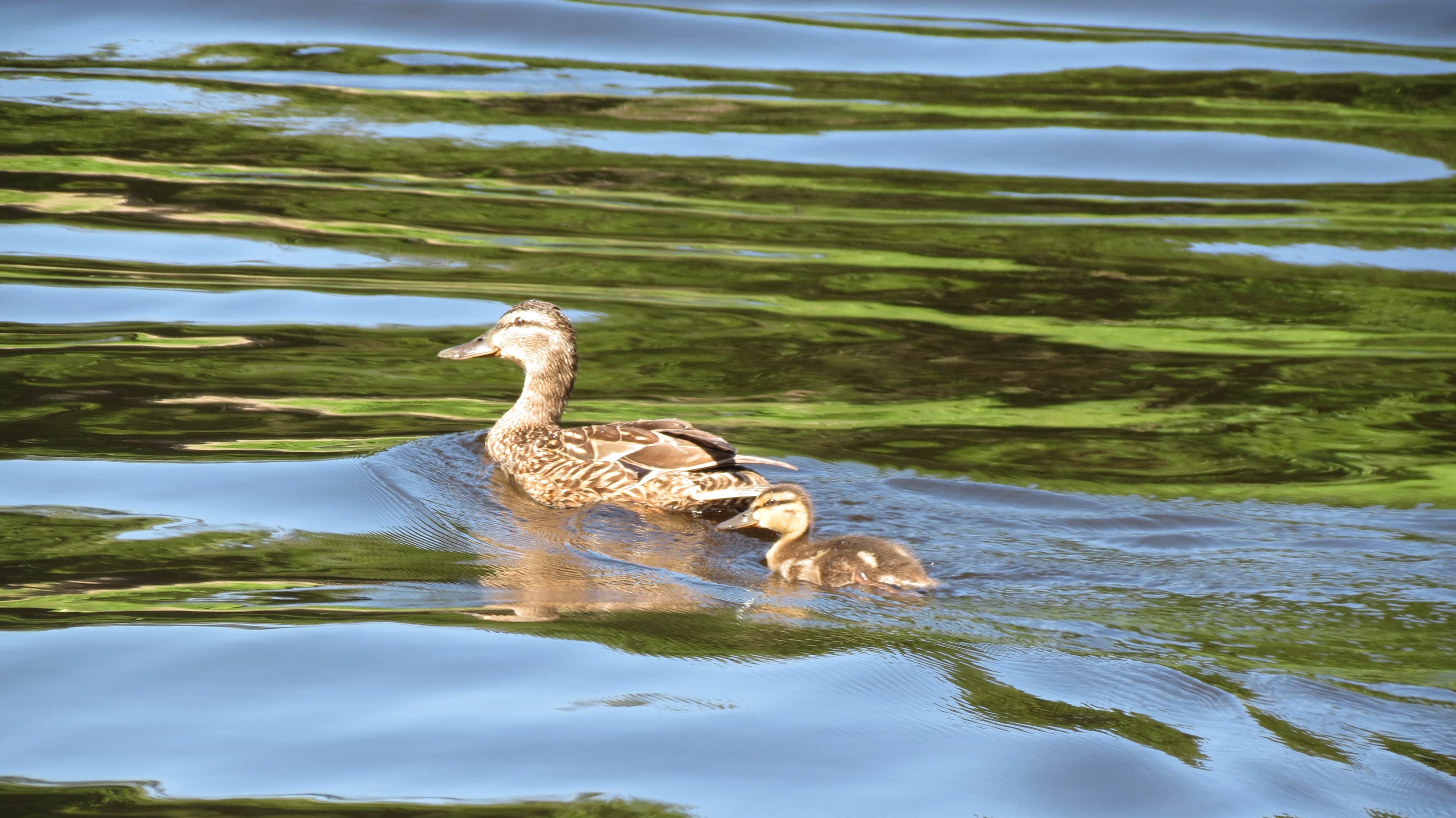
Mallard hen with duckling

Sole survivor

By mid-July on the Rideau River this mallard hen has only one of her brood left. She will have started out with a brood of six to eight newly hatched ducklings in May-June, but ducklings fall prey to seagulls, snapping turtles and other predators very easily. Chances are the surviving duckling will not survive its first year of life. This is the reality in the natural world: 85% of the birds and animals born in spring do not last a year, but enough do last long enough to breed the following spring and perpetuate their species.

Photographed and posted by Geoffrey

Eastern kingbird

Eastern kingbird

Eastern kingbird keeping a wary eye on us as we passed by its nesting site in a shrub next to the Rideau River, July 1, 2013.

Photographed and posted by Geoffrey

Brown-headed cowbird

Trio of male brown-headed cowbirds

Three male brown-headed cowbirds perched in the treetops next to the Rideau River, June 30, 2013. The brown-headed cowbird is unusual in that it practices nest parasitism. Cowbirds do not rear their own young. The female lays an egg in another bird’s nest and the cowbird chick hatches and is reared by the other birds. It pushes the chicks of the host birds out of the nest so it does not compete for food. Some species of songbird have adapted to this threat in building dummy nests to lure the cowbird to leave its eggs, leaving them free to rear their own broods.

Photographed and posted by Geoffrey

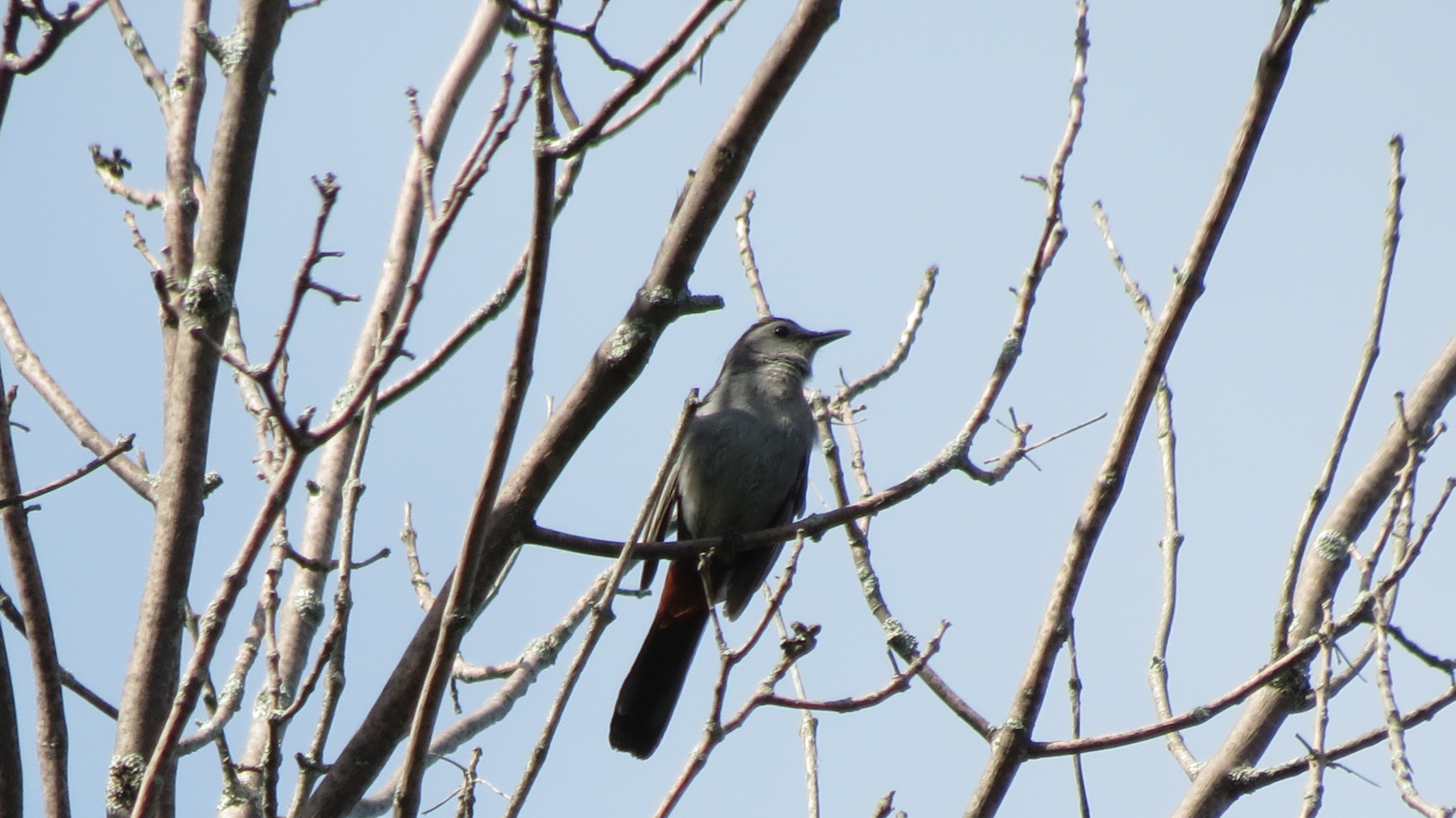
Gray catbird

Gray catbird

Gray catbird perched in the treetops at the edge of the Rideau River, June 30, 2013. The gray catbird is so named because of its call that sounds like a cat meowing. You can usually hear the call of the gray catbird in shrubs and wooded areas near bodies of water. If you meow back at a catbird, often it will respond and show itself.

Photographed and posted by Geoffrey