
Tag Archives: bisexual

Love him and let him love you. Do you think anything else under heaven really matters? — James Baldwin

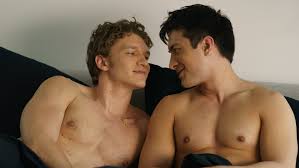
Connor Storrie and Hudson Williams as Ilya Rozanov and Shane Hollander.

I noticed the sensation generated by the release of the series Heated Rivalry on Crave. It piqued my interest. I subscribed to Crave and settled in to watch the first episode of the series. Based on the first episode of the series, I expected the rest to be decidedly underwhelming. Thankfully, I found the following episodes much improved. I get what the storyline is about; at least I think so. The story is about two young men, one from Canada — his name is Shane Hollander — and the other from Russia — his name is Ilya Rozanov — who are rising stars in elite-level Junior Hockey and fierce competitors. They go on to become professional hockey players and captains of their respective teams. Each one has issues with his family and feels the pressures of navigating the byzantine world of professional hockey. Their story progresses through several years; along the way, they found they had a mutual sexual attraction. That further complicated things for them.
Continue reading

Those who forget the past are condemned to repeat it. — George Santayana

I am watching a Spanish Netflix series called Merli: Sapere Aude, and it is excellent. It is a dramedy, and the plot revolves around the protagonist, a young man named Pol Rubio, played by a fine young Spanish actor named Carlos Cuevas. Pol is a young man in his first year of studies in philosophy at a university in Barcelona. He has a bisexual orientation, and though he favours men, he does have dalliances with women occasionally. Pol is an anti-hero; while he generally strives to do good, he betrays a friend and his father when it serves his interests. He learns in the first episode of season two that he is HIV+. Pol is devastated by the news, despite the doctor’s assurance that the virus can be managed with treatment. He starts the regimen of taking the medication and tries to carry on. In a subsequent episode, Pol converses with a former co-worker who likely exposed him to the virus. His friend lost his job when the employer learned he was HIV+. The friend reminds Pol that people will feel sorry for you when you get cancer, but when you get HIV, you are viewed as a “dirty faggot.” Pol also converses with his employer, a mature gay man living with HIV. The employer lived through the AIDS crisis of the 1980s and 1990s and saw many gay men succumb to the disease. He recounted an incident where a friend was beaten to death for being queer. I bristled when I heard “queer” used to refer to a gay man, but I realized in the context of the anecdote that it was the attackers who called him a queer as they beat him to death. Queer is a slur, the last thing many gay men heard as they were beaten to death by gangs of thugs.

Continue reading

Time makes us sentimental. Perhaps, in the end, it is because of the time that we suffer. — André Aciman

This is what a gay high school boy looked like in 1979.

I like gay romance in print and on film. The positive portrayal of romance and intimacy between two men or high school boys is lovely. Gay youth and men exist and have the same need for love and companionship as the heterosexual majority. Especially given that in Western society, intimacy between men was criminalized for a long time–it was considered “gross indecency” and punishable by imprisonment. Beyond that, public prejudice was prevalent throughout the 20th century. I remember it well. Recently, I met up with a man I knew in high school. We had not seen each other since graduation in 1980. We met through a mutual friend and ex of mine. I had no idea that my high school buddy was gay. We are both in our sixties and retired. I am happily partnered, and he is single. It was good to see him again.

Continue reading

Olivier said that drama is an affair of the heart, or it’s nothing, and he was right. — Pam Gems

Joe Locke and Kit Connor as Charlie and Nick in Heartstopper.

I watched season two of the charming Netflix series Heartstopper. I liked it despite it being aimed at a much younger audience. What drew me to the series was the gay storyline; the romance between the two protagonists, the high school boys Nick and Charlie. The series is a drama, although it pulls its punches. The boys never go past kissing and cuddling in their relationship. Also, Nick is bisexual, and Charlie is gay. It is cute and appealing to its teenage audience. I like that a teenage gay romance is portrayed as a positive thing. Coincidentally, the actors who play Nick and Charlie are, like the characters they play, gay and bisexual. Kit Connor, who plays Nick, declared his bisexuality. Joe Locke, who plays Charlie, is openly gay. That the young actors are gay and bisexual is interesting. It is nice that they are free to be themselves.

Continue reading

Violence can only be concealed by a lie, and the lie can only be maintained by violence. — Aleksandr Solzhenitsyn

200421-women-violencepp_wide_elliotrodgers

In light of a recent mass murder-suicide in Santa Barbara, California, there has been a frenzy of intense speculation about what spurred the killer, Elliot Rodger, into carrying out his crime. One point of view put forward is that it was the phenomenon of violence against women, not just on his part, but on the part of men in general that spurred him on to commit this crime. That and abuse of women by men is tolerated in US society in a “culture of misogyny and toxic masculinity.” The abuse of women is a problem and, without any doubt, reprehensible, but is it fair to solely blame men? Is it reasonable to assert that the abuse of women is tolerable in US society? These questions merit discussion, but in short, my answer to both questions is a resounding no. Continue reading