
Tag Archives: gay

That’s so I can recognize you filthy queer scum before you get close, he explained with a nasty smile. ― Heinz Heger

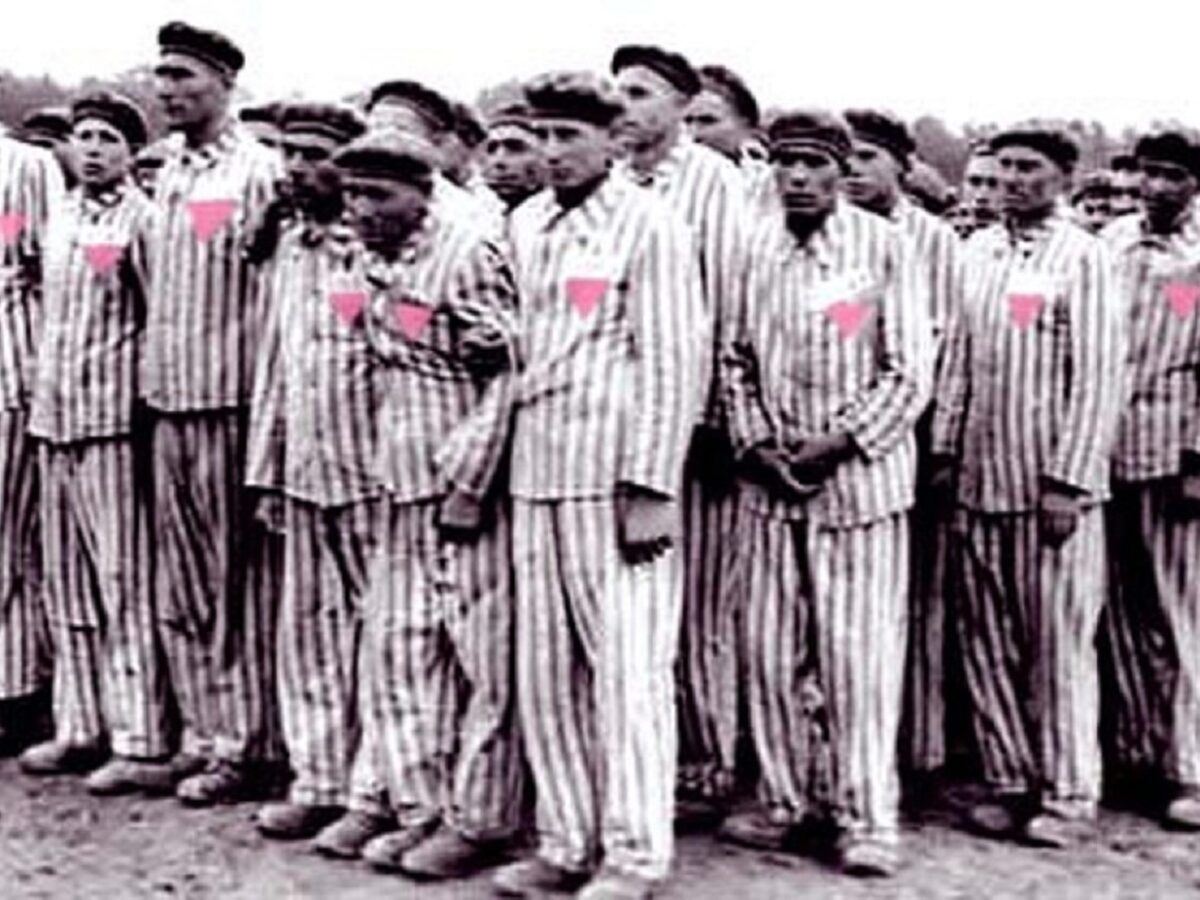
Homosexual prisoners in a Nazi concentration camp.
Michael Elmgreen and Ingar Dragset and the Memorial to Persecuted Homosexuals under National Socialism.

The persecution of gay men in Germany goes back to the 1794 and 1851 Prussian legal codes. In 1871, Paragraph 175 of the German Empire’s criminal code was enacted, based on the Prussian legal codes.

The 1871 version of Paragraph 175 read:

Unnatural sexual acts (widernäturliche Unzucht) committed between persons of the male sex, or by humans with animals, is punishable with imprisonment; a loss of civil rights may also be sentenced. (Holocaust Encyclopedia)

Yes, it criminalized sex acts between men; it did not criminalize men for having a homosexual orientation. Also, it did not apply to lesbians. The law was enforced sparingly during the Imperial and Weimar eras, as a conviction required that two men be caught in the act of having sex. When the Nazi Party took power in Germany in 1933, Paragraph 175 was revised to read:

A man who commits sexual acts (Unzucht) with another man, or allows himself to be misused for sexual acts by a man, will be punished with prison. (Holocaust Encyclopedia)

There was opposition to Paragraph 175. Notably, it was a German physician and gay rights advocate, Magnus Hirschfeld, who first conducted experiments in hormone therapy and sex reassignment surgeries at his clinic, the Institute for Sexual Science in Berlin. No, there was nothing in German law that prohibited his experiments. It was Hirschfeld who coined the term, transvestite in 1910. He founded the clinic in 1919. Before his trials in hormone therapy and sex reassignment surgeries, he established the Scientific-Humanitarian Committee in 1897 with Max Spohr, Franz Josef von Bülow, and Eduard Oberg. Its primary aim was to fight for the abolition of Paragraph 175 of the German Imperial Penal Code, which criminalized sexual contact between men. Then as now, experiments in hormone therapy and sex reassignment surgeries carried risks, as Fara Naz Khan noted in 2016, In 1922, Hirschfeld performed castration on Dora Richter, one of the institute’s employees who later went on to complete her sex reassignment in 1931 with further surgeries at the institute. The institute’s most famous patient was arguably Danish painter Lili Elbe (born Einar Wegener) whose life story has been fictionalized in the popular film The Danish Girl. Starting in 1930, Elbe had five surgeries performed as part of her male-to-female transition. Unfortunately, Elbe died from infection-related complications of her final surgery in 1931. (Scientific American)

Hirschfeld’s trials stopped when the Nazis rose to power in Germany, as Hirschfeld was Jewish. He lived out the last years of his life in exile. The Nazis destroyed his papers–those in which he documented his research and experiments in hormone therapy and sex reassignment in the burning of “non-German” texts beginning in 1933. By 1936, it was Heinrich Himmler, the head of the SS and the Criminal Police (Kripo), who founded the Reich Central Office for the Combating of Homosexuality and Abortion (Reichszentrale zur Bekämpfung der Homosexualität und der Abtreibung). In doing so, he called male homosexuality a “public scourge.” Interestingly, men who cross-dressed and were caught having sex with men were convicted under Paragraph 175. They were prosecuted for sexual offences, not for cross-dressing or pretending that they were women. So the treatment of some cross-dressers or transvestites by the Nazis was peripheral in relation to the stated aim of hunting down male homosexuals. The rate of convictions of homosexual men under Nazi rule increased significantly, as the following data show:

Additionally, two sections were added to Paragraph 175: Paragraph 175a and Paragraph 175b, which read:

coercing another man to have sex;

initiating sexual relations with a male subordinate or employee;

having sexual relations with a male minor (under the age of 21);

engaging in prostitution with another man. (Holocaust Museum)

In 1934, there were 948 convictions for violating Paragraph 175. This number is comparable to conviction rates during the Weimar Republic, albeit on the high end.

In 1936, there were 5,320 convictions.

In 1938, the number of convictions increased to approximately 8,500. (Holocaust Encyclopedia)

Also, of the homosexual men convicted under Paragraph 175, most received prison sentences and were not sent to concentration camps. Those who were sent to the concentration camps were made to wear the pink triangle on their clothing. They suffered extreme abuse and had a low chance of survival. By contrast, lesbianism was never criminalized under German law. That does not mean that lesbians did not suffer under Nazi rule. There were lesbians who were sent to the concentration camps, but it was because of membership in the following categories: Jews, Roma, asocials, political prisoners, and professional criminals. (Holocaust Encyclopedia) They never wore the pink triangle. There is the Memorial to the Persecuted Homosexuals under National Socialism in Berlin. The memorial was designed by Michael Elmgreen and Ingar Dragset, a homosexual couple who live in Berlin. The memorial was dedicated in 2008. From the website Foundation Memorial to the Murdered Jews of Europe, “the memorial is intended to honour the homosexual victims of National Socialism and at the same time ‘set a constant sign against intolerance, hostility and exclusion towards gays and lesbians’”. That is a noble sentiment and good that the record of the persecution of gay men and lesbians under Nazi rule is preserved for posterity.

Unfortunately, in the present, there is a concerted effort underway to overlay a narrative that what happened to gays and lesbians under the Nazi regime was a part of “queer history.” “Queer,” meaning the 2SLGBTQIA+ community. Recently, I viewed a video produced by Amanda W. Timpson, a “queer public historian,” who runs the website Yesterqueers. I stumbled upon a video she produced about the Memorial to the Persecuted Homosexuals under National Socialism, where she called it a “queer” monument. No, gay men were the primary target of the Nazis, who persecuted them in line with existing German law. Lesbians were affected, too, but not directly targeted by the Nazis or in German law for being lesbians. Experiments in sex reassignment got underway before the rise of Nazism, and there was nothing in German law that prohibited it. As noted above, there were cross-dressing men who were prosecuted under German law for homosexual offences. They were singled out for being homosexuals, not cross-dressers. Absolutely, many people suffered at the hands of the Nazis, but this insipid effort to rewrite gay and lesbian history, diluting it with “queer” gender identity politics, is beyond the pale.

Posted by Geoffrey

OH! The good ol’ Hockey game, is the best game you can name. And the best game you can name, is the good ol’ Hockey game. — Stompin Tom Connors

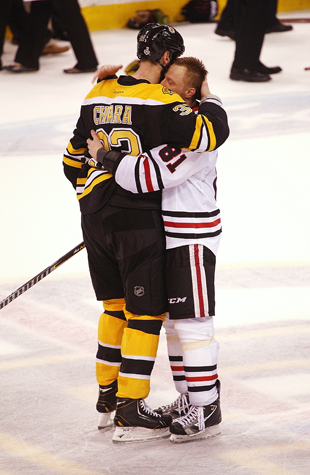
BOSTON, MA – JUNE 24: Zdeno Chara #33 of the Boston Bruins congratulates Marian Hossa #81 of the Chicago Blackhawks on winning the Stanley Cup in Game Six of the Stanley Cup Final at the TD Garden on June 24, 2013 in Boston, Massachusetts. The Blackhawks defeated the Boston Bruins 3-2. (Photo by Gail Oskin/Getty Images)
Ice hockey is a rough-and-tumble sport, whether it is men or women who play. Yes, ice hockey requires a plurality of skills to play. Skating is first and foremost what a successful hockey player needs to master, along with stick handling and teamwork. Hockey is a contact sport. Players wear pads, helmets, and eye protection when they go on the ice. Checking is a part of the game, and sometimes fights break out. When I was in high school, I refereed house league hockey, including girls’ hockey. The girls were as tough as the boys on the ice. I remember hearing the girls calling to their teammates from the bench, “Cream the bitch!” I played house league hockey as a boy. In my last year in the Midget-level (15-17 years old) hockey league, the girls’ team goalie in our village often practiced with us. My brother and one of my sisters played hockey growing up, too. My brother was the athlete in the family. He started in the house league and eventually played in a competitive league and on our high school hockey team. He suffered a fractured collarbone in a game when he played on the high school team. I remember it well as I picked him up at the hospital, where the technician showed me how to tighten the harness he put on my brother to set the fracture. So, yes, ice hockey is a rough-and-tumble sport, and players are sometimes injured. The checking and competition between the opposing teams on the ice is the appeal for the fans. Having watched many amateur hockey games as a spectator and as a referee, I can assure you that the crowd loves it when a player makes a hit on the ice. Watching the crowd’s reaction made me think of what it must have been like in the Roman Coliseum when fans went to watch the gladiatorial games. Elite-level amateur and professional hockey are immensely popular worldwide, and many people, children and adults alike, have fun playing at the house league level.
 
I remember in the 1990s, I was acquainted with a man at the gym where we worked out. He told me that he played in a gay men’s hockey league. I do not know the details of the gay men’s hockey league in Ottawa in the 1990s, but since 2020, Ottawa has had a “queer and trans friendly team,” called Ottawa Pride Hockey. The Ottawa Senators, the NHL team in Ottawa, is among the team’s sponsors. Ottawa Pride Hockey hosts an annual tournament called the Queer Capital Cup. The team’s rules specify, “Overly competitive or aggressive play is not tolerated.” (Ottawa Pride Hockey) Similarly, in Toronto, there is the Toronto Gay Hockey Association, which was founded in 1994. The mission statement states, in part, “To create an LGBTQ+ and allied positive space where people enjoy the game of hockey in an environment free from all forms of harassment or discrimination, which encourages fair play, openness and friendship.” (TGHA) A key feature of the Toronto Gay Hockey Association is that the rules do not allow body checking. So, there are “queer and trans friendly” spaces for those so inclined to play hockey and for any spectators who would watch them play. Somehow, I doubt that most hockey fans would be interested. Furthermore, if they demand that the NHL become “queer and trans friendly” in the manner that Ottawa Pride Hockey and the Toronto Gay Hockey Association play, they are going to be disappointed. No, ice hockey is a rough-and-tumble sport in which body checking is integral. True, in minor hockey, body checking is regulated by age groups, with Hockey Canada stating, “While positioning, angling, stick-checking and body contact is taught in the younger age divisions, full body-checking is not permitted until U15 at most intermediate and competitive levels. Some community (house) leagues will offer a non-body-checking option for all age divisions, including U15 and U18.” (Hockey Canada) The fact remains, however, that hockey is a contact sport, and body checking is a major appeal for the fans.
 
What made me think of this was the release of the Crave series, Heated Rivalry, a story about two professional hockey players, one bisexual and the other gay, who strike up an intimate relationship. The series became an overnight sensation. It has generated discussion and has the approval of the National Hockey League, as a representative for the NHL praised the show as, “The most unique driver for creating new fans.” (New York Times) The success of Heated Rivalry has some people discussing male homosexuality and professional hockey. Currently, there are no known openly gay players in the National Hockey League. There may be closeted players. Personally, I do not see why it matters. There are many thousands of young men who rise through the ranks of competitive junior and minor hockey, dreaming of making it to the NHL. A lucky few succeed. What does their sexual orientation have to do with any of it? Sure, fans are interested in players’ personal lives. I remember watching Hockey Night in Canada on Saturday nights in the early 1970s on the Canadian Broadcasting Corporation (CBC). Sometimes, in the segments between periods, segments featured a look into the players’ personal lives. They were either single or family men. Whether there were any gay players then is anyone’s guess, and, yes, they would have been wise to stay closeted. In the present, I doubt that most hockey fans would care if an NHL player came out as gay. For others, it is important that there is gay representation in professional sports. Again, I think it is irrelevant. The fans are there to watch a hockey game in all its rough-and-tumble glory. All they care about is the players’ skill.
 
Posted by Geoffrey
 

In the acronym LGBTQ+, “queer” is one of the multiple meanings for the Q. But that general acceptability does not erase queer’s treacherous and hateful history. — A. Pallas Gutierrez

I remember submitting an essay for grading in a course on the sociology of religion I took at Queen’s University in 1983. When the essay was returned to me with the grade and the professor’s comments, he noted that I used the terms Catholic and Christian interchangeably. He pointed out that while Catholics are Christians, so are Protestants. By using the terms Catholic and Christian interchangeably, I blurred the distinction between the two and risked giving the reader the impression that Protestants were somehow not Christians. Naturally, I understand that there are several denominations and sects in Christendom that profess different beliefs concerning Christian doctrine. However, I took the professor’s point that a little clarity goes a long way. What prompted the memory of my essay and the comment is how I noticed that so many people use the terms gay and queer interchangeably. I see this in news articles and discussions on online forums. Occasionally, someone refers to me as queer or a member of the queer community. I politely correct them, telling them that I am gay, not queer, and no, I am not a member of the queer community. I ask that they respectfully not refer to me as a queer, as I do not like it. The term is a slur, a derogatory term used historically to describe a gay man. It is like calling a black man a coon or a Jewish man a Hebe. Yes, I know that there is a countercultural constituency that claimed to have “reclaimed” the term. They are free to call themselves what they want, but it is objectionable when they use the terms gay and queer interchangeably when referring to gay men. In short, a gay man is a male homosexual, a man who experiences same-sex romantic and sexual attraction. Gay men are represented in all races and ethnicities. They are individuals, and the only thing they have in common is their sex and orientation.

Sadly, countercultural thinking in gay rights activism emerged in 1990 with the introduction of Queer theory; this is an ideological position, as Renee Janiak notes, the Queer theory holds:

To be queer means, “fighting about social injustice issues all the time, due to the structure of sexual order that is still deeply embedded in society” (Warner: 1993). Queer people are not assigned into a specific group or category, which would be comparable with any other type of grouping such as “class” or “race” (Warner: 1993). Queer people have made a change with how they identify themselves, they went from “gay” to “queer”. The self- identification change is due to that fact that “queer” represents the struggle of not wanting to fit into the systems of being “normal”. Queer theory has allowed for new political gender identities (Butler: 1990). (Queer Theory)

By 2016, Noah Michaelson, editorial director of HuffPost Gay Voices, rebranded the blog as HuffPost Queer Voices. In doing so, he claimed, “We, like many others before us, have chosen to reclaim ‘queer’ and to rename the section HuffPost Queer Voices because we believe that word is the most inclusive and empowering one available to us to speak to and about the community — and because we are inspired by all of the profound possibilities it holds for self-discovery, self-realization and self-affirmation,” […]. “We also revere its emphasis on intersectionality, which aids in creating, building and sustaining community while striving to bring about the liberation of all marginalized people, queer or not.” (Advocate) He added, “For a lot of people, intersectionality is difficult,” […]. “I think that a lot of groups who are marginalized or disenfranchised have their sights set on trying to bring about liberation for that particular group. It’s only been recently that people understand that most oppressions are all tied together. We’re not going to really get very far if we’re just trying to work in our own lane. We actually have to be working with each other because at the end of the day we’re all trying to get the same thing, I hope. And that is liberation for all marginalized people and for all people.” (Advocate)

Queer or 2SLGBTQQIA+ replaced gay and lesbian, meaning gay and lesbian people not wanting to fit in “existing social institutions,” defined by the queer theory as “heteronormativity.” Queer activists strive to organize a community composed of “the more socially conscious” gays and lesbians “to provide leadership to the whole mass of social variants” in developing a parallel “queer culture.” Yes, they are free to promote this narrative and pursue their desired goal. That said, in reality, gay remains gay, a demographic, not a community, and increasingly, many gay men, myself included, have actively rejected that narrative. When I mention in passing that I am gay, I typically mention my husband, Mika, with whom I have been for twenty-seven years. We are a conventional gay couple who are not at odds with heterosexuality or “heteronormativity.” Others understand that we are gay, male homosexuals, in a loving and committed relationship. We are assuredly not queer; what does that even mean? What we think of the “marginalized and disenfranchised” has nothing to do with your sex, race, orientation, or anything else. When it comes to the queer community, we ask that they stay in their own lane and kindly stop using the terms gay and queer interchangeably in referring to gay men. Yes, a little clarity goes a long way.

Posted by Geoffrey

Love him and let him love you. Do you think anything else under heaven really matters? — James Baldwin

Connor Storrie and Hudson Williams as Ilya Rozanov and Shane Hollander.

I noticed the sensation generated by the release of the series Heated Rivalry on Crave. It piqued my interest. I subscribed to Crave and settled in to watch the first episode of the series. Based on the first episode of the series, I expected the rest to be decidedly underwhelming. Thankfully, I found the following episodes much improved. I get what the storyline is about; at least I think so. The story is about two young men, one from Canada — his name is Shane Hollander — and the other from Russia — his name is Ilya Rozanov — who are rising stars in elite-level Junior Hockey and fierce competitors. They go on to become professional hockey players and captains of their respective teams. Each one has issues with his family and feels the pressures of navigating the byzantine world of professional hockey. Their story progresses through several years; along the way, they found they had a mutual sexual attraction. That further complicated things for them.

Continue reading

When I joined the military it was illegal to be homosexual, then it became optional, and now it’s legal. I’m getting out before the Democrats make it mandatory. — Sgt. Harry Berres, USMC

A gay Marine greets his husband upon his return from a deployment.

The Netflix series “Boots” is not “woke garbage,” as the United States Department of Defence alleged. No, while it is fiction, it is good storytelling. I admit, when I saw the trailer and the still images, a part of me rolled my eyes. I suspected it might be a cheesy rom-com featuring queeny ephebes prancing through the United States Marine Corps boot camp. On the contrary, the protagonist, Cameron Cope, is a gay seventeen-year-old high school graduate who chose military service, specifically the Marines, because his good friend had enlisted, and he wanted a change. The story is set in 1990, when male homosexuality was grounds for refusal in enlistment and grounds for discharge. He was reminded of that upon arrival at Parris Island, where a sign at the entrance for induction listed reasons for disqualification that included homosexuality. He kept his homosexuality to himself, though those around him suspected that he was gay.

The U.S. Department of Defense was clear when it issued the following regulation to clarify its stand in 1981:

(DOD Directive 1332.14 (Enlisted Administrative Separations), January 1981)

Homosexuality is incompatible with military service. The presence in the military environment of persons who engage in homosexual conduct or who, by their statements, demonstrate a propensity to engage in homosexual conduct, seriously impairs the accomplishment of the military mission. The presence of such members adversely affects the ability of the armed forces to maintain discipline, good order, and morale; to foster mutual trust and confidence among service members; to ensure the integrity of the system of rank and command; to facilitate assignment and worldwide deployment of service members who frequently must live and work in close conditions affording minimal privacy; to recruit and retain members of the armed forces; to maintain the public acceptability of military service; and to prevent breaches of security.

Under this regulation, persons having homosexual proclivities were deemed unfit for military service and either refused induction into military service or quietly mustered out with either a general, undesirable or dishonorable discharge if found out after having been inducted. The consequences of the three types of discharge varied in degree of severity. Still, in each, the individual was ineligible for veterans’ benefits and could face discrimination in employment in civilian life. That was the reality in 1990. The Don’t Ask, Don’t Tell policy in the United States Military was not enacted until 1993. So, serving in the U.S. Military in 1990 as a gay man meant you had to conceal the truth about yourself on pain of serious consequences.

As the story unfolded, it was revealed that one of the drill instructors, Staff Sergeant Sullivan, a seasoned Marine with a distinguished service record and a recipient of the Silver Star, was a gay man. Despite his impeccable record, he came under investigation when a man, a Major in the Marine Corps, with whom he had a romance, was outed and dismissed from the service. Despite the support of his commanding officer and enlisted colleagues, he chose to nearly beat a man to death in a bar fight, knowing it would result in a dishonorable discharge from the service. In his estimation, a conviction of aggravated assault of a civilian was preferable to being outed and dismissed in disgrace as a homosexual. The tragedy in his case was that had he held on another three years, he could have continued his career in the Marines—the U.S. Department of Defense is correct in pointing out that in 2025, gay men are free to serve openly. The Don’t Ask, Don’t Tell policy and the general ban on gays serving in the military were lifted in 2011. “Boots,” however, is set in 1990, when gay men did not have the option of serving with discretion, let alone openly. So, no, “Boots” is not “woke garbage,” it is well-written and superbly acted by the stellar cast. I highly recommend watching the series.

Posted by Geoffrey

It is a great plague to be too handsome a man. — Plautus

When I first viewed the photo, the portrait of the two young men struck me. Initially, I could not quite place why, but then it dawned on me. In the summer of 1980, I was a reservist in the Canadian Army. I served in the 30th Field Artillery Regiment based in Ottawa. It was the summer following my graduation from high school and before my enrollment at Queen’s University in Kingston. I went to Canadian Forces Base Petawawa to work as a driver in a transportation company through July and August. I worked with young men from other regiments who were posted there, too–we were in our late teens and early twenties.

Continue reading

I am the Love that Dare not Speak its Name. ― Alfred B. Douglas

This self-portrait, taken in Havelock, New Brunswick, shows the simplicity of the intimacy shared by Leonard Olive Keith (1891-1950) and Joseph Austin “Cub” Coates (1899-1965), who lived and loved in the first half of the 20th century. They were two men in love in Canada when male homosexuality was a crime in Canadian law, and public prejudice against male homosexuality was openly expressed. It was as simple as it is in the present. Some men are romantically and sexually attracted to men. It is a natural expression of human sexual attraction and behaviour. To those who knew and loved them, they were Len and Cub, a homosexual couple. To those who reviled male homosexuals, they were beneath contempt. They were what we call normal gays in the 21st century. Len was a harness racing driver who opened a garage after serving as an engineer in the Canadian Army in World War I. Cub was a mechanic who served as an engineer in the Canadian Army in World War I and volunteered for service in the Canadian Army in World War II. They were ordinary men who had a sense of duty, served their King and country as volunteers in the Great War, and found love and companionship in each other’s company. Despite their discretion, suspicion over their relationship in Havelock drove them apart in the 1920s. Len moved to the United States, where he lived out his days. Cub married in 1940. That fate was not unusual for gay men in Canada in the 20th century.

Continue reading

A sound discretion is not so much indicated by never making a mistake as by never repeating it. — Christian Nestell Bovee

Life for gay youth in the Heartstopper universe is generally reasonable. The protagonists, Nick Nelson and Charlie Spring—Nick is bisexual, and Charlie is gay—find each other and become boyfriends despite elements of antigay prejudice that linger. They initially feel the need for discretion in their relationship. Naturally, they yearn for privacy also. The scene where Nick’s mum walked in on them as they got close and personal in Nick’s room illustrated the point. It made me think of what life was like for me as a young gay man in the 1980s. I was a student at Queen’s University in Kingston, Ontario, Canada, in the first half of the 1980s. It was the height of the AIDS crisis, and gay men were the most affected. There was a moral panic; people did not know for sure how HIV was transmitted and feared exposure to the virus. It was seen as a gay plague, something that gay men brought on themselves for their unprincipled ways. Trust me, it was not a good time to be a gay man. Discretion was necessary because the consequences would be dire if you were outed.

Continue reading

There’s this illusion that homosexuals have sex and heterosexuals fall in love. That’s completely untrue. Everybody wants to be loved. — Boy George

I recall when I was in university in 1982. I enrolled in a film studies class, and one of the films we watched was Pagan Rhapsody. There is a scene in the film where two men play a sex scene. Though the scene was as vanilla as possible–there was kissing and a little friendly groping (nothing graphic)–the student audience’s vocal expressions of disgust were notable. In 2024, male homosexuality was generally accepted as a natural expression of human intimacy and treated with sensitivity in film and television. Netflix series such as Young Royals and Heartstopper feature a gay romance and intimacy between high school boys in a way that leaves something to the viewers’ imagination. Both series are immensely popular with younger viewers. Things have changed since the screening of Pagan Rhapsody in 1982. Still, when it comes to public perceptions of intimacy between gay men, there are a lot of people who have an unsavoury fixation on what they imagine goes on when two men are intimate. I get expressions of disgust in the comments on blog posts I write on gay rights advocacy, where people say things like, “There’s nothing more disgusting than two men fucking each other in the ass,” and “Cocksucking is not a men’s issue.” I mean, that is beyond the pale.

Continue reading

Those who forget the past are condemned to repeat it. — George Santayana

I am watching a Spanish Netflix series called Merli: Sapere Aude, and it is excellent. It is a dramedy, and the plot revolves around the protagonist, a young man named Pol Rubio, played by a fine young Spanish actor named Carlos Cuevas. Pol is a young man in his first year of studies in philosophy at a university in Barcelona. He has a bisexual orientation, and though he favours men, he does have dalliances with women occasionally. Pol is an anti-hero; while he generally strives to do good, he betrays a friend and his father when it serves his interests. He learns in the first episode of season two that he is HIV+. Pol is devastated by the news, despite the doctor’s assurance that the virus can be managed with treatment. He starts the regimen of taking the medication and tries to carry on. In a subsequent episode, Pol converses with a former co-worker who likely exposed him to the virus. His friend lost his job when the employer learned he was HIV+. The friend reminds Pol that people will feel sorry for you when you get cancer, but when you get HIV, you are viewed as a “dirty faggot.” Pol also converses with his employer, a mature gay man living with HIV. The employer lived through the AIDS crisis of the 1980s and 1990s and saw many gay men succumb to the disease. He recounted an incident where a friend was beaten to death for being queer. I bristled when I heard “queer” used to refer to a gay man, but I realized in the context of the anecdote that it was the attackers who called him a queer as they beat him to death. Queer is a slur, the last thing many gay men heard as they were beaten to death by gangs of thugs.

Continue reading