Tag Archives: Mika

In the acronym LGBTQ+, “queer” is one of the multiple meanings for the Q. But that general acceptability does not erase queer’s treacherous and hateful history. — A. Pallas Gutierrez

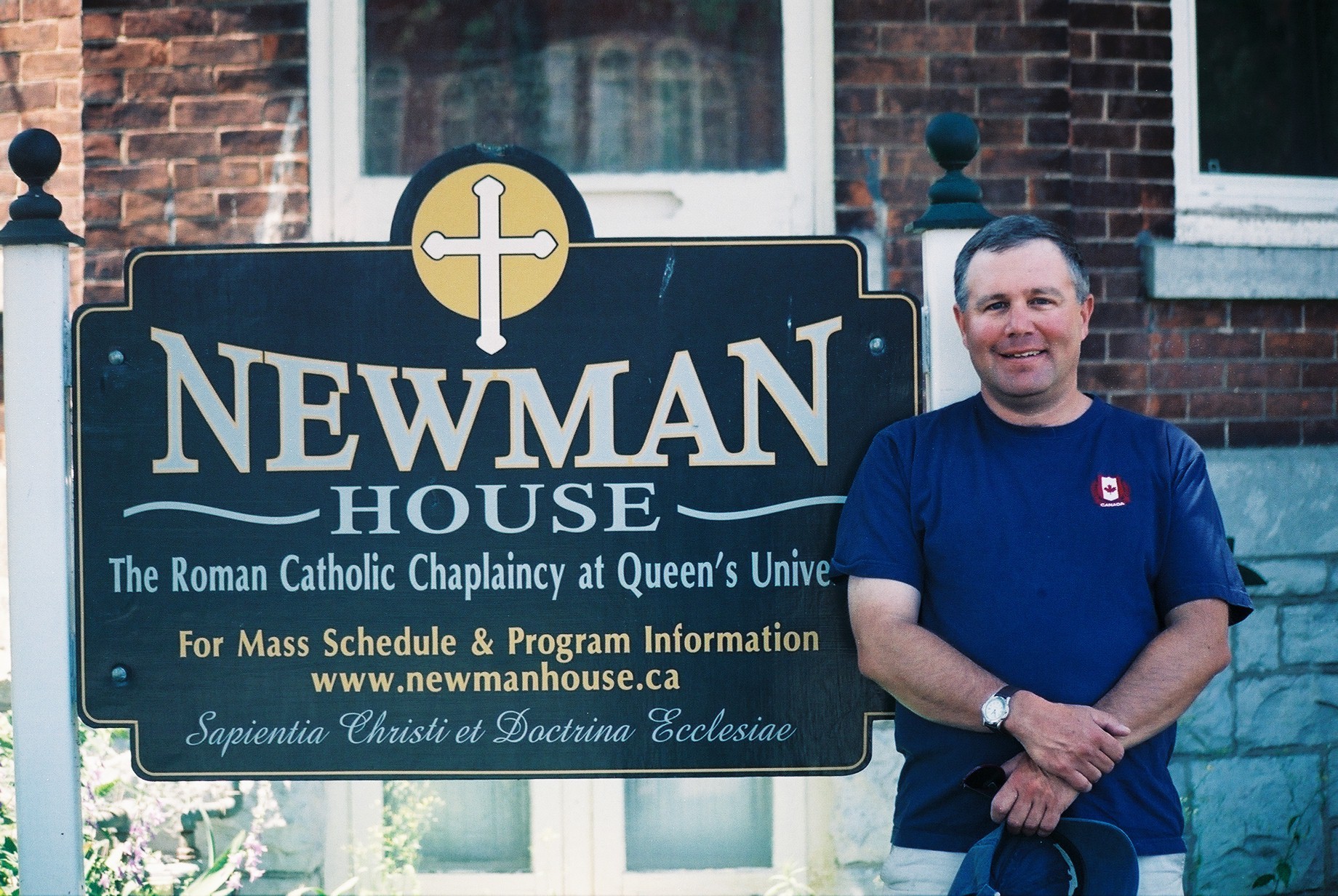
I remember submitting an essay for grading in a course on the sociology of religion I took at Queen’s University in 1983. When the essay was returned to me with the grade and the professor’s comments, he noted that I used the terms Catholic and Christian interchangeably. He pointed out that while Catholics are Christians, so are Protestants. By using the terms Catholic and Christian interchangeably, I blurred the distinction between the two and risked giving the reader the impression that Protestants were somehow not Christians. Naturally, I understand that there are several denominations and sects in Christendom that profess different beliefs concerning Christian doctrine. However, I took the professor’s point that a little clarity goes a long way. What prompted the memory of my essay and the comment is how I noticed that so many people use the terms gay and queer interchangeably. I see this in news articles and discussions on online forums. Occasionally, someone refers to me as queer or a member of the queer community. I politely correct them, telling them that I am gay, not queer, and no, I am not a member of the queer community. I ask that they respectfully not refer to me as a queer, as I do not like it. The term is a slur, a derogatory term used historically to describe a gay man. It is like calling a black man a coon or a Jewish man a Hebe. Yes, I know that there is a countercultural constituency that claimed to have “reclaimed” the term. They are free to call themselves what they want, but it is objectionable when they use the terms gay and queer interchangeably when referring to gay men. In short, a gay man is a male homosexual, a man who experiences same-sex romantic and sexual attraction. Gay men are represented in all races and ethnicities. They are individuals, and the only thing they have in common is their sex and orientation.

Sadly, countercultural thinking in gay rights activism emerged in 1990 with the introduction of Queer theory; this is an ideological position, as Renee Janiak notes, the Queer theory holds:

To be queer means, “fighting about social injustice issues all the time, due to the structure of sexual order that is still deeply embedded in society” (Warner: 1993). Queer people are not assigned into a specific group or category, which would be comparable with any other type of grouping such as “class” or “race” (Warner: 1993). Queer people have made a change with how they identify themselves, they went from “gay” to “queer”. The self- identification change is due to that fact that “queer” represents the struggle of not wanting to fit into the systems of being “normal”. Queer theory has allowed for new political gender identities (Butler: 1990). (Queer Theory)

By 2016, Noah Michaelson, editorial director of HuffPost Gay Voices, rebranded the blog as HuffPost Queer Voices. In doing so, he claimed, “We, like many others before us, have chosen to reclaim ‘queer’ and to rename the section HuffPost Queer Voices because we believe that word is the most inclusive and empowering one available to us to speak to and about the community — and because we are inspired by all of the profound possibilities it holds for self-discovery, self-realization and self-affirmation,” […]. “We also revere its emphasis on intersectionality, which aids in creating, building and sustaining community while striving to bring about the liberation of all marginalized people, queer or not.” (Advocate) He added, “For a lot of people, intersectionality is difficult,” […]. “I think that a lot of groups who are marginalized or disenfranchised have their sights set on trying to bring about liberation for that particular group. It’s only been recently that people understand that most oppressions are all tied together. We’re not going to really get very far if we’re just trying to work in our own lane. We actually have to be working with each other because at the end of the day we’re all trying to get the same thing, I hope. And that is liberation for all marginalized people and for all people.” (Advocate)

Queer or 2SLGBTQQIA+ replaced gay and lesbian, meaning gay and lesbian people not wanting to fit in “existing social institutions,” defined by the queer theory as “heteronormativity.” Queer activists strive to organize a community composed of “the more socially conscious” gays and lesbians “to provide leadership to the whole mass of social variants” in developing a parallel “queer culture.” Yes, they are free to promote this narrative and pursue their desired goal. That said, in reality, gay remains gay, a demographic, not a community, and increasingly, many gay men, myself included, have actively rejected that narrative. When I mention in passing that I am gay, I typically mention my husband, Mika, with whom I have been for twenty-seven years. We are a conventional gay couple who are not at odds with heterosexuality or “heteronormativity.” Others understand that we are gay, male homosexuals, in a loving and committed relationship. We are assuredly not queer; what does that even mean? What we think of the “marginalized and disenfranchised” has nothing to do with your sex, race, orientation, or anything else. When it comes to the queer community, we ask that they stay in their own lane and kindly stop using the terms gay and queer interchangeably in referring to gay men. Yes, a little clarity goes a long way.

Posted by Geoffrey

I consider promiscuity immoral. Not because sex is evil, but because sex is too good and too important. — Ayn Rand

In the summer of 1987, I lived with my boyfriend Fabio in a two-bedroom apartment in Kingston, Ontario. We met as students at Queen’s University and secretly carried on our love affair before moving in together. We became boyfriends during the burgeoning AIDS crisis. One evening, we sat in bed and watched a panel discussion held by one of the American News Networks–I cannot remember which one. What struck me was the inflammatory opening remark made by a conservative Congressman, whose name I do not remember, who asserted that “perversion and promiscuity” were to blame for the AIDS crisis. That sentiment was shared through the 1980s. I remember the stand-up comic Sam Kinison, who screamed in one of his routines that AIDS became an epidemic “because a few fags fuck some monkeys; they got tired of their own assholes.” Jerry Falwell claimed it was God’s judgement on homosexuals and blamed the spread of the disease into the innocent heterosexual population on bisexual men. Yes, AIDS was seen as a gay plague. Fabio and I, like countless gay men in the 1980s, were concerned. There was uncertainty about how easily the virus was transmitted. Before the dawn of the AIDS crisis, our biggest concern as students in the 1980s was the risk of an unwanted pregnancy or getting herpes.

Continue reading

Time makes us sentimental. Perhaps, in the end, it is because of the time that we suffer. — André Aciman

This is what a gay high school boy looked like in 1979.

I like gay romance in print and on film. The positive portrayal of romance and intimacy between two men or high school boys is lovely. Gay youth and men exist and have the same need for love and companionship as the heterosexual majority. Especially given that in Western society, intimacy between men was criminalized for a long time–it was considered “gross indecency” and punishable by imprisonment. Beyond that, public prejudice was prevalent throughout the 20th century. I remember it well. Recently, I met up with a man I knew in high school. We had not seen each other since graduation in 1980. We met through a mutual friend and ex of mine. I had no idea that my high school buddy was gay. We are both in our sixties and retired. I am happily partnered, and he is single. It was good to see him again.

Continue reading

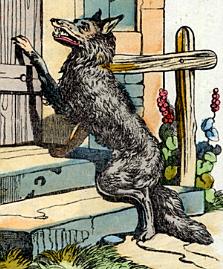
The wolf is always at the door, reprise.

wolfatthedoorwheel_of_fortune_british_museum_424x560

The wheel of fortune has turned, and as the Covid 19 pandemic spreads, Mika and I watch the chaos unfold around us. The pandemic is bad enough in its own right–just as the flu takes a terrible toll every year–the Covid 19 virus will take a dreadful toll before it runs its course. So far, we are making the best of staying home–we are naturally reclusive, we keep to ourselves at the best of times. It is unlikely that we will be exposed to the deadly virus. We are working from home–Mika works for the federal government at Statistics Canada, and I work in the MacOdrum Library at Carleton University. For the time being, we are drawing our salary and benefits–we accept that we are fortunate. Beyond that, our house is paid for, and we are out of debt and Mika informed me that we have enough in savings to sustain us for a while should one or both of us get laid off.

What concerns us the most is the economic upheaval that will result from the quarantine currently in place. We are among those fortunate enough to have our jobs and full salaries still–for the time being. We are in a comfortable position because of a blend of our efforts and good fortune. Both Mika and I experienced hardship in our lives. I did not land my full-time job at Carleton University until I turned thirty-nine. In the years before I started working at Carleton, I went through tough times. I struggled to get by on temp work and contract jobs–often in return for bum’s wages. I experienced long bouts of unemployment and went on social assistance when I was between jobs. I underwent personal bankruptcy over the Canada Student Loans I had no hope of repaying. Trust me, I tried to repay them, but given my spotted employment record in my thirties, the situation was hopeless. I never gave up. I applied myself during bouts of unemployment, working voluntarily in libraries to keep up my skills as a librarian.

Mika is hearing impaired. He has partial hearing only in his right ear. He was born this way and grew up with this disability. It did not stop him from excelling in school. He went to Queen’s University on an academic scholarship, where he studied mathematics and computer science. He works for Statistics Canada as a programmer. Yes, he applied himself to overcome his disability and had the good fortune to land a full-time job with the federal government shortly after he graduated from Queen’s in 1996. Mika is savvy at financial management too. It is his skill at managing money that ensured our prosperity as a couple. It is his skill and discipline in financial management–he is no spendthrift–that will get us through the crisis.

In our isolation, we have not lost track of the gravity of the situation. On a personal level, we have friends who fear that the loss of employment could lead to the loss of their home. Mika and I increased the wages for an acquaintance we employ to clean our house. We offered him a hand up, and he happily accepted. He was laid off from his day job and is waiting for his Employment Insurance benefits to kick in. Yes, the federal government instituted a guaranteed income for workers–seventy-five percent of their wages and salaries–and bailouts for small business owners who are forced to close for the duration of the crisis. It is like we are passengers on the RMS Titanic. The ship is sinking, and though there are not enough boats for all the passengers, the federal government has at least thrown out a lifeline to offer as many people as possible a chance to survive.

Mika and I are fortunate. We have each other and lots for which to be thankful. We kept the wolf from the door throughout our lives through a combination of our efforts and good fortune. It is distressing to think that the Covid 19 pandemic and the economic crisis it spawned could spell a drastic reversal of fortune for us. However, as I wrote in an essay I published last year: “The wolf is always at the door and you never know what fortune will bring but rather than despairing I accept I am still among the living and intend to live my life to the fullest.” Mika and I will keep our friends and families in our thoughts as we weather the storm. We hope that the current crisis is resolved with as little hardship as possible to everyone across the world.

Posted by Geoffrey and Mika


What will survive of us is love. — Phillip Larkin’s An Arundel Tomb

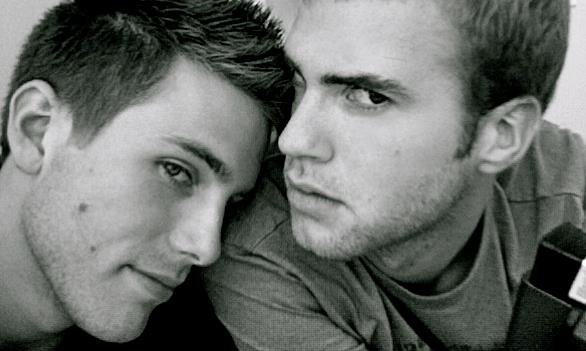
536072_486556508070130_1208265843_nGeoffrey and Mika in their library.

The story of the life and love shared by Thomas Lee Bridegroom and Shane Bitney Crone resonates with me to this day. I learned of their life together and the tragedy that befell them in viewing It could happen to you, the YouTube video produced by Shane Bitney Crone in memory of Thomas Lee Bridegroom, who died in a tragic accident on May 7, 2011. Though I do not know either of these men, I was so moved in a way that I normally am not upon hearing of a personal tragedy that strikes people who are strangers to me. Watching It could happen to you had a profound effect on me; I felt grief and outrage well up inside me upon learning of the injustice and iniquity that was heaped on Shane Bitney Crone following the death of his partner, Thomas Lee Bridegroom. As same sex couples could not marry in California at the time of Tom’s death, Shane had no legal standing as Tom’s partner and could do nothing as the Bridegroom family claimed Tom’s body, his assets and barred Shane from attending his funeral. This is so wrong and it happens to other couples. From the grief and outrage I experienced I was inspired to join in the effort to advocate for full civil rights for gay people, marriage rights in particular. Continue reading

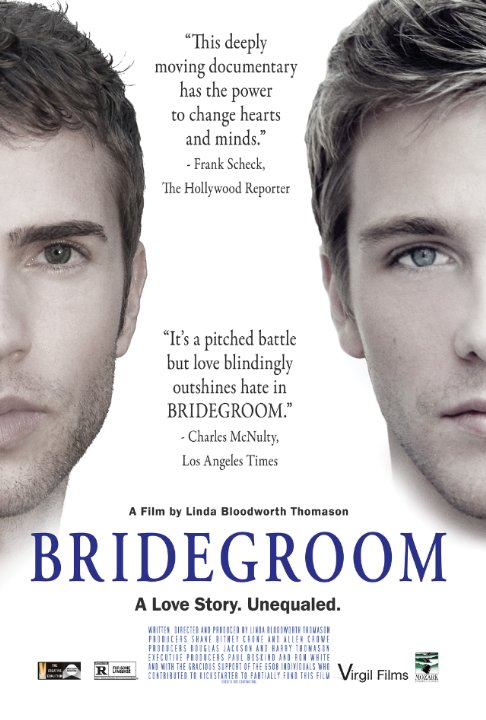
Bridegroom A Love Story, Unequaled

Bridegroom536072_486556508070130_1208265843_n

Mika and I enjoy reading and viewing biographies in print and on film. The latest addition to our library collection is a copy on DVD of the documentary film Bridegroom A Love Story, Unequaled, produced by Linda Bloodworth-Thomason. The documentary was inspired by  the video It could happen to you, published on YouTube by Shane Bitney Crone in 2012. The video is a moving account of the loving relationship between Thomas Lee Bridegroom and Shane Bitney Crone, the untimely death of Tom Bridegroom in a tragic accident and the unfortunate events that followed. The story of the tragedy that struck these two young men has resonated with people across the world following publication of the YouTube video It could happen to you. The documentary film, Bridegroom A Love Story, Unequaled, while dealing with the disturbing events following Bridegroom’s death, presents a biography of both Thomas Lee Bridegroom and Shane Bitney Crone, giving more detailed accounts of their childhoods, formative years, how, as young men, they came to meet and become a couple.

The film is a blend of still photos and video footage of Thomas Lee Bridegroom and Shane Bitney Crone, their families, friends and acquaintances taken throughout their lives. If also features interviews with Bitney Crone, members of his family, friends and acquaintances of both men. Thomas Lee Bridegroom’s family has consistently exercised their right to silence and refused any comment on the matter and appear only in still photos and snippets of video taken before their son’s untimely death. The look into their respective childhoods was particularly interesting. Before viewing the film, I surmised that Bridegroom came from a comfortable, middle-class background. He attended the Culver Military Academy, which commands rather hefty school fees and enrolled at Vassar College following his graduation. I learned in viewing the film his parents mounted an extraordinary effort, his mother took a job at Culver to help raise the money to pay the school fees. They saw to it he had the opportunity for a very good education. Shane Bitney Crone attended state schools and left for Los Angeles following his graduation from high school to seek his fortune in the entertainment industry. He had the support of his family in pursuing his dream.

The tone of the film is quite temperate and gets the point across very gently and eloquently that gay people fall in love, become couples and set up households together. It shows just how precarious it is for a gay couple when their relationship is not given the same legal standing of that of a heterosexual couple; thereby making a strong case for marriage equality. It is well worth viewing and though inspired by the personal tragedy that befell Thomas Lee Bridegroom and Shane Bitney Crone, it documents, as the title indicates, a love story, unequaled.

Posted by Geoffrey and Mika

Hera and her master

Hera curled up with Geoffrey, May 26, 2013.

Photographed and posted by Mika

Geoffrey & Mika: Mika’s 40th Birthday!

Mika and I went to the Keg restaurant with our good friends Jason and Fran to celebrate Mika’s 40th birthday. Two happy couples getting together to celebrate a milestone in Mika’s life. Mika and I are in our 15th year together and life is great!

Video produced and published by Geoffrey