
Tag Archives: lesbians

That’s so I can recognize you filthy queer scum before you get close, he explained with a nasty smile. ― Heinz Heger

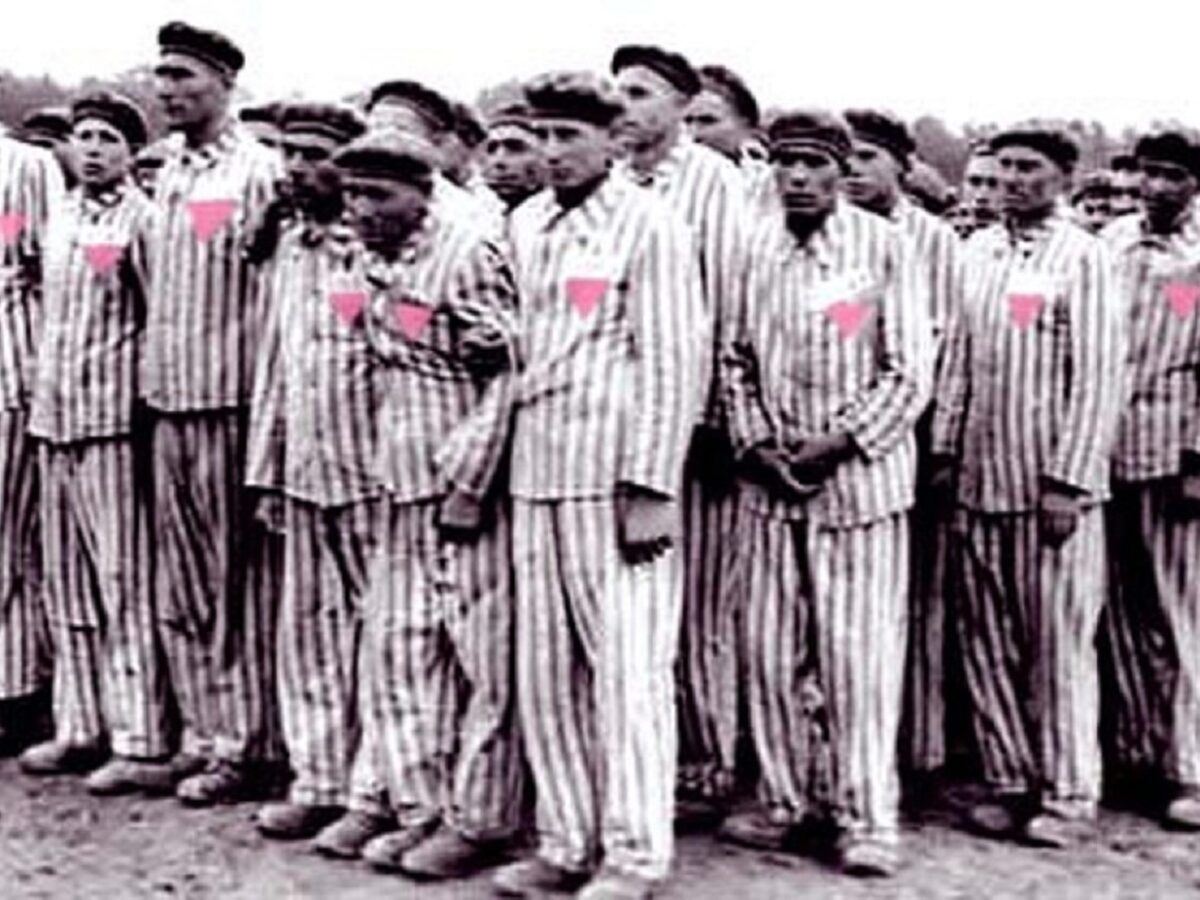
Homosexual prisoners in a Nazi concentration camp.
Michael Elmgreen and Ingar Dragset and the Memorial to Persecuted Homosexuals under National Socialism.

The persecution of gay men in Germany goes back to the 1794 and 1851 Prussian legal codes. In 1871, Paragraph 175 of the German Empire’s criminal code was enacted, based on the Prussian legal codes.

The 1871 version of Paragraph 175 read:

Unnatural sexual acts (widernäturliche Unzucht) committed between persons of the male sex, or by humans with animals, is punishable with imprisonment; a loss of civil rights may also be sentenced. (Holocaust Encyclopedia)

Yes, it criminalized sex acts between men; it did not criminalize men for having a homosexual orientation. Also, it did not apply to lesbians. The law was enforced sparingly during the Imperial and Weimar eras, as a conviction required that two men be caught in the act of having sex. When the Nazi Party took power in Germany in 1933, Paragraph 175 was revised to read:

A man who commits sexual acts (Unzucht) with another man, or allows himself to be misused for sexual acts by a man, will be punished with prison. (Holocaust Encyclopedia)

There was opposition to Paragraph 175. Notably, it was a German physician and gay rights advocate, Magnus Hirschfeld, who first conducted experiments in hormone therapy and sex reassignment surgeries at his clinic, the Institute for Sexual Science in Berlin. No, there was nothing in German law that prohibited his experiments. It was Hirschfeld who coined the term, transvestite in 1910. He founded the clinic in 1919. Before his trials in hormone therapy and sex reassignment surgeries, he established the Scientific-Humanitarian Committee in 1897 with Max Spohr, Franz Josef von Bülow, and Eduard Oberg. Its primary aim was to fight for the abolition of Paragraph 175 of the German Imperial Penal Code, which criminalized sexual contact between men. Then as now, experiments in hormone therapy and sex reassignment surgeries carried risks, as Fara Naz Khan noted in 2016, In 1922, Hirschfeld performed castration on Dora Richter, one of the institute’s employees who later went on to complete her sex reassignment in 1931 with further surgeries at the institute. The institute’s most famous patient was arguably Danish painter Lili Elbe (born Einar Wegener) whose life story has been fictionalized in the popular film The Danish Girl. Starting in 1930, Elbe had five surgeries performed as part of her male-to-female transition. Unfortunately, Elbe died from infection-related complications of her final surgery in 1931. (Scientific American)

Hirschfeld’s trials stopped when the Nazis rose to power in Germany, as Hirschfeld was Jewish. He lived out the last years of his life in exile. The Nazis destroyed his papers–those in which he documented his research and experiments in hormone therapy and sex reassignment in the burning of “non-German” texts beginning in 1933. By 1936, it was Heinrich Himmler, the head of the SS and the Criminal Police (Kripo), who founded the Reich Central Office for the Combating of Homosexuality and Abortion (Reichszentrale zur Bekämpfung der Homosexualität und der Abtreibung). In doing so, he called male homosexuality a “public scourge.” Interestingly, men who cross-dressed and were caught having sex with men were convicted under Paragraph 175. They were prosecuted for sexual offences, not for cross-dressing or pretending that they were women. So the treatment of some cross-dressers or transvestites by the Nazis was peripheral in relation to the stated aim of hunting down male homosexuals. The rate of convictions of homosexual men under Nazi rule increased significantly, as the following data show:

Additionally, two sections were added to Paragraph 175: Paragraph 175a and Paragraph 175b, which read:

coercing another man to have sex;

initiating sexual relations with a male subordinate or employee;

having sexual relations with a male minor (under the age of 21);

engaging in prostitution with another man. (Holocaust Museum)

In 1934, there were 948 convictions for violating Paragraph 175. This number is comparable to conviction rates during the Weimar Republic, albeit on the high end.

In 1936, there were 5,320 convictions.

In 1938, the number of convictions increased to approximately 8,500. (Holocaust Encyclopedia)

Also, of the homosexual men convicted under Paragraph 175, most received prison sentences and were not sent to concentration camps. Those who were sent to the concentration camps were made to wear the pink triangle on their clothing. They suffered extreme abuse and had a low chance of survival. By contrast, lesbianism was never criminalized under German law. That does not mean that lesbians did not suffer under Nazi rule. There were lesbians who were sent to the concentration camps, but it was because of membership in the following categories: Jews, Roma, asocials, political prisoners, and professional criminals. (Holocaust Encyclopedia) They never wore the pink triangle. There is the Memorial to the Persecuted Homosexuals under National Socialism in Berlin. The memorial was designed by Michael Elmgreen and Ingar Dragset, a homosexual couple who live in Berlin. The memorial was dedicated in 2008. From the website Foundation Memorial to the Murdered Jews of Europe, “the memorial is intended to honour the homosexual victims of National Socialism and at the same time ‘set a constant sign against intolerance, hostility and exclusion towards gays and lesbians’”. That is a noble sentiment and good that the record of the persecution of gay men and lesbians under Nazi rule is preserved for posterity.

Unfortunately, in the present, there is a concerted effort underway to overlay a narrative that what happened to gays and lesbians under the Nazi regime was a part of “queer history.” “Queer,” meaning the 2SLGBTQIA+ community. Recently, I viewed a video produced by Amanda W. Timpson, a “queer public historian,” who runs the website Yesterqueers. I stumbled upon a video she produced about the Memorial to the Persecuted Homosexuals under National Socialism, where she called it a “queer” monument. No, gay men were the primary target of the Nazis, who persecuted them in line with existing German law. Lesbians were affected, too, but not directly targeted by the Nazis or in German law for being lesbians. Experiments in sex reassignment got underway before the rise of Nazism, and there was nothing in German law that prohibited it. As noted above, there were cross-dressing men who were prosecuted under German law for homosexual offences. They were singled out for being homosexuals, not cross-dressers. Absolutely, many people suffered at the hands of the Nazis, but this insipid effort to rewrite gay and lesbian history, diluting it with “queer” gender identity politics, is beyond the pale.

Posted by Geoffrey
Gay men don’t have much in common with lesbians. — Douglas Murray

The thing to remember is that gay is a demographic, not a coherent community. I am a gay man, a free thinker and a skeptic. I am proudly Anglo-Saxon; both sides of my family came from the British Isles, my father’s family from England and my mother’s from Ireland. Short of taking a DNA test, it is anyone’s guess what blend of ethnicities may be in my ancestry. However, that is neither here nor there. The fact remains that I am a middle-aged, gay white man. That said, those characteristics are irrelevant. Above all else, I am an individual. I am the man I am today because of my childhood and adolescence circumstances. I grew up in Canada in the latter half of the 20th century. I remember the Centennial celebrations in 1967 on Canada’s 100th birthday. I learned to take pride in my heritage, and the freedoms and opportunities afforded me as a Canadian. Still, growing up gay in my generation had its challenges. Continue reading

I would say that I’m a feminist theorist before I’m a queer theorist or a gay and lesbian theorist. — Judith Butler

The quotation by Judy Rebick at the start of the Wikipedia article on lesbian feminism prompted me, in part, to discuss the detrimental effect of the infiltration of feminism on the gay rights movement. “According to Judy Rebick, a leading Canadian journalist and feminist activist, lesbians were and always have been “the heart of the women’s movement,” while their issues were “invisible” in the same movement.” (Cited in Wikipedia) Rebick is an American ex-pat who lives in Toronto. I could write at great length about her impropriety, but I digress. What I remember about Rebick is what she said in an interview in 1990 regarding feminism. She said, in short, that feminism was dominated and too focused on the interests of middle-class heterosexual white women. It needed to be more inclusive, broaden its scope to include lesbians and non-white women, and take up the cause of gay rights. When I heard that, I was aghast. “Whoa there, Medusa,” I thought, “stay in your own lane! No one asked for your help. Gay men are doing just fine in standing up for their civil rights.” Continue reading

When a man does a queer thing, or two queer things, there may be a meaning to it, but when everything he does is queer, then you begin to wonder. ― Arthur Conan Doyle, The Case-Book of Sherlock Holmes

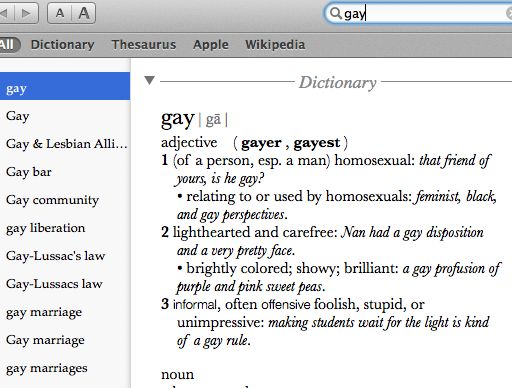
dictionary

002 (5)

Geoffrey and Mika in their library.

I cancelled my subscription to what was formerly Huff Post Gay Voices when the editorial director Noah Michelson changed the title to Huff Post Queer Voices earlier this year. Michelson justifies substituting “queer” in place of “gay” on the grounds the “word is the most inclusive and empowering one available to us to speak to and about the community.” (Noah Michelson as cited in OUT) The thinking behind it is people who are gay, lesbian, bisexual, transsexual, etc. form a “community,” that is they share a collective group identity. Following this train of thought, Michelson asserts “‘queer’ functions as an umbrella term that includes not only the lesbians, gays, bisexuals and transgender people of ‘LGBT,’ but also those whose identities fall in between, outside of or stretch beyond those categories, including genderqueer people, intersex people, asexual people, pansexual people, polyamorous people and those questioning their sexuality or gender, to name just a few.” (Noah Michelson as cited in OUT) I get that “queer” is used by some as a blanket term for gay, lesbian, bisexual, transsexual, etc., but I heartily disagree with and refute of this point of view. Continue reading

If a couple of gay guys want to throw the gayest, most fabulous wedding of all time, the only way it should offend you is if you weren’t invited. ― Orlando Winters

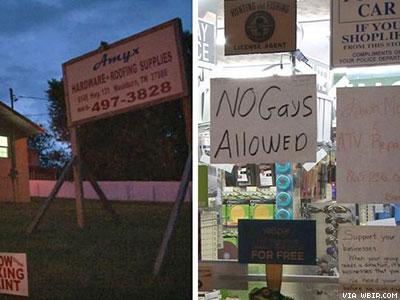
sweetcakesTennessee-No-Gays-Allowed-Sign-x400

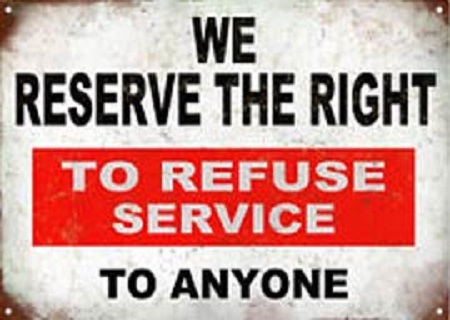
“No shirt, no shoes, no service,” how often do I find a sign with these words posted when I approach the entrance to a restaurant or shop. There are hotels, bed & breakfasts, resorts and housing developments that refuse to allow children. I remember in 1968 my mother and father were asked by owners to leave their bed & breakfast in Cheltenham, England because other guests did not like that there were children on the premises. I remember back in 1987 when I was a student at Wilfrid Laurier University trying to find a place to live in Kitchener-Waterloo. It was a very tight market for student housing and for one of the ads I answered was told curtly by the voice on the telephone “we only take girls.” In 1989 back in Ottawa as I browsed ads in the newspaper for shared accommodation, I noticed more than a few that included the phrase “straight only.” People discriminate against others in the marketplace for various reasons, and in many cases, such as those listed above, it is lawful to do so, while in others it is not. The question is what is the appropriate response if you find yourself confronted with a situation when you think you are the butt of either unjust or unlawful discrimination. Continue reading

Violence can only be concealed by a lie, and the lie can only be maintained by violence. — Aleksandr Solzhenitsyn

200421-women-violencepp_wide_elliotrodgers

In light of a recent mass murder-suicide in Santa Barbara, California, there has been a frenzy of intense speculation about what spurred the killer, Elliot Rodger, into carrying out his crime. One point of view put forward is that it was the phenomenon of violence against women, not just on his part, but on the part of men in general that spurred him on to commit this crime. That and abuse of women by men is tolerated in US society in a “culture of misogyny and toxic masculinity.” The abuse of women is a problem and, without any doubt, reprehensible, but is it fair to solely blame men? Is it reasonable to assert that the abuse of women is tolerable in US society? These questions merit discussion, but in short, my answer to both questions is a resounding no. Continue reading

“If all printers were determined not to print anything till they were sure it would offend nobody, there would be very little printed.” ― Benjamin Franklin

censorshipdo-not-read

The 2014 Rose Bowl Parade included a float “Love Is the Best Protection,” sponsored by the AIDS Healthcare Foundation. The reasoning behind the inclusion of the float, according to Ged Kenslea, Foundation President, is, “by showing the dream of lesbians and gay men fulfilled, the float is perfect with this year’s Rose Parade theme of ‘Dreams Come True.’” (as cited in Breitbart) The decision to include the float drew a mixed response. One impassioned response comes from a woman who was deeply offended. Angela Wingenroth offered the following comment:

“We don’t care what the states say about it — God is clear that this isn’t right and I will NOT have this SHOVED DOWN MY CHILDREN’S THROATS!! The intolerance is theirs. They will not accept peoples’ objections to their lifestyle — you HAVE to accept that it’s not just ok, but GOOD or you’re a bigot! If they want to get ‘married,’ that’s their choice, but my kids don’t need to see it.” (as cited in American Power)

I expect this is what she was told to think by her pastor and various anti-gay commentators about the fact that gay people are being granted full civil rights in US society. Still, I wonder who, if anyone, called this woman a bigot for feeling this way. Continue reading

Let justice be done, though the world perish. (Fiat justitia et pereat mundus.) — Ferdinand I (1503–1564), Hungarian King of Bohemia and Hungary, Holy Roman Emperor 1558-1564

black-death-4the-wrath-of-god

I took the time to comment on a Facebook thread, the premise of which was, that Western nations should discontinue immigration from the Islamic world. I do not think this course of action is warranted and doubt any government in the Western world would take up such a policy, but what got me thinking was a comment from an individual who believes the difficulties of integrating newcomers in Canadian society, with its official policy of multiculturalism, is divine punishment for what he sees as our having abandoned Christian principles as a society. This belief in divine punishment or retribution or justice is very old and not found solely in Christianity. Though I am no longer a practicing Christian, I admit such thoughts have crossed my mind when I experienced hard times and personal tragedy in my own life. When my four year old Brittany, Juno, succumbed to cancer in 2012, I remember talking to the breeder who sold her to me, asking if there had ever been any incidence of cancer in her dogs at such a young age. She told me no and she was just as shocked and horrified as me by the news. I then asked her “is it something I have done?” “What have I done to deserve this?” The questions were essentially rhetorical, but she answered, saying no, it was not anything I had done and assured me that “God does not hand us a burden He knows we cannot bear.” Continue reading