Tag Archives: Pierre Elliott Trudeau

I am the Love that Dare not Speak its Name. ― Alfred B. Douglas

This self-portrait, taken in Havelock, New Brunswick, shows the simplicity of the intimacy shared by Leonard Olive Keith (1891-1950) and Joseph Austin “Cub” Coates (1899-1965), who lived and loved in the first half of the 20th century. They were two men in love in Canada when male homosexuality was a crime in Canadian law, and public prejudice against male homosexuality was openly expressed. It was as simple as it is in the present. Some men are romantically and sexually attracted to men. It is a natural expression of human sexual attraction and behaviour. To those who knew and loved them, they were Len and Cub, a homosexual couple. To those who reviled male homosexuals, they were beneath contempt. They were what we call normal gays in the 21st century. Len was a harness racing driver who opened a garage after serving as an engineer in the Canadian Army in World War I. Cub was a mechanic who served as an engineer in the Canadian Army in World War I and volunteered for service in the Canadian Army in World War II. They were ordinary men who had a sense of duty, served their King and country as volunteers in the Great War, and found love and companionship in each other’s company. Despite their discretion, suspicion over their relationship in Havelock drove them apart in the 1920s. Len moved to the United States, where he lived out his days. Cub married in 1940. That fate was not unusual for gay men in Canada in the 20th century.

Continue reading

The despotism of custom is everywhere the standing hindrance to human advancement. — John Stuart Mill

1967_wolfenden-reportmill

The publication of the Wolfenden Report in 1957 was a landmark in the movement that led to the destigmatization of homosexuality across the Western world in that it brought about the decriminalization of male homosexuality in England and Wales in 1967. The repeal of the Criminal Law Amendment Act 1885 (48 & 49 Vict. c.69) accomplished this. Section 11 of the Act, in particular the clause known as the Labouchere Amendment, applied to male homosexuality. In short, the clause provided for a term of imprisonment “not exceeding two years”, with or without hard labour, for any man found guilty of “gross indecency” with another male, whether “in public or in private”. In 1953 the Home Secretary, David Maxwell Fyffe, referred to male homosexuality as a “plague over England,” and vowed to wipe it out. In 1954, the Departmental Committee on Homosexual Offences and Prostitution was convened with John Wolfenden appointed chairman. Continue reading

The Firearms Act is about licensing and registration, not confiscation. — Former Justice Minister Anne McLellan, July 31, 1998.

gun-typescdn_flag_bg

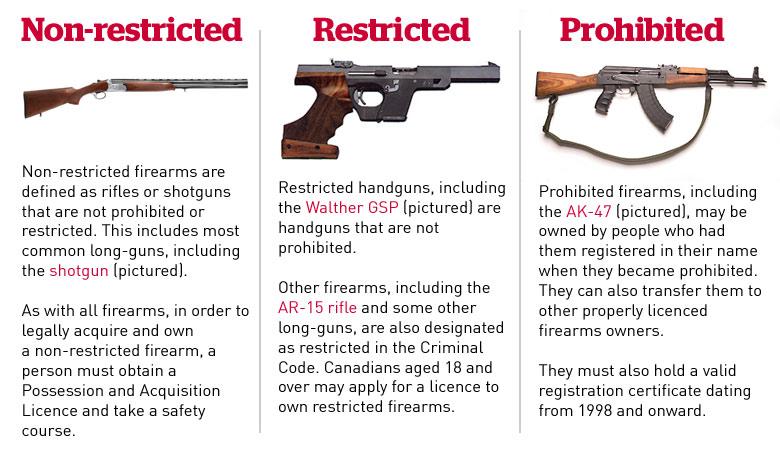
I bought my first gun in a private sale, back in 1977 when I was sixteen. As it happens, 1977 was a turning point in the regulatory framework for gun owners in Canada; it was the last of the good old days for gun owners in Canada. The familiar classification system for firearms was in effect (non restricted, restricted and prohibited). This was enacted in 1969 with the passage of Criminal Law Amendment Act, 1968-69 (S.C. 1968-69, c. 38), which, coincidentally, also decriminalized homosexuality. In 1977 it was unlawful to sell guns to individuals of unsound mind or those under prohibition orders, otherwise Canadians were free to own and use guns for hunting, sport shooting and collecting without having the state on their back. As the Minister Justice, Pierre Elliott Trudeau, observed in shepherding the Criminal Law Amendment Act, 1968-69 through parliament, “obviously, the state’s responsibility should be to legislate rules for a well-ordered society. It has no right or duty to creep into the bedrooms of the nation.” (as cited in Wikipedia) In 1977, just as the state had no business in bedrooms of the nation, neither did the state have any business in the basements and gun cabinets of the nation.

Continue reading

A person’s sexuality is so much more than one word “gay.” No one refers to anyone as just “hetero” because that doesn’t say anything. Sexual identity is broader than a label. — Gus Van Sant

sex-question-personal-gay-pride-month-ecards-someecardssantorum-gay-sex

Recently the question came to mind as to why so many religious folk and social conservatives hold such a prurient fixation on what they imagine goes on in other people’s bedrooms. Sex is a part of every conjugal relationship: gay and straight. Sex is natural, a part of living and to enjoy. Sodomy laws, as they were called, were repealed in Canada in 1969. Then Minister of Justice Pierre Elliott Trudeau famously declaring in 1967, “there’s no place for the state in the bedrooms of the nation.” (CBC Digital Archives) Sodomy laws were repealed across the United States as of 2003 when U.S. Supreme Court in a 6-3 decision in Lawrence v. Texas Justice Anthony Kennedy, writing for the majority, ruled that the state could not single out gay people for harassment and discriminatory treatment simply “because of ‘moral disapproval’ of homosexuality. He wrote of ‘respect’ for same-sex couples and warned that ‘the state cannot demean their existence,’ describing same-sex relationships as a ‘personal bond’ involving much more than just sex. Kennedy also wrote that reducing same-sex couples to ‘sex partners,’ as anti-gay organizations often do, is offensive in the same way that describing a husband and wife as nothing more than sex partners would be offensive.” (National Gay and Lesbian Task Force) Continue reading