Tag Archives: RCMP

For every complex problem there is an answer that is clear, simple, and wrong. — H. L. Mencken

The Liberal Party of Canada, the governing Party in 2016, rewrote the Canadian Human Rights Act to include gender identity and expression as prohibited grounds of discrimination. It was puzzling at the time, as they could not define gender identity conclusively. The Canadian Human Rights Act defines gender identity as follows:

Gender identity is each person’s internal and individual experience of gender. It is their sense of being a woman, a man, both, neither, or anywhere along the gender spectrum. A person’s gender identity may be the same as or different from the gender typically associated with their sex assigned at birth. For some persons, their gender identity is different from the gender typically associated with their sex assigned at birth; this is often described as transgender or simply trans. Gender identity is fundamentally different from a person’s sexual orientation. (Canadian Human Rights Act)

Basically, it is an individual’s belief in something that cannot be observed or measured. It is a subjective sense of self, based on irrational ideas; it can be anything you want or nothing at all. That is entirely up to the individual. That in itself is fine. Canadian law guarantees the right to freedom of belief and conscience—as it should. That being the case, belief in gender identity was guaranteed in existing law. Also, existing Canadian law prohibits discrimination based on religion. The thing to remember is that while you are free to believe in gender identity, you are also free not to. From what I surmise, belief in gender identity asserts that we have gendered souls which can be either male, female, or anything in between. Hence, people who are sure of their sex, male or female, are called “cisgender,” as their gender identity and sex align. “Transgender” people are those whose sex and gender identity do not align; they sometimes say that they were born in the wrong body. Again, that is a matter of personal belief and conviction, and no one is stopping anyone from holding these beliefs. Jordan Peterson warned at the time the Liberal government revised the Canadian Human Rights Act to include gender identity and expression, that it would result in compelled speech. His concerns were dismissed, mockingly. Unfortunately, state institutions like the public service, military, police, and schools have been compelled to adopt the belief in gender identity as dogma. Yes, the Party, the Liberal Party of Canada, decreed that in Canada, 2+2=5, in that gender identity is grounded in reality because they say so. Not only that, but anyone who dissents is a heretic whose rejection of the doctrine must be singled out and sanctioned. In short, Canadians are expected to bend the knee to this particular belief system, which runs contrary to Canadian law, notably the Canadian Charter of Rights and Freedoms. I do not understand why the Liberal Party of Canada is so determined to overlay this doctrine of gender identity on Canadians. It is as if they want to impose a new state religion. In doing so, they sowed division among Canadians, resulting in bitter conflict. It is as if the Party declared in fact and established in law that not only do angels exist, but how many angels can fit on the head of a pin, so that the public can quarrel over how many angels do fit on the head of a pin or if angels even exist.

I look at things logically, and the law of non-contradiction, a fundamental law of logic, states that contradictory propositions cannot both be true at the same time and in the same sense. The Liberal Party of Canada decided that it is possible to be male and female at the same time and in the same sense. We saw an example of how this played out in the recent mass shooting in Tumbler Ridge, British Columbia, where the RCMP and the state-funded news media insisted that the suspect was female despite having been born male. Of course, to most people viewing the news reports from the RCMP spokesman, who initially used the term “gunperson” and female in referring to the suspect, when it was quickly revealed that he was an 18-year-old male who had decided to identify as female four years prior. They insisted on referring to him as “she/her” in their statements. The police and court records will show that he was a she, despite the reality that he was male, because in existing Canadian law, whether an individual is male or female is determined by self-identification, and frankly, that is absurd. No, the reality is that 2+2=4, and sex is observable, measurable, and immutable. In this instance, eight people, two adults and six children, died, and twenty-seven were injured, some critically. The RCMP and the state-funded media feel compelled to walk on eggshells so as not to “misgender” the suspect who died at the scene for fear of being condemned for heresy against doctrine. Their priority should be enforcing the law and reporting on current events objectively, without being compelled to adhere to the tenets of any particular belief system, and without looking ridiculous in the process.

Posted by Geoffrey

The weapons’ menacing looks, coupled with the public’s confusion over fully automatic machine guns versus semi-automatic assault weapons—anything that looks like a machine gun is assumed to be a machine gun—can only increase the chance of public support for restrictions on these weapons. — Josh Sugarmann

gbMini-14sm10bseriesvo3

The term assault weapon comes up frequently in media reports on guns in society. The term has its origins in the 1980s and is credited to Josh Sugarmann executive director and founder of the Violence Policy Center (VPC) and noted prohibitionist. Before founding the Violence Policy Center in 1988, Sugarmann served as communications director for the National Coalition to Ban Handguns (renamed the Coalition to Stop Gun Violence (CSGV) in 1989). The term assault weapon entered common parlance after Sugarmann authored a publication entitled Assault Weapons and Accessories in America in 1988. Sugarmann and the Violence Policy Center are among those advocates of prohibition who frame the argument that ban is a matter of public health and safety, that this trumps the individual right to own and use guns. In their effort to advance this agenda, prohibitionists resort to the underhanded tactic of framing the debate in a manner that confuses the issue, causing people to quarrel over what is they view as good guns vs bad guns. Continue reading

Security is the mother of danger and the grandmother of destruction — Thomas Fuller

japannotMontague_Placard

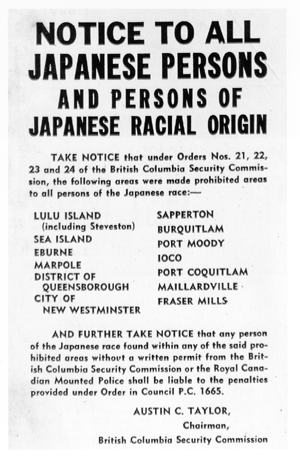
The Canadian Firearms Program, a component of the Canadian Firearms Act, a stupid law, drafted by the Liberal government led by Prime Minister Jean Chretien and enacted in 1995, burdens peaceful and law-abiding hunters, sport shooters and gun collectors with oppressive regulations. Moreover, it enables belligerent and defiant bureaucrats in the Royal Canadian Mounted Police (RCMP) to arbitrarily order the prohibition and confiscation of legally acquired and owned firearms. The decision to proceed with this policy was rooted in the moral panic that arose following the mass murder of fourteen women at an engineering school in Montreal in 1989. Moral panic is defined as “an intense feeling expressed in a population about an issue that appears to threaten the social order.” (Jones, M, and E. Jones as cited in Wikipedia)  Following this tragedy, Canadian gun owners were singled out as a menace to the social order. This was not the first time in Canadian history that a federal government responded to a moral panic in pushing forward with stupid legislation, against the counsel of advisors from within its ranks. A stupid law that resulted in the oppressive regulation and confiscation of property from a segment of the population in Canadian society who were unjustly deemed to threaten the social order. Continue reading

The bedfellows politics made are never strange. It only seems that way to those who have not watched the courtship. — Marcel Achard

Mathison-ElectropsychometerHgh-River-RCMP-Gun-Seizures

The following comment was posted as a response to my recent post on the current state of firearms laws in Canada.

I think male homosexuality repellent, and therefore do not follow those issues closely. Because I am a genuine (which is to say, 19th century, tolerant, John-Stuart-Mill-type liberal) I believe that things which are none of my business are, you know, none of my business: You do not need, nor would receive, my approval, much less “celebration” for whatever passes for your lifestyle choice. But whatever consenting adults want to do that does not harm or threaten others is NONE OF MY BUSINESS. It is most certainly none of government’s business, and I believed that, and supported homosexual rights, from the times when homosexuality was an imprisonable felony in Canada.
I am heartened to see therefore, that with your lifestyle, you account responsible arms ownership on the list of things that are None Of Government’s Business.
When the government wants to prosecute those who harm or threaten others, they have my entire support. When they want to persecute those whose lifestyle choices are contrary to contemporary fashion, the resistance, subversion, and defiance are called for.

Continue reading

The Firearms Act is about licensing and registration, not confiscation. — Former Justice Minister Anne McLellan, July 31, 1998.

gun-typescdn_flag_bg

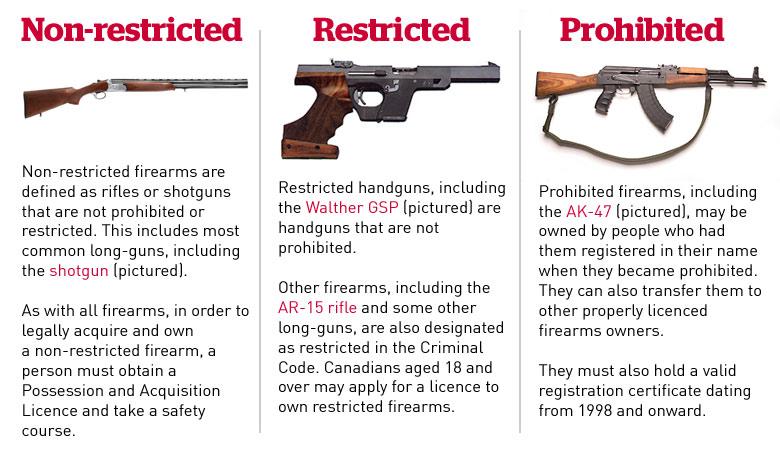
I bought my first gun in a private sale, back in 1977 when I was sixteen. As it happens, 1977 was a turning point in the regulatory framework for gun owners in Canada; it was the last of the good old days for gun owners in Canada. The familiar classification system for firearms was in effect (non restricted, restricted and prohibited). This was enacted in 1969 with the passage of Criminal Law Amendment Act, 1968-69 (S.C. 1968-69, c. 38), which, coincidentally, also decriminalized homosexuality. In 1977 it was unlawful to sell guns to individuals of unsound mind or those under prohibition orders, otherwise Canadians were free to own and use guns for hunting, sport shooting and collecting without having the state on their back. As the Minister Justice, Pierre Elliott Trudeau, observed in shepherding the Criminal Law Amendment Act, 1968-69 through parliament, “obviously, the state’s responsibility should be to legislate rules for a well-ordered society. It has no right or duty to creep into the bedrooms of the nation.” (as cited in Wikipedia) In 1977, just as the state had no business in bedrooms of the nation, neither did the state have any business in the basements and gun cabinets of the nation.

Continue reading