Gay men have long been seen as a novelty, a standard deviation in the demographic where most of humanity is heterosexual. Attitudes toward male homosexuality varied throughout history. In Antiquity, for the Etruscans, Greeks, and Romans, it was a part of life. They understood that people were sexual, so same-sex liaisons were common and depicted in their artwork. With the development of the Abrahamic faiths, Judaism, Christianity, and Islam, male homosexuality was viewed in a critical light. Eventually, it was condemned in the Abrahamic faiths and in the wider society. Gay men lived and died through centuries where, at best, they were tolerated, sometimes, and at worst, persecuted and imprisoned. By the eighteenth century in England, the argument was advanced by the British philosopher, Jeremy Bentham, for the decriminalisation of homosexual behaviour between consenting adults in private, in his essay Offences Against Oneself. He wrote the essay around 1785, but it was published posthumously in 1931. Bentham thought homosexuality, as Jeffrey Weeks notes, “an ‘imaginary offence’ dependent on changing concepts of taste and morality.” (Wolfenden and beyond: the remaking of homosexual history) Bentham thought through the issue and reasoned:
To what class of offences shall we refer these irregularities of the venereal appetite which are stiled [sic] unnatural? When hidden from the public eye there could be no colour for placing them any where else: could they find a place any where it would be here. I have been tormenting myself for years to find if possible a sufficient ground for treating them with the severity with which they are treated at this time of day by all European nations: but upon the principle utility I can find none. (Offences Against Oneself)
However, in England and Wales, the passage of the Criminal Law Amendment Act 1885 (48 & 49 Vict. c.69) included Section 11, in particular the clause known as the Labouchere Amendment, which applied to male homosexuality. In short, the clause provided for a term of imprisonment “not exceeding two years”, with or without hard labour, for any man found guilty of “gross indecency” with another male, whether “in public or in private”. The Labouchere Amendment was enforced sparingly and selectively. However, the consequences of arrest and conviction could be devastating. John Gielgud very nearly saw his career as an actor come to an abrupt end in 1953 when a scandal arose over his arrest for ‘persistently importuning male persons for immoral purposes’ (he was caught trying to pick up a man in a public washroom). He was fined £10, and news of the arrest reached the press, causing him a most personal humiliation and the refusal of a visa to travel to the United States with his company to perform Shakespeare’s The Tempest. Gielgud was fortunate that the theatre-going public forgave his momentary indiscretion, and he continued his acting career both in the United Kingdom and the United States. Also, in 1953, the Home Secretary, David Maxwell Fyffe, referred to male homosexuality as a “plague over England,” and vowed to wipe it out. The Labouchere Amendment was repealed in English law in 1967—interestingly, a backbench Conservative Member of Parliament, Margaret Thatcher, broke ranks with the party to vote for its repeal. Since the decriminalisation of male homosexuality in England and Wales in 1967, many countries followed. It was decriminalised in Canada in 1969.
Now, in the twenty-first century, male homosexuality is seen by most as inconsequential. It is a natural expression of human sexuality. True, gay men remain a minority, but are free to take their place in society and live openly. Gay men marry and have families. They are represented in all occupations, and take part in a plurality of pastimes like anyone else. Unfortunately, for some, gay men remain a novelty. The series, Heated Rivalry, released by Crave, a Canadian streaming service, has become a worldwide hit with viewers. The series is based on novels by Rachel Reid, a Canadian author. I do not begrudge her success or the television series’s success, but what concerns me is that the story is pure fantasy. Yes, it is good writing and acting, absolutely, only it made me think of a quotation by Maria Von Trapp. When she saw the first production of The Sound of Music, she said, “That’s a nice story, but it’s not my story.” The story of two professional hockey players, one bisexual and the other gay, came from the imagination of a heterosexual woman. I am not saying there is anything wrong with that. Hardly, she is free to write stories about any characters she chooses. Though they say, “Art imitates life,” sometimes, particularly in romance novels, the lives of the characters are idealised beyond belief. The reality is that there is nothing novel about gay men living in the twenty-first century in most Western jurisdictions. There is no need to fashion romantic fantasies about how you imagine gay men live, how they feel, and what they think. The truth is, we are like everybody else, despite being a minority. There are plenty of openly gay professional athletes, including Jason Collins (an NBA player), Robbie Rogers (an NFL player), Tom Daley (a diver for the British Olympic team), Gus Kenworthy (a skier for the U.S. Olympic team), and Carl Nassib (an NFL player). I do not know much about the personal lives of these men, except for Tom Daley, whose private life is on the public record. Daley is married to his husband, Dustin Lance Black, and has two sons. They lead a conventional life like any other married couple. So, why are people so agog over a fantasy television series that treats the ordinary lives of gay men as something new and unusual?
Hannah Arendt developed the concept of the banality of evil: “Evil comes from a failure to think. It defies thought for as soon as thought tries to engage itself with evil and examine the premises and principles from which it originates, it is frustrated because it finds nothing there. That is the banality of evil.” I am reminded of this when I note the dismay of Intactivists when Facebook posts pop up where a newborn boy is subject to involuntary genital cutting for any reason or no reason. I also note the angry reactions of the parents who do not care for the criticism or condemnation for doing this to their newborn sons. Yes, there is no shortage of people who see nothing wrong with it and will tell you to mind your own business. That and they retort, “Don’t choose it for your son if that’s how you feel!” I watch with interest as Eric Clopper, Attorney at Law and Founder & President of Intact Global, mounts a constitutional challenge in Oregon for the protection of boys from involuntary genital cutting. I stand with him and hope for the best as he and his team of lawyers proceed with the challenge. The challenge is based on the constitutional guarantee of legal equal protection. As the involuntary genital cutting of girls is prohibited in US law (in several states, not federally), the reasoning is that boys deserve equal protection. Though I am neither a lawyer nor a legal scholar, as a well-informed layman, I expect the challenge will be an uphill battle.
I am watching a Spanish Netflix series called Merli: Sapere Aude, and it is excellent. It is a dramedy, and the plot revolves around the protagonist, a young man named Pol Rubio, played by a fine young Spanish actor named Carlos Cuevas. Pol is a young man in his first year of studies in philosophy at a university in Barcelona. He has a bisexual orientation, and though he favours men, he does have dalliances with women occasionally. Pol is an anti-hero; while he generally strives to do good, he betrays a friend and his father when it serves his interests. He learns in the first episode of season two that he is HIV+. Pol is devastated by the news, despite the doctor’s assurance that the virus can be managed with treatment. He starts the regimen of taking the medication and tries to carry on. In a subsequent episode, Pol converses with a former co-worker who likely exposed him to the virus. His friend lost his job when the employer learned he was HIV+. The friend reminds Pol that people will feel sorry for you when you get cancer, but when you get HIV, you are viewed as a “dirty faggot.” Pol also converses with his employer, a mature gay man living with HIV. The employer lived through the AIDS crisis of the 1980s and 1990s and saw many gay men succumb to the disease. He recounted an incident where a friend was beaten to death for being queer. I bristled when I heard “queer” used to refer to a gay man, but I realized in the context of the anecdote that it was the attackers who called him a queer as they beat him to death. Queer is a slur, the last thing many gay men heard as they were beaten to death by gangs of thugs.
I had a similar experience to the one dramatized in the video. It was in the late spring, early summer of 1980. I had graduated from high school and eagerly looked forward to enrolling at Queen’s University in the Fall. I served as a Reservist in the Canadian Army in an artillery regiment in Ottawa and made friends with another young man I met in the unit. We became fast friends. I made friends with that man and others in my regiment. Still, I was ribbed, called the “Regimental Fag” in the banter among the ranks. When I came to the Christmas Party in 1979 with a young woman for my date, I was asked, “So, you like girls?” We spent time alone together at his mother’s house. We sat on the living room floor and listened to Beatles records on the stereo. I remember my overwhelming desire for him; I wanted to throw my arms around him and kiss him. I did not understand why I felt that way, which was horrifying. I dared not try it as that would have gone badly for me (assuming he was not gay or did not return my feelings). Had I been singled out as a homosexual in 1980, it would have meant dismissal from the Service. I would likely have lost my friends and become the butt of salacious gossip.
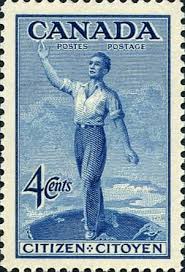
“I am a Canadian,” is the opening phrase in a notable quotation from the Right Honourable John Diefenbaker (1895-1979) 13th Prime Minister of Canada serving from June 21, 1957, to April 22, 1963. The entire quote reads as follows:
“I am Canadian, a free Canadian, free to speak without fear, free to worship God in my own way, free to stand for what I think right, free to oppose what I believe wrong, free to choose those who govern my country. This heritage of freedom I pledge to uphold for myself and all mankind.” (John Diefenbaker, House of Commons Debates, 1 July 1960)
Yes, John Diefenbaker was a proud Canadian–not only that he was a proud Canadian nationalist. As Prime Minister, Diefenbaker advanced the cause of Canadian nationalism. He envisioned:
One Canada, one Canada, where Canadians will have preserved to them the control of their own economic and political destiny. Sir John A. Macdonald gave his life to this party [Conservative]. He opened the West. He saw Canada from east to west. I see a new Canada – a Canada of the North! (John Diefenbaker, Winnipeg Manitoba, 12 February 1958)
Diefenbaker lived during the first century of Canada’s existence. He witnessed the development by which Canada gained independence from Britain. Until 1931, with the passage of the Statute of Westminster, the British government managed Canada’s international affairs. Diefenbaker saw Canada fight in two world wars and Canadians suffer through the Great Depression. He proudly saw the passage of the Canadian Citizenship Act in 1947. Canadians have much to be proud of in their history.
While Diefenbaker saw all that is good in Canada and being Canadian, he did not overlook the problematic moments in Canadian history. Canadian society was not without issues of unjust discrimination and prejudice. Diefenbaker observed:
From my earliest days, I knew the meaning of discrimination. Many Canadians were virtually second-hand citizens because of their names and racial origin. Indeed, it seemed until the end of World War II that the only first-class Canadians were either of English or French descent. As a youth, l determined to devote myself to assuring that all Canadians, whatever their racial origin, were equal and declared myself to be a sworn enemy of discrimination. (John Diefenbaker, Nowlan Lecture, 6)
Diefenbaker knew of the head tax charged on Chinese immigrants. The head tax, enacted in 1885, remained in effect until 1923. Chinese immigrants to Canada were charged (at its worst) $500 for admission to Canada as landed immigrants. From 1923 to 1947 Chinese immigration to Canada was banned. He knew of the internment of Japanese-Canadians in World War II. He was well aware of the Catholic-Protestant divide in Christendom that existed well into the 20th-century in Canada. I remember my mother telling me that my father had to convert to Roman Catholicism to marry her in 1960. My father’s family is Anglican. It is hard to believe such tribal divisions existed in Canada historically, but it is the reality.
Diefenbaker envisioned Canada as a nation organized according to the values of liberalism and pluralism. In shaping his vision of Canadian society, Diefenbaker was inspired, in part, by the passage of the Universal Declaration of Human Rights in 1948. The Universal Declaration of Human Rights was a Canadian-led effort. John Humphrey, a professor of law at McGill University, became director of the United Nations Division on Human Rights in 1946. Humphrey produced the first draft of the declaration. When Diefenbaker became Prime Minister in 1957, he set out to enact a piece of legislation–following up the passage of the Universal Declaration of Human rights–called the Canadian Bill of Rights. In addressing the historical issues of unjust discrimination and prejudice in Canada’s history, the Canadian Bill of Rights asserts in part:
1 It is hereby recognized and declared that in Canada there have existed and shall continue to exist without discrimination by reason of race, national origin, colour, religion or sex, the following human rights and fundamental freedoms, namely,
(a) the right of the individual to life, liberty, security of the person and enjoyment of property, and the right not to be deprived thereof except by due process of law;
(b) the right of the individual to equality before the law and the protection of the law;
To his credit, John Diefenbaker laid the groundwork for our national identity as Canadians. Despite what so many people think currently, nationalism is not a dirty word. As I grew up the values of liberalism and pluralism–the proposition on which Canadian identity is built–that John Diefenbaker advocated were instilled in me. I remember the Centennial celebrations in 1967 fondly; the swell of national pride Canadians felt in celebrating Canada’s first 100 years as a nation. I am proudly Canadian. I am not ashamed of my European heritage–my ancestry goes back to the British Isles. In keeping with Diefenbaker’s vision, I view the people with whom I interact as individuals and judge them according to the content of their character. I reject the notion that expressing Canadian nationalism is racist, that it is a declaration of white supremacy. No, Canada is not a “post-national state.” Canadians are well within their rights to stand up for their national interest, and Canadian law guarantees them their right to speak up and do so.
I hope Canadians will not lose sight of the fact that Canada is a great place to live and Canadian citizenship is worth fighting for. Yes, John Diefenbaker got it right when he advanced the cause of Canadian nationalism and Canadians would do well to remember as they face the challenges of life in the 21st-century.
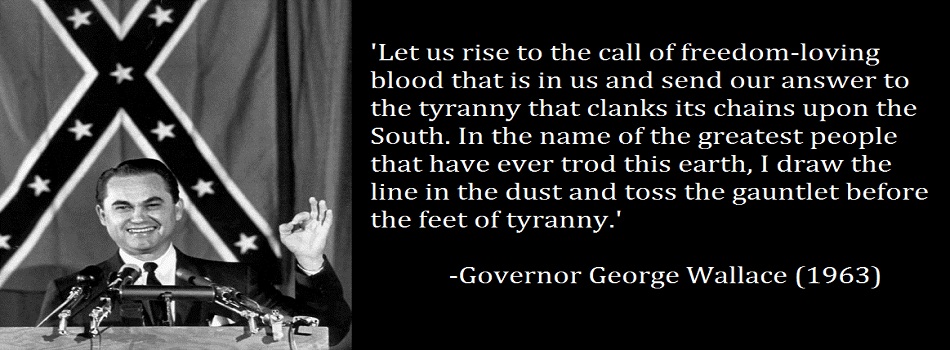
Despite gains in the movement for marriage equality in the United States, such as the repeal of the Defense of Marriage Act (DOMA) and Proposition 8 by the Supreme Court of the United States in 2013 and the repeal of Amendment 1 in North Carolina by a U.S. District Court in 2014, resistance rooted in cynical appeals to populism and the tyranny of the majority rears its head in Alabama. This is manifest in the looming showdown between Judge Roy Moore of the Alabama Supreme Court and the Supreme Court of the United States (SCOTUS) following the repeal of the Alabama Sanctity of Marriage Amendment, in a ruling handed down by Justice Callie V. Granade of the United States District Court for the Southern District of Alabama on January 23, 2015. This is not unlike the showdown that took place between Governor George C. Wallace and President John F. Kennedy in 1963 when Governor Wallace defied the SCOTUS ruling in Brown v. Board of Education, handed down in 1954 that declared segregation unconstitutional. In both cases, support for segregation and for a ban on same sex marriage was overwhelming and Wallace and Moore insisted their respective stands on the issues was justified in that they represented the opinion of the majority of voters in Alabama. Continue reading →
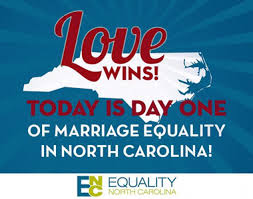
Religion and the definition of marriage remain intertwined in the present, just as in the past. Historically, disputes over the definition of marriage concerned marriage, divorce and remarriage. Dispute over these issues in the court of King Henry VIII of England in the 16th century caused upheaval in the Church and English society. Heads rolled, literally, in the process. In the present, there is an ongoing dispute over the definition of marriage or the redefinition of marriage to allow same sex couples to marry. As I view the movement for same sex marriage, defined as marriage equality, in the United States, North Carolina is a focal point. Amendment 1 to the state constitution, enacted in 2012 following a ballot measure, defined marriage as the union of one man to one woman. Amendment 1 was struck down on October 10, 2014 by U.S. District Court Judge Max O. Cogburn, Jr. It is now lawful for same sex couples to marry in North Carolina, much to the dismay of opponents of marriage equality, including Charles L. Worley and Billy Graham, who object on religious grounds. Heads are rolling, though not literally, in North Carolina now that Amendment 1 is no longer in force. Continue reading →
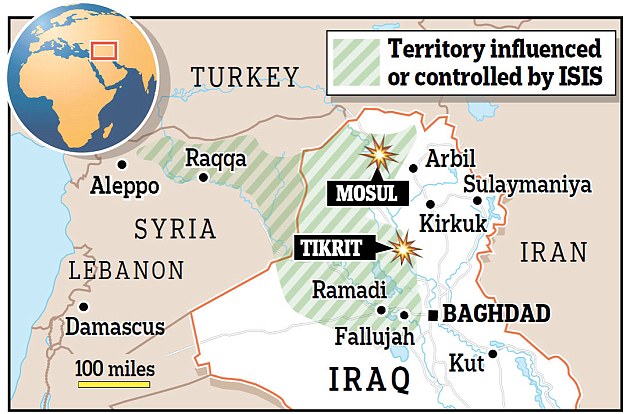
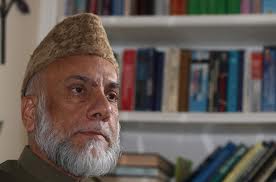
Imam Syed Soharwardy is a respected Muslim cleric and scholar, chairman of the Al-Madinah Calgary Islamic Assembly and founder and president of the Islamic Supreme Council of Canada. His research interests in Islam consist of “Islamic beliefs, challenges for Muslims in the western world, conflicts within the Muslim community and interreligious conflict.” (Wikipedia) On August 22, 2014, Soharwardy drew attention to himself in announcing he was embarking on a 48 hour fast to protest the murder of James Foley, an American journalist, by the Islamic State of Iraq and Syria (ISIS) earlier in the week. In condemning the killing of James Foley, Soharwardy also made a bold statement declaring there is nothing Islamic in what ISIS represents, asserting:
I want to create awareness about the nature of their work — they are using Islam, they are quoting Qur’an, they look like Muslims, they pray like Muslims but they are not Muslim. They are deviant people, and they are doing exactly everything which goes against Islam. (CBC News Calgary)
In making this assertion, Soharwardy raises an interesting question. Do the actions of ISIS have nothing to do with Islam? Continue reading →
The publication of the Wolfenden Report in 1957 was a landmark in the movement that led to the destigmatization of homosexuality across the Western world in that it brought about the decriminalization of male homosexuality in England and Wales in 1967. The repeal of the Criminal Law Amendment Act 1885 (48 & 49 Vict. c.69) accomplished this. Section 11 of the Act, in particular the clause known as the Labouchere Amendment, applied to male homosexuality. In short, the clause provided for a term of imprisonment “not exceeding two years”, with or without hard labour, for any man found guilty of “gross indecency” with another male, whether “in public or in private”. In 1953 the Home Secretary, David Maxwell Fyffe, referred to male homosexuality as a “plague over England,” and vowed to wipe it out. In 1954, the Departmental Committee on Homosexual Offences and Prostitution was convened with John Wolfenden appointed chairman. Continue reading →
Years ago, I remembered while discussing theology with a group of friends, one in the group referred to himself as a pious atheist. I was taken aback by his comment as piety and atheism were not terms I associated with one another. Piety is most commonly associated with religious beliefs and practices. Since then, I gave this notion a great deal of thought: is secular piety a possibility? This question is worth considering in that how one expresses their piety in an increasingly secular society has become a contentious issue of late; as is evidenced by the controversy surrounding the proposedQuebec Charter of Values (Charte de la laïcité or Charte des valeurs québécoises). The stated aim of the charter is to ensure there is a clear separation of religion and state and that public employees have religious neutrality. What this means is wearing ostentatious religious symbols or garb on the job will be prohibited.Continue reading →