Tag Archives: politics

For every complex problem there is an answer that is clear, simple, and wrong. — H. L. Mencken

The Liberal Party of Canada, the governing Party in 2016, rewrote the Canadian Human Rights Act to include gender identity and expression as prohibited grounds of discrimination. It was puzzling at the time, as they could not define gender identity conclusively. The Canadian Human Rights Act defines gender identity as follows:

Gender identity is each person’s internal and individual experience of gender. It is their sense of being a woman, a man, both, neither, or anywhere along the gender spectrum. A person’s gender identity may be the same as or different from the gender typically associated with their sex assigned at birth. For some persons, their gender identity is different from the gender typically associated with their sex assigned at birth; this is often described as transgender or simply trans. Gender identity is fundamentally different from a person’s sexual orientation. (Canadian Human Rights Act)

Basically, it is an individual’s belief in something that cannot be observed or measured. It is a subjective sense of self, based on irrational ideas; it can be anything you want or nothing at all. That is entirely up to the individual. That in itself is fine. Canadian law guarantees the right to freedom of belief and conscience—as it should. That being the case, belief in gender identity was guaranteed in existing law. Also, existing Canadian law prohibits discrimination based on religion. The thing to remember is that while you are free to believe in gender identity, you are also free not to. From what I surmise, belief in gender identity asserts that we have gendered souls which can be either male, female, or anything in between. Hence, people who are sure of their sex, male or female, are called “cisgender,” as their gender identity and sex align. “Transgender” people are those whose sex and gender identity do not align; they sometimes say that they were born in the wrong body. Again, that is a matter of personal belief and conviction, and no one is stopping anyone from holding these beliefs. Jordan Peterson warned at the time the Liberal government revised the Canadian Human Rights Act to include gender identity and expression, that it would result in compelled speech. His concerns were dismissed, mockingly. Unfortunately, state institutions like the public service, military, police, and schools have been compelled to adopt the belief in gender identity as dogma. Yes, the Party, the Liberal Party of Canada, decreed that in Canada, 2+2=5, in that gender identity is grounded in reality because they say so. Not only that, but anyone who dissents is a heretic whose rejection of the doctrine must be singled out and sanctioned. In short, Canadians are expected to bend the knee to this particular belief system, which runs contrary to Canadian law, notably the Canadian Charter of Rights and Freedoms. I do not understand why the Liberal Party of Canada is so determined to overlay this doctrine of gender identity on Canadians. It is as if they want to impose a new state religion. In doing so, they sowed division among Canadians, resulting in bitter conflict. It is as if the Party declared in fact and established in law that not only do angels exist, but how many angels can fit on the head of a pin, so that the public can quarrel over how many angels do fit on the head of a pin or if angels even exist.

I look at things logically, and the law of non-contradiction, a fundamental law of logic, states that contradictory propositions cannot both be true at the same time and in the same sense. The Liberal Party of Canada decided that it is possible to be male and female at the same time and in the same sense. We saw an example of how this played out in the recent mass shooting in Tumbler Ridge, British Columbia, where the RCMP and the state-funded news media insisted that the suspect was female despite having been born male. Of course, to most people viewing the news reports from the RCMP spokesman, who initially used the term “gunperson” and female in referring to the suspect, when it was quickly revealed that he was an 18-year-old male who had decided to identify as female four years prior. They insisted on referring to him as “she/her” in their statements. The police and court records will show that he was a she, despite the reality that he was male, because in existing Canadian law, whether an individual is male or female is determined by self-identification, and frankly, that is absurd. No, the reality is that 2+2=4, and sex is observable, measurable, and immutable. In this instance, eight people, two adults and six children, died, and twenty-seven were injured, some critically. The RCMP and the state-funded media feel compelled to walk on eggshells so as not to “misgender” the suspect who died at the scene for fear of being condemned for heresy against doctrine. Their priority should be enforcing the law and reporting on current events objectively, without being compelled to adhere to the tenets of any particular belief system, and without looking ridiculous in the process.

Posted by Geoffrey

So, I’m a big Second Amendment fan but I think most politicians are cowards when it comes to defending why we have a Second Amendment. — Charlie Kirk

Sighting in my Tikka T3 in .243.

The murder weapon used in the killing of Charlie Kirk was a Mauser bolt-action rifle in 30-06 with a scope, a make and model of hunting rifle commonly used in North America. I have several left-hand bolt-action rifles topped with scopes in my collection in various calibres. I use them for hunting small game, varmints and big game. I occasionally visit the rifle range to ensure the rifles are sighted in before hunting. I am a good shot. When you choose to kill a game animal, you want to place the bullet in its vital area to ensure a quick, humane death. The suspect in the killing of Charlie Kirk, I will not mention his name, allegedly shot Mr. Kirk in the neck from a distance of two hundred yards. I have no idea of the suspect’s history with guns or whether he was a good shot. Regardless, he succeeded in mortally wounding Charlie Kirk with either a well-placed or a lucky shot. Of course, that is reprehensible. When a hunting rifle is used in a homicide, inevitably, some people blame the rifle, guns and gun owners in general. There is an expectation that I should rethink being a gun owner and hunter because someone used a hunting gun to commit murder.

Continue reading

‘Woman’ is not an idea in a man’s head. — J. K. Rowling

Despite Rowling’s proposition being a non sequitur, she is correct that “woman is not an idea in a man’s head.” The majority of men, rational men at least, know that the definition of a woman is an adult human female. The definition of a woman she refers to in her topsy-turvy proposition is that of feminists who subscribe to queer theory and their half-baked metaphysics that spawned gender identity and expression. The belief that people have gendered souls is a feminist invention made into a sacred cow by the Woke with their triune doctrine of Equity, Diversity and Inclusion (more aptly known as Division, Iniquity and Exclusion). Yes, it was queer feminists such as Judith Butler and barbara findlay (she insists on spelling her name without capital letters) who fashioned gender identity and expression. 

Continue reading

We can always call them Bulgarians. — Samuel Goldwyn (Attributed)

Plamen

Dining with my friend Plamen at a restaurant in Sofia.

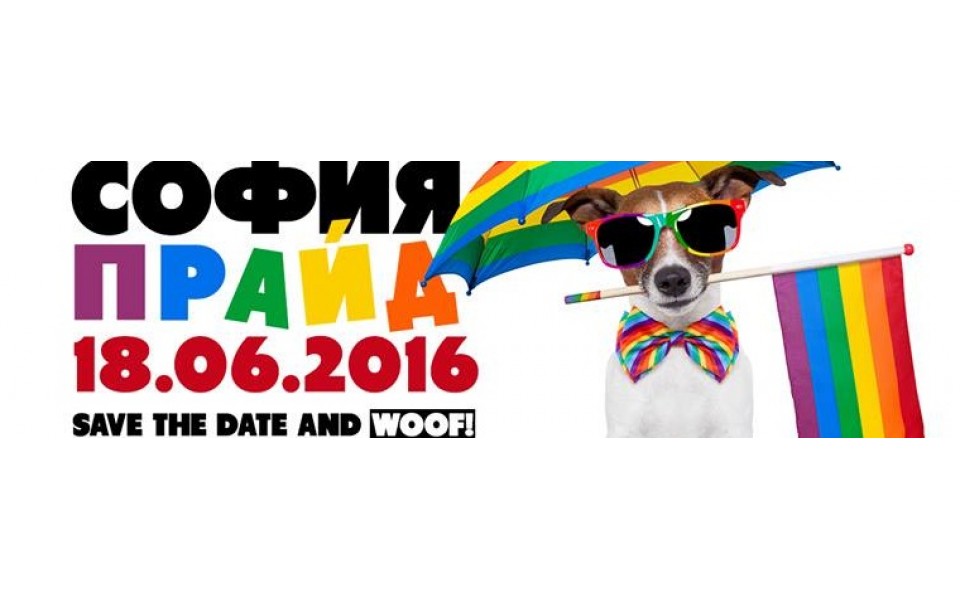
sofia pride-960x600

“We can always call them Bulgarians,” is a quotation attributed by Wilella Waldorf to “Samuel Goldwyn or somebody” in the New York Post, September 17, 1937. (as cited in The origin of “Bulgarian” as a euphemism for sexual minorities.) The euphemism was used in American cinema and theatre when referring to gay and lesbian characters on screen and stage starting in the first half of the 20th century. What made me think of this is my recent trip to Bulgaria. I left Ottawa, bound for Bulgaria, on July 14 and returned on July 25. I met up with my friend Plamen in Sofia, the capital city of Bulgaria, and embarked on a whirlwind tour with him as my guide and interpreter. We had a great time. Bulgaria has a rich history and culture going back to antiquity, and today Bulgaria is a peaceful and prosperous society. During the tour, we did not visit any gay bars or clubs in Bulgaria as it was not on the itinerary; still, in the back of my mind, I wondered what life is like for gay people in Bulgaria. Do gay people live openly in Bulgarian society, or do they remain closeted and if so, why? Continue reading

Today, the degradation of the inner life is symbolized by the fact that the only place sacred from interruption is the private toilet. — Lewis Mumford

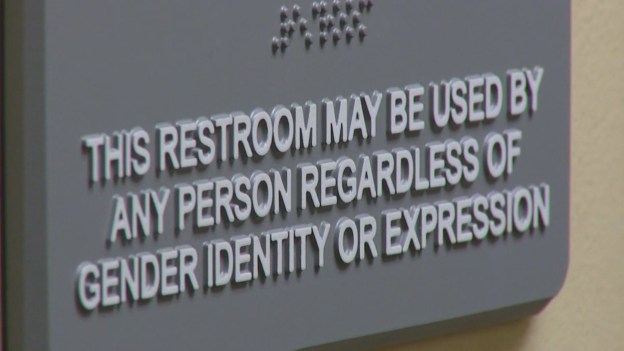
unisex

boys

Using the toilet is a basic human need. Everyone needs to relieve themselves and defecate; these are natural bodily functions. As small children, going to the bathroom is typically a shameless affair. It is not unusual to do your business under the care and supervision of a parent or caregiver at home and in public washrooms. I remember accompanying my mother into public women’s washrooms as a small boy when I had to go. As we grow older, using the bathroom becomes a more private affair. People generally prefer to respond to the call of nature without an audience. This preference was brought home to me the time while serving in the Canadian Army I found myself and my regiment taking part in an exercise at a National Guard camp in Grayling, Michigan. In 1979 at least, the U.S. Army did not concern itself with privacy in the washroom facilities for the lower ranks. The urinal was an open trough, and the “shitters” were in a row in plain view. Pooping in plain sight of your comrades took a little getting used to. Fortunately, with existing etiquette concerning public washrooms, one is generally assured a modicum of privacy. Also, public washrooms are designated for men and women separately. This has long been the norm and quite reasonable, so how did public washroom etiquette become such a hot button issue in recent history? Continue reading

Piety is not a goal but a means to attain through the purest peace of mind the highest culture. — Johann Wolfgang von Goethe (1749-1832)

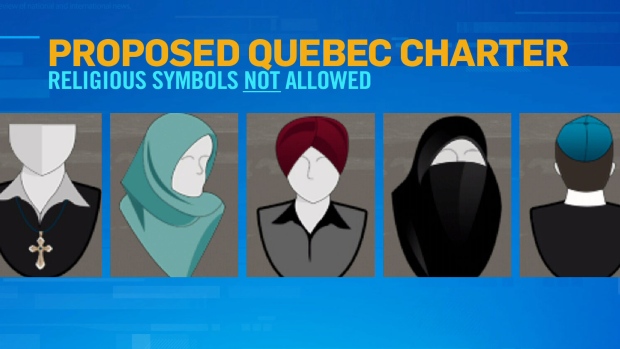
Quebecpiety

Years ago, I remembered while discussing theology with a group of friends, one in the group referred to himself as a pious atheist. I was taken aback by his comment as piety and atheism were not terms I associated with one another. Piety is most commonly associated with religious beliefs and practices. Since then, I gave this notion a great deal of thought: is secular piety a possibility? This question is worth considering in that how one expresses their piety in an increasingly secular society has become a contentious issue of late; as is evidenced by the controversy surrounding the proposed Quebec Charter of Values (Charte de la laïcité or Charte des valeurs québécoises). The stated aim of the charter is to ensure there is a clear separation of religion and state and that public employees have religious neutrality. What this means is wearing ostentatious religious symbols or garb on the job will be prohibited. Continue reading

I think Islam is in a sense, in crisis. It needs to question and re-question itself. — Azar Nafisi

shariaimagesCARN2W12

Criticism of religion is a tender subject. Criticism of Islam, in particular, is especially so as is evidenced by the court battle that threatened to take shape between the National Council of Canadian Muslims (NCCM), Prime Minister Stephen Harper and Jason MacDonald (spokesman for Prime Minister Harper). The NCCM filed a notice of libel in the Ontario Superior Court of Justice over remarks made by Jason MacDonald in dismissing their objection to the inclusion of Rabbi Daniel Korobkin of the Beth Avraham Yosef Synagogue in Toronto as part of the delegation that accompanied Prime Minister Harper on a visit to Israel in January 2014. MacDonald dismissed their objection stating “we will not take seriously criticism from an organization with documented ties to terrorist organization such as Hamas.” (as cited in CTV News) The NCCM objected to the inclusion of Rabbi Korobkin in the delegation accompanying Prime Minister Harper because he hosted speaking engagements featuring Robert Spencer and Pamela Geller, two noted critics of Islam, in September 2013. Continue reading

In the Universal Declaration of Human Rights (December 1948) in most solemn form, the dignity of a person is acknowledged to all human beings; and as a consequence there is proclaimed, as a fundamental right, the right of free movement in search for truth and in the attainment of moral good and of justice, and also the right to a dignified life. — Pope John XXIII, 1881-1963 Pacem in Terris, 1963

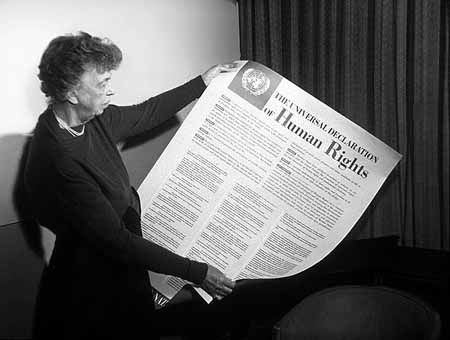
eleanor-rooseveltcairo-1990-declaration

In essays published earlier on this blog the topic of religion in society, particularly the direction the Western world took in gradually establishing a clear separation of religion and state, relegating religion to the sphere of private conscience is discussed. The last remnants of Papal authority in temporal affairs ended with the signing of the Lateran Treaty between the Vatican and the Italian government in 1929. In the present, in the Western world, religious liberty is guaranteed in law and members of religious institutions are free to comment on moral and political issues just as anyone else. In the Islamic world, this distinction between religion and state never emerged, save for the Republic of Turkey which was founded as a secular state in 1923. The Ottoman Caliphate was abolished in 1924. The constitutional, civil and common law legal systems in effect across the Western world are rooted in the theory of natural rights, primarily as espoused by the men of the Enlightenment, such as John Locke and Thomas Paine. By contrast, across the Islamic world, the system of law, sharia, a religiously based moral and legal code applies. The differences in the legal systems and the place of religion in society between the Western world and the Islamic world are quite noticeable in comparing responses to the the Universal Declaration of Human Rights of 1948. Continue reading

“Dignity is not negotiable. Dignity is the honor of the family.” — Vartan Gregorian

shame3shouldnt_real_family_values_value_all_families_tshirt-r9af494bc515f443588ea2190db93cf65_804gs_512

A good friend and hunting buddy of mine, Omer, is an observant Muslim whose family immigrated to Canada from Pakistan. Omer is an educated man as is the rest of his family. He is someone I have known several years and with whom I have enjoyed many in-depth discussions, learning about his faith and the culture in which he grew up before coming to Canada.  He tells me that family honour and shame are taken very seriously by some elements of Pakistani society. The phenomenon of honour killing is a reality for these elements of Pakistani society, particularly in the rural and tribal regions. Family honour is taken so seriously in this culture that if a family member (typically a girl or young woman) brings shame on the family the whole family suffers. They become untouchables; they are deemed unfit to associate with and most certainly are not welcome to marry into other families. The only way family honour can be restored in such a case is in killing the family member who brought the shame onto the family. This understanding of family honour is bound up in religion (Islam) and a culture in which men dominate. He certainly does not approve of this behaviour. He recognizes it as a problem that Pakistani society must address. Continue reading

Conservatives believe in the ties that bind us. Society is stronger when we make vows to each other and we support each other. I don’t support gay marriage in spite of being a conservative. I support gay marriage because I am a conservative. — David Cameron

RainbowLeaves2.jpgConservative_Party_of_Canada-logo-617795D556-seeklogo.com

Mika and I are supporters of the Conservative Party of Canada. While we support the government led by Prime Minister Harper, we do not have membership in the Conservative Party of Canada, nor do we donate money to the Party. Neither do we agree with every position taken by the Conservative government, and where instances of wrongdoing are exposed, we think those responsible should suffer the consequences. You may find it odd that a gay couple identifies as conservative, but we see ourselves moderate centre-right politically in our outlook and values. We value personal liberty, religious liberty (freedom of conscience), intellectual freedom, equality of opportunity and the pursuit of happiness. In our opinion, the Conservative Party of Canada, under the leadership of Prime Minister Stephen Harper, currently best represents these values. Continue reading