Tag Archives: sexual orientation

OH! The good ol’ Hockey game, is the best game you can name. And the best game you can name, is the good ol’ Hockey game. — Stompin Tom Connors

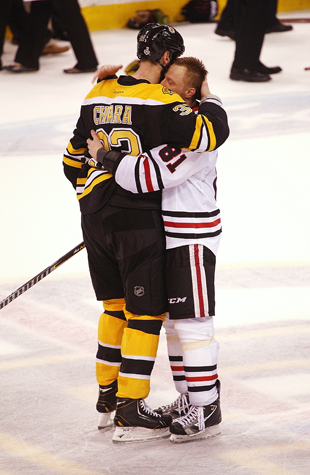
BOSTON, MA – JUNE 24: Zdeno Chara #33 of the Boston Bruins congratulates Marian Hossa #81 of the Chicago Blackhawks on winning the Stanley Cup in Game Six of the Stanley Cup Final at the TD Garden on June 24, 2013 in Boston, Massachusetts. The Blackhawks defeated the Boston Bruins 3-2. (Photo by Gail Oskin/Getty Images)
Ice hockey is a rough-and-tumble sport, whether it is men or women who play. Yes, ice hockey requires a plurality of skills to play. Skating is first and foremost what a successful hockey player needs to master, along with stick handling and teamwork. Hockey is a contact sport. Players wear pads, helmets, and eye protection when they go on the ice. Checking is a part of the game, and sometimes fights break out. When I was in high school, I refereed house league hockey, including girls’ hockey. The girls were as tough as the boys on the ice. I remember hearing the girls calling to their teammates from the bench, “Cream the bitch!” I played house league hockey as a boy. In my last year in the Midget-level (15-17 years old) hockey league, the girls’ team goalie in our village often practiced with us. My brother and one of my sisters played hockey growing up, too. My brother was the athlete in the family. He started in the house league and eventually played in a competitive league and on our high school hockey team. He suffered a fractured collarbone in a game when he played on the high school team. I remember it well as I picked him up at the hospital, where the technician showed me how to tighten the harness he put on my brother to set the fracture. So, yes, ice hockey is a rough-and-tumble sport, and players are sometimes injured. The checking and competition between the opposing teams on the ice is the appeal for the fans. Having watched many amateur hockey games as a spectator and as a referee, I can assure you that the crowd loves it when a player makes a hit on the ice. Watching the crowd’s reaction made me think of what it must have been like in the Roman Coliseum when fans went to watch the gladiatorial games. Elite-level amateur and professional hockey are immensely popular worldwide, and many people, children and adults alike, have fun playing at the house league level.
 
I remember in the 1990s, I was acquainted with a man at the gym where we worked out. He told me that he played in a gay men’s hockey league. I do not know the details of the gay men’s hockey league in Ottawa in the 1990s, but since 2020, Ottawa has had a “queer and trans friendly team,” called Ottawa Pride Hockey. The Ottawa Senators, the NHL team in Ottawa, is among the team’s sponsors. Ottawa Pride Hockey hosts an annual tournament called the Queer Capital Cup. The team’s rules specify, “Overly competitive or aggressive play is not tolerated.” (Ottawa Pride Hockey) Similarly, in Toronto, there is the Toronto Gay Hockey Association, which was founded in 1994. The mission statement states, in part, “To create an LGBTQ+ and allied positive space where people enjoy the game of hockey in an environment free from all forms of harassment or discrimination, which encourages fair play, openness and friendship.” (TGHA) A key feature of the Toronto Gay Hockey Association is that the rules do not allow body checking. So, there are “queer and trans friendly” spaces for those so inclined to play hockey and for any spectators who would watch them play. Somehow, I doubt that most hockey fans would be interested. Furthermore, if they demand that the NHL become “queer and trans friendly” in the manner that Ottawa Pride Hockey and the Toronto Gay Hockey Association play, they are going to be disappointed. No, ice hockey is a rough-and-tumble sport in which body checking is integral. True, in minor hockey, body checking is regulated by age groups, with Hockey Canada stating, “While positioning, angling, stick-checking and body contact is taught in the younger age divisions, full body-checking is not permitted until U15 at most intermediate and competitive levels. Some community (house) leagues will offer a non-body-checking option for all age divisions, including U15 and U18.” (Hockey Canada) The fact remains, however, that hockey is a contact sport, and body checking is a major appeal for the fans.
 
What made me think of this was the release of the Crave series, Heated Rivalry, a story about two professional hockey players, one bisexual and the other gay, who strike up an intimate relationship. The series became an overnight sensation. It has generated discussion and has the approval of the National Hockey League, as a representative for the NHL praised the show as, “The most unique driver for creating new fans.” (New York Times) The success of Heated Rivalry has some people discussing male homosexuality and professional hockey. Currently, there are no known openly gay players in the National Hockey League. There may be closeted players. Personally, I do not see why it matters. There are many thousands of young men who rise through the ranks of competitive junior and minor hockey, dreaming of making it to the NHL. A lucky few succeed. What does their sexual orientation have to do with any of it? Sure, fans are interested in players’ personal lives. I remember watching Hockey Night in Canada on Saturday nights in the early 1970s on the Canadian Broadcasting Corporation (CBC). Sometimes, in the segments between periods, segments featured a look into the players’ personal lives. They were either single or family men. Whether there were any gay players then is anyone’s guess, and, yes, they would have been wise to stay closeted. In the present, I doubt that most hockey fans would care if an NHL player came out as gay. For others, it is important that there is gay representation in professional sports. Again, I think it is irrelevant. The fans are there to watch a hockey game in all its rough-and-tumble glory. All they care about is the players’ skill.
 
Posted by Geoffrey
 

Time makes us sentimental. Perhaps, in the end, it is because of the time that we suffer. — André Aciman

This is what a gay high school boy looked like in 1979.

I like gay romance in print and on film. The positive portrayal of romance and intimacy between two men or high school boys is lovely. Gay youth and men exist and have the same need for love and companionship as the heterosexual majority. Especially given that in Western society, intimacy between men was criminalized for a long time–it was considered “gross indecency” and punishable by imprisonment. Beyond that, public prejudice was prevalent throughout the 20th century. I remember it well. Recently, I met up with a man I knew in high school. We had not seen each other since graduation in 1980. We met through a mutual friend and ex of mine. I had no idea that my high school buddy was gay. We are both in our sixties and retired. I am happily partnered, and he is single. It was good to see him again.

Continue reading

Olivier said that drama is an affair of the heart, or it’s nothing, and he was right. — Pam Gems

Joe Locke and Kit Connor as Charlie and Nick in Heartstopper.

I watched season two of the charming Netflix series Heartstopper. I liked it despite it being aimed at a much younger audience. What drew me to the series was the gay storyline; the romance between the two protagonists, the high school boys Nick and Charlie. The series is a drama, although it pulls its punches. The boys never go past kissing and cuddling in their relationship. Also, Nick is bisexual, and Charlie is gay. It is cute and appealing to its teenage audience. I like that a teenage gay romance is portrayed as a positive thing. Coincidentally, the actors who play Nick and Charlie are, like the characters they play, gay and bisexual. Kit Connor, who plays Nick, declared his bisexuality. Joe Locke, who plays Charlie, is openly gay. That the young actors are gay and bisexual is interesting. It is nice that they are free to be themselves.

Continue reading

I would say that I’m a feminist theorist before I’m a queer theorist or a gay and lesbian theorist. — Judith Butler

The quotation by Judy Rebick at the start of the Wikipedia article on lesbian feminism prompted me, in part, to discuss the detrimental effect of the infiltration of feminism on the gay rights movement. “According to Judy Rebick, a leading Canadian journalist and feminist activist, lesbians were and always have been “the heart of the women’s movement,” while their issues were “invisible” in the same movement.” (Cited in Wikipedia) Rebick is an American ex-pat who lives in Toronto. I could write at great length about her impropriety, but I digress. What I remember about Rebick is what she said in an interview in 1990 regarding feminism. She said, in short, that feminism was dominated and too focused on the interests of middle-class heterosexual white women. It needed to be more inclusive, broaden its scope to include lesbians and non-white women, and take up the cause of gay rights. When I heard that, I was aghast. “Whoa there, Medusa,” I thought, “stay in your own lane! No one asked for your help. Gay men are doing just fine in standing up for their civil rights.” Continue reading

People have gone down this spiral of cancel culture and the idea that everything is offensive. — Bianca Del Rio

Jason and I are good friends and hunting buddies.

Here is a photo of my friend and hunting buddy Jason and me. Jason is a family man and a man’s man; he is happily married and has a six-year-old daughter. Not long after we became hunting buddies some years ago, I told him I am gay. His response was, “and that will affect our hunting how?” Since then, our friendship and hunting partnership flourished. It was under Jason’s guidance I took up whitetail deer hunting. Hitherto, I was first and foremost a gamebird hunter. Upon taking up deer hunting with Jason as my mentor, I took four deer to date, starting in the 2012 season with a nice doe, a nine-point buck in 2016, a spike horn buck in 2017, and an eight-point buck in 2020. As a result, I have a presence online as a gay hunter. I publish a blog, Geoffrey’s Hunting Diary, subtitled “memoirs of a gay huntsman.” In addition, I have a YouTube channel called The Gay Huntsman. Those who view my videos and read my blog posts find the emphasis on hunting and not that I am gay. Yes, Jason gets it; my sexual orientation is irrelevant–it has no bearing on our shared passion for hunting and our friendship. Continue reading

What matters most is not ‘what’ you are, but ‘who’ you are. ― DaShanne Stokes


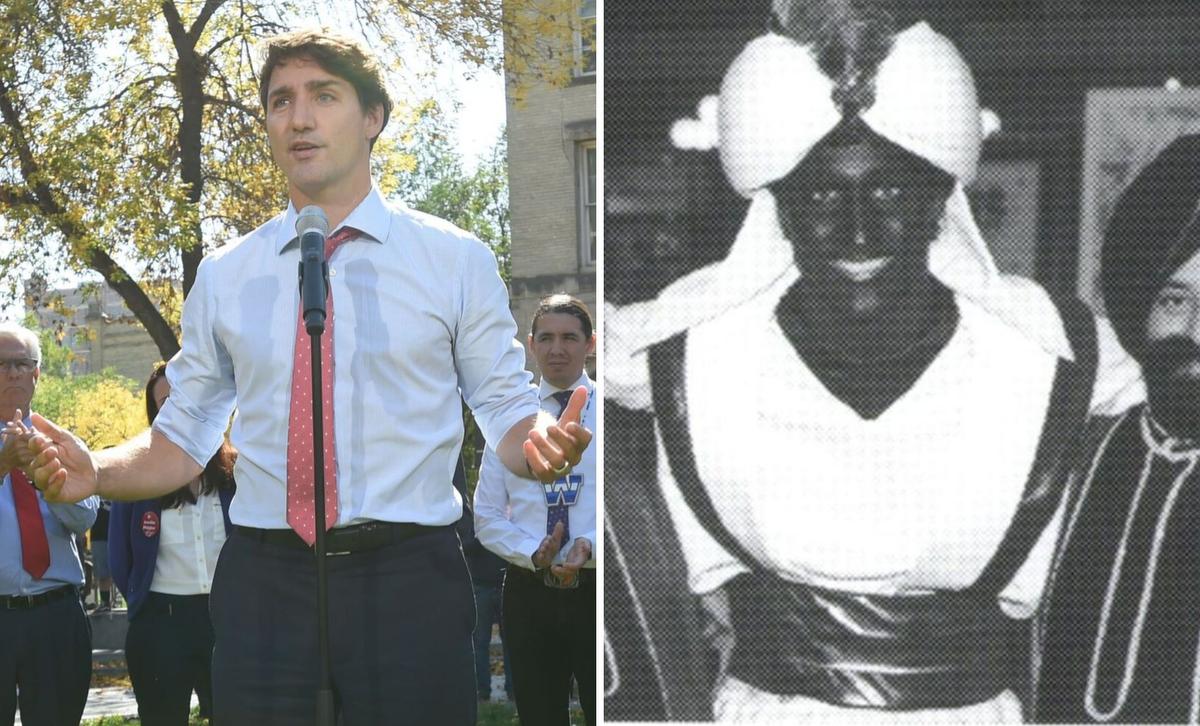
Blackface diptych

The Right Honourable Prime Minister of Canada Justin Trudeau.


A general election is scheduled for Canadians on October 21st. The governing Liberal Party with Justin Trudeau as its frontman seeks re-election. I think it likely the Trudeau Liberals will win re-election, and if so, this is bad news for Canadians. Since taking office in 2015, the Liberal government with the prancing popinjay that is Justin Trudeau consistently sowed division among Canadians. The Liberal government promoted its globalist agenda in pitting Canadians against one another via the imposition of identity politics on Canadians. Yes, the Liberals, with Justin Trudeau as their spokesman, pushed the belief that group identity matters more than individuality and the content of character in each of us as individuals. In doing so, the Liberal government instilled division rather than unity among Canadians since taking office in 2015. In 2019, Canadians are set against each other according to superficial differences such as race, ethnicity, religious affiliation, sex, sexual orientation and the like. Not only that but the Liberal government set a standard of political correctness to which not even the sanctimonious Justin Trudeau can adhere. Continue reading

The Lord is my Shepherd and he knows I’m gay. — Troy Perry

triintylawaustin

The issues of gay rights, religious liberty, and religion in Canada and the United States remain contentious. While the destigmatization of homosexuality is a welcome trend in Canada and the United States, it is by no means a fait accompli. Lawful discrimination on religious grounds against gay people remains an issue, notably in secondary and post-secondary education, as religious institutions operate and have sole proprietorship of their high schools, colleges and universities. The issue of lawful discrimination against gay people on religious grounds and opposition to it from the wider society is highlighted by recent events concerning Trinity Western University in Langley, British Columbia and Lutheran High North (a high school ) in Houston, Texas. Both schools have moral codes founded on their interpretation of Christianity that bar sexual activity outside marriage and between persons of the same sex. The schools stand firm in their opposition to homosexuality in the face of controversy and maintain they are within their rights to do so. In either case, presumably, a gay student is welcome to attend, provided they abide by the respective schools’ moral codes. It is legal in both Canada and the United States, but is it tolerable, and what is the appropriate response for those who take issue with these school policies? Continue reading

We are living at a time when creeds and ideologies vary and clash. But the gospel of human sympathy is universal and eternal. — Samuel Hopkins Adams

whatIsSB1062Hundreds_rally_against_SB1062_in_Flagsta_1360360000_3123610_ver1_0_640_480

Is religious liberty under threat in the United States? This is an interesting question and bears examination. The controversy over the passage of SB 1062 in Arizona and the decision by the Governor, Jan Brewer, to veto the legislation has many people insisting their religious liberty is threatened and determined to stiffen their resistance to this perceived threat. Regarding religious liberty in US society, the National Council of the Churches of Christ in the USA, in 1944 (then Federal Council of Churches of Christ), formed the following definition:

Religious liberty shall be interpreted to include freedom to worship according to conscience and to bring up children in the faith of their parents; freedom for the individual to change his religion; freedom to preach, educate, publish and carry on missionary activities; and freedom to organize with others, and to acquire and hold property, for these purposes. (as cited in Wikipedia)

At present, these are fundamental freedoms guaranteed in US law. Is there any reason to believe they are at risk? Continue reading

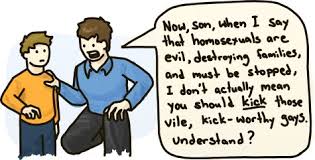
Once again, there will be a chorus screaming “special rights” when the subject of gay bashing being punished as a hate crime arises. But near as anybody can tell, the opportunity to be threatened, humiliated and to live in fear of being beaten to death is the only “special right” our culture bestows on homosexuals. — Diane Carman

bash1bash

Is gay bashing a hate crime? Does it merit prosecution and punishment as a hate crime? The murder of Matthew Shepard, a 21-year-old student at the University of Wyoming, in 1998 ignited the debate over these questions when it was alleged his assailants, Aaron McKinney and Russell Henderson, targeted him because he was gay. In the course of the court proceedings against Aaron McKinney in November 1999, Prosecutor Calvin Rerucha stated:

The two had led Shepard to believe they were gay. Matthew, believing they wanted to discuss the politics and struggle of the gay movement, followed McKinney and Henderson into their truck. After getting in the truck, Henderson said “McKinney pulled out a gun and told Matthew Shepard to give him his wallet.” McKinney said “Guess what. We’re not gay. And you’re gonna get jacked.” When Matthew refused, McKinney hit him with the gun. With Henderson behind the wheel, they drove more than a mile outside Laramie, as Matthew begged for his life, McKinney struck him while Henderson laughed. “He (McKinney) told me to get a rope out of the truck,” Henderson said. According to Henderson, McKinney allegedly tied Shepard’s beaten body to a wooden split-rail post fence, robbed him of his wallet and patent leather shoes, continued to beat him and then left him to die for over 18 hours bleed profusely in near freezing temperatures “with only the constant Wyoming wind as his companion.” (as cited in Matthew Shepard)

His assailants pistol-whipped him so severely that he suffered fractures to the back of his head and in front of his right ear. He experienced severe brainstem damage, which affected his body’s ability to regulate heart rate, body temperature, and other vital functions. There were also about a dozen minor lacerations around his head, face, and neck. His injuries were too severe for doctors to operate. He never regained consciousness, succumbing to his injuries at 12:53 a.m. on October 12, 1998, at Poudre Valley Hospital in Fort Collins, Colorado.

I remember being horrified when hearing news reports of Matthew Shepard’s murder. Aaron McKinney and Russell Henderson were tried separately on charges of kidnapping and murder, convicted on both counts and handed life sentences for both crimes to be served consecutively. They will die in prison. In the aftermath of their son’s murder, Dennis and Judy Shepard established the Matthew Shepard Foundation. Its stated aim is “… to honour Matthew in a manner that was appropriate to his dreams, beliefs, and aspirations, the Foundation seeks to “Replace Hate with Understanding, Compassion, & Acceptance” through its varied educational, outreach and, advocacy programs and by continuing to tell Matthew’s story.” Also, Judy Shepard joined in the campaign for the inclusion of sexual orientation in hate crimes laws in the United States. It was a tough fight, but she prevailed when, on October 28, 2009, President Obama signed the Matthew Shepard Act into law.

Opposition to the campaign for the inclusion of sexual orientation in hate crimes laws in the United States was tenacious. It came from the ranks of religious and social conservative interests such as James Dobson, founder of Focus on the Family. Dobson holds the belief that homosexuality is either a lifestyle choice or a mental disorder that afflicts a minuscule percentage of the population. Therefore, gay people are not a legitimate minority, and to include sexual orientation in hate crimes laws gives gay people “special rights.” These “special rights,” according to James Dobson, include:

universal acceptance of the gay lifestyle, discrediting of scriptures that condemn homosexuality, muzzling of the clergy and Christian media, granting of special privileges and rights in the law, overturning laws prohibiting pedophilia, indoctrinating children and future generations through public education, and securing all the legal benefits of marriage for any two or more people who claim to have homosexual tendencies.

That James Dobson and like-minded people hold such egregious thoughts and beliefs about homosexuality is disappointing to me personally and not very helpful for gay people from families who subscribe to these beliefs. Still, I find satisfaction that US society is moving forward despite this opposition. Attitudes toward gay people are changing in the United States, with the opinion of the majority favouring acceptance, as polls listed by the American Enterprise Institute in March 2013 indicate. Earlier this month (May 2013), the states of Delaware, Minnesota and Rhode Island enacted legislation that gives same-sex couples the right to marry, joining the states of Connecticut, Iowa, Maine, Maryland, Massachusetts, New Hampshire, New York, Vermont and Washington, plus the District of Columbia that allow same-sex marriage. The Supreme Court of the United States (SCOTUS) is expected to hand down a judgement in June (2013) on the legality of the 1996 Defense of Marriage Act, which defines marriage as a union between a male and a female for federal purposes and California’s Proposition 8, a 2008 voter initiative that narrowly overturned the state’s Supreme Court ruling that granted gays and lesbians the right to marry. It is anyone’s guess as to how the SCOTUS will rule on these cases, but whatever the outcome, the movement toward marriage equality will move forward.

While this is all very encouraging, there was an incident in New York City where a gay couple, Nick Porto and Kevin Atkins, were attacked and beaten in broad daylight on May 5, 2013. The beating took place in plain view of passersby and serves as a sobering reminder there are still elements of US society who think it just fine to harass and assault gay people or people they perceive to be gay. The New York City Police Department is investigating the crime and searching for the assailants and has released surveillance photos of one of the men suspected to have taken part. Whether or not this proves to have been a hate crime is up to the courts to decide, but this incident brings home the reality to gay people that this remains a possibility wherever they choose to live. The fact that this attack took place in broad daylight in the middle of New York City in front of people who stood by and did nothing but photographs and videos of the attack is frightening. Still, I do not think there is any need for panic. I am confident that most people are duly horrified and disgusted with this crime and want to see that justice is served. I hope, also, that the wider heterosexual society will more fully appreciate the fact that gay people still face discrimination and, in extreme cases, outright hatred, which does, sometimes, manifest itself in gay bashing.

Posted by Geoffrey