Tag Archives: United States

Reason obeys itself, and ignorance submits to whatever is dictated to it. — Thomas Paine

Those of us across the world who are working to end the involuntary genital cutting of boys are at an impasse. We have demonstrated beyond any doubt that intact genitals are as nature intended and debunked the claims that the male prepuce was a vestigial piece of skin that served no purpose. Despite that, cowardly politicians insist their hands are tied because they cannot breach the rights to religious liberty and parental autonomy over their children’s bodies. At least not when boys are at issue. They had no trouble enacting prohibitions on all forms of genital alteration on girls, no matter how minimal, despite the religious sensibilities and autonomy of parents to raise their daughters how they saw fit. Western nations lead an international effort through the United Nations to end female genital mutilation. When Iceland, a European country with a population of 340,000 people, moved to update its legislation in 2018, prohibiting involuntary genital cutting of girls to include boys, the United States intervened. The US House of Representatives Foreign Affairs Committee, in a letter sent to the Embassy of Iceland, Congressmen Ed Royce, the Republican chairman of the committee, and Eliot Engel, its top Democrat, wrote: “While Jewish and Muslim populations in Iceland may be small, your country’s ban could be exploited by those who stoke xenophobia [read anti-Muslim prejudice] and anti-Semitism in countries with more diverse populations.[…] As a partner nation, we urge your government to stop this intolerant bill from advancing any further.” (Times of Israel.) The Amendment to the legislation did not pass.
 
The thing to remember, also, is that in Iceland and the rest of Europe, the majority of the population does not cut the genitals of boys and girls involuntarily–which might make people think that a ban is moot. Still, one wonders why the ban on cutting girls is not viewed as something that “could be exploited by those who stoke xenophobia” [read anti-Muslim attitudes] in countries with more diverse populations.” Somehow, that only applies if you make the ban on involuntary genital cutting universal by including boys, and that is irrational. Despite these hurdles, the effort to protect boys continues — no one said it was easy. There is an interesting development in the recent controversy over “gender-affirming care” for minors. The issues of religious liberty and parental autonomy are back at the fore in the dispute over the ethics and legality of subjecting children to surgeries and drug therapies that result in the chemical and surgical castration of children whose parents believe they were of the opposite sex into which they were born. The Supreme Court of the United States ruled that a Tennessee law that prohibits gender-affirming care for minors is constitutional. The challenge to the law was based on the 14th Amendment, with arguments that the ban was discriminatory based on sex and violated the laws and the rights of parents to make medical decisions for their children, following their beliefs. The court did not consider the latter arguments in reaching its decision.
 
Given this development, one wonders how scurvy politicians will justify the involuntary genital cutting of boys based on the superstitions and wants of their parents. Why is it not tolerable to alter a girl’s private parts or allow parents to authorize sex changes on their children regardless of their beliefs, but it is bearable to allow radical and irreversible alterations to a boy’s genitals for no other reason than someone else wants it? Why is the notion that boys have rights, particularly to the integrity and security of their person, so contentious? I am cautiously optimistic that the Supreme Court ruling that upheld a ban on gender-affirming care for minors will cause renewed attention to the ethical and legal issues of the involuntary genital cutting of boys. I hope that the Icelandic parliament will reintroduce its legislation to protect boys and girls alike from involuntary genital cutting and that other Western jurisdictions will follow suit. This invidious state of affairs has gone on too long.
 
Posted by Geoffrey

The sad truth is that most evil is done by people who never make up their minds to be good or evil. — Hanna Arendt

Hannah Arendt developed the concept of the banality of evil: “Evil comes from a failure to think. It defies thought for as soon as thought tries to engage itself with evil and examine the premises and principles from which it originates, it is frustrated because it finds nothing there. That is the banality of evil.” I am reminded of this when I note the dismay of Intactivists when Facebook posts pop up where a newborn boy is subject to involuntary genital cutting for any reason or no reason. I also note the angry reactions of the parents who do not care for the criticism or condemnation for doing this to their newborn sons. Yes, there is no shortage of people who see nothing wrong with it and will tell you to mind your own business. That and they retort, “Don’t choose it for your son if that’s how you feel!” I watch with interest as Eric Clopper, Attorney at Law and Founder & President of Intact Global, mounts a constitutional challenge in Oregon for the protection of boys from involuntary genital cutting. I stand with him and hope for the best as he and his team of lawyers proceed with the challenge. The challenge is based on the constitutional guarantee of legal equal protection. As the involuntary genital cutting of girls is prohibited in US law (in several states, not federally), the reasoning is that boys deserve equal protection. Though I am neither a lawyer nor a legal scholar, as a well-informed layman, I expect the challenge will be an uphill battle.

Continue reading

Olivier said that drama is an affair of the heart, or it’s nothing, and he was right. — Pam Gems

Joe Locke and Kit Connor as Charlie and Nick in Heartstopper.

I watched season two of the charming Netflix series Heartstopper. I liked it despite it being aimed at a much younger audience. What drew me to the series was the gay storyline; the romance between the two protagonists, the high school boys Nick and Charlie. The series is a drama, although it pulls its punches. The boys never go past kissing and cuddling in their relationship. Also, Nick is bisexual, and Charlie is gay. It is cute and appealing to its teenage audience. I like that a teenage gay romance is portrayed as a positive thing. Coincidentally, the actors who play Nick and Charlie are, like the characters they play, gay and bisexual. Kit Connor, who plays Nick, declared his bisexuality. Joe Locke, who plays Charlie, is openly gay. That the young actors are gay and bisexual is interesting. It is nice that they are free to be themselves.

Continue reading

The counterculture is always repackaged and made into a product. It’s part of America. — Jim Jarmusch

queer-theory-6-638

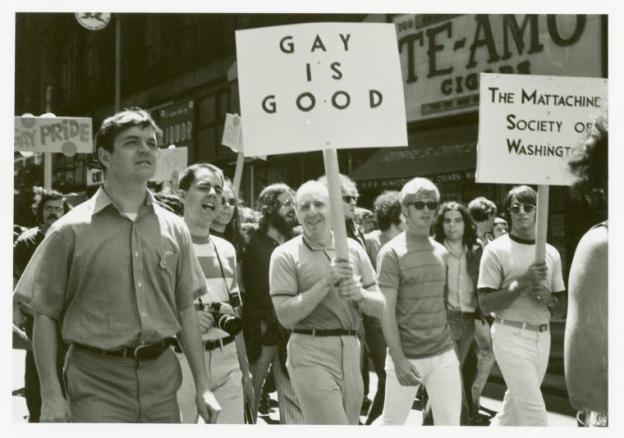
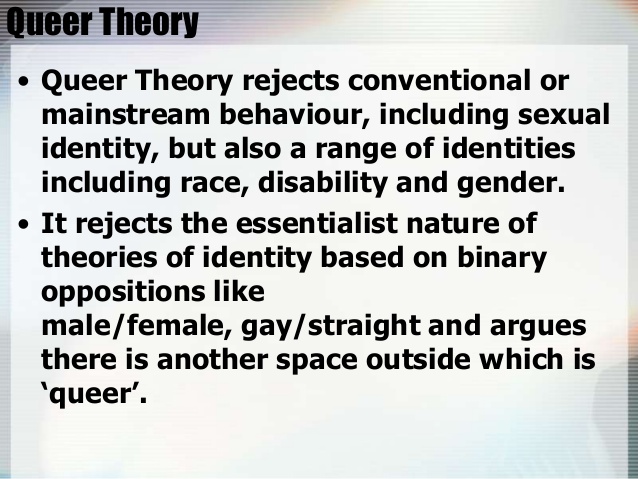
The history of the gay rights movement in the United States is fascinating. Is it a civil rights movement or is it a social justice movement? Is gay a demographic or is gay a community? Are gay rights the drive for civil rights, that gay people be at liberty, as individuals, to participate in society, openly, and free from persecution? Is it a social justice movement, the gay community driven by a countercultural constituency, intent on separating itself from mainstream culture? The answer to these questions is the gay rights movement in the United States is a combination of the two perspectives. To date, the successes of the gay rights movement in the United States are laudable. The repeal of laws that criminalized homosexual sex is a significant gain. Gay people live openly and are free to marry. True, elements of anti-gay prejudice linger, mainly from the ranks of the religious and socially conservative; moreover, there is only a patchwork of laws in place across the 50 states that prohibit discrimination in employment on the grounds of sexual orientation. However, I think these are the least of the worries for the gay rights movement in the United States. While both perspectives, civil rights and social justice, contributed to the success of the gay rights movement; what most concerns me about the current state of the gay rights movement in the United States is the influence of a decidedly countercultural constituency of U.S. society on the gay rights movement. In my opinion, this only undermines the successes of the gay rights movement in the United States and hinders its progress as a civil rights movement. Continue reading

Today, the degradation of the inner life is symbolized by the fact that the only place sacred from interruption is the private toilet. — Lewis Mumford

unisex

boys

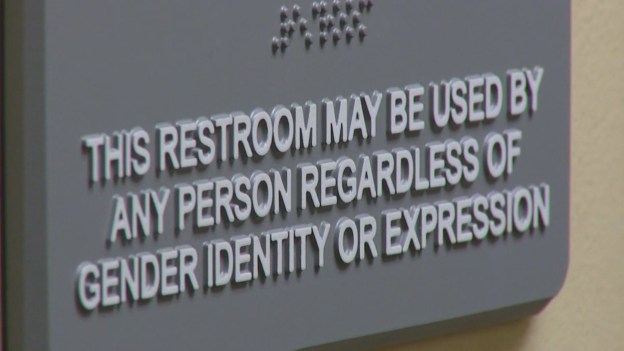
Using the toilet is a basic human need. Everyone needs to relieve themselves and defecate; these are natural bodily functions. As small children, going to the bathroom is typically a shameless affair. It is not unusual to do your business under the care and supervision of a parent or caregiver at home and in public washrooms. I remember accompanying my mother into public women’s washrooms as a small boy when I had to go. As we grow older, using the bathroom becomes a more private affair. People generally prefer to respond to the call of nature without an audience. This preference was brought home to me the time while serving in the Canadian Army I found myself and my regiment taking part in an exercise at a National Guard camp in Grayling, Michigan. In 1979 at least, the U.S. Army did not concern itself with privacy in the washroom facilities for the lower ranks. The urinal was an open trough, and the “shitters” were in a row in plain view. Pooping in plain sight of your comrades took a little getting used to. Fortunately, with existing etiquette concerning public washrooms, one is generally assured a modicum of privacy. Also, public washrooms are designated for men and women separately. This has long been the norm and quite reasonable, so how did public washroom etiquette become such a hot button issue in recent history? Continue reading

Indiana wants me, Lord, I can’t go back there. — R. Dean Taylor

religious-freedom2religious-freedom-bill-gen-con

Indiana is a state situated in the mid-western United States and is well-known across the rest of the United States and much of the world for the Indianapolis 500-Mile Race, one of the most prestigious motor sports races in the world. This week, however, Indiana finds itself in the spotlight because of the passage of SB 101 the Religious Freedom Restoration Act into law. Governor Mike Pence signed the bill into law on March 26, 2015, and the law went into effect on July 1, 2015. The legislation is necessary, as supporters of the bill such as Eric Miller of  Advance America asserted because, “it is vitally important to protect religious freedom in Indiana […] to help protect churches, Christian businesses, and individuals from those who want to punish them because of their Biblical beliefs!” (Victory at the State House) Those in opposition to the legislation such as Democratic Party Senate Minority Leader Tim Lanane fear the legislation allows for discrimination on religious grounds. As Senator Lanane stated, it is “extremely disappointing that Governor Pence endorses this out-of-touch, discriminatory legislation. Not only is this law unnecessary, it, unfortunately, has already portrayed our state as intolerant, unfriendly, and backwards; things which I believe most Hoosiers reject.” (as cited in the Indy Star) Governor Pence disagrees, stating “this bill is not about discrimination and if I thought it legalized discrimination I would have vetoed it.” (as cited in the Indy Star) Is religious freedom threatened in Indiana and does this legislation intended to safeguard religious freedom allow for legal discrimination on religious grounds? These questions merit further discussion. Continue reading

There is hardly a political question in the United States which does not sooner or later turn into a judicial one. — Alexis de Tocqueville

WALLACERoy-Moore-Quote-Seperation-of-church-and-state

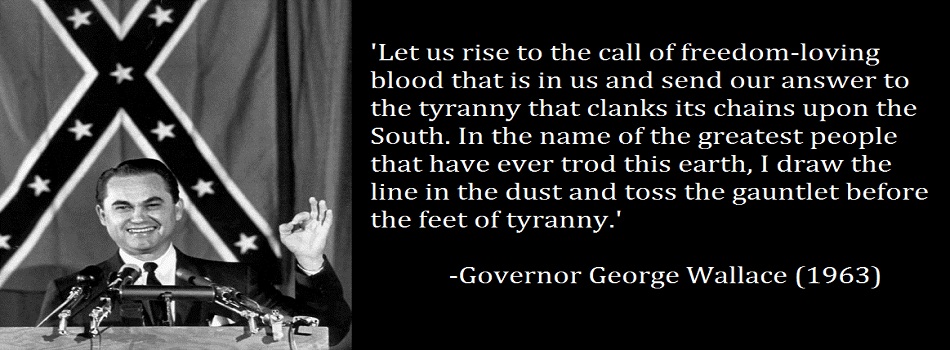
Despite gains in the movement for marriage equality in the United States, such as the repeal of the Defense of Marriage Act (DOMA) and Proposition 8 by the Supreme Court of the United States in 2013 and the repeal of Amendment 1 in North Carolina by a U.S. District Court in 2014, resistance rooted in cynical appeals to populism and the tyranny of the majority rears its head in Alabama. This is manifest in the looming showdown between Judge Roy Moore of the Alabama Supreme Court and the Supreme Court of the United States (SCOTUS) following the repeal of the Alabama Sanctity of Marriage Amendment, in a ruling handed down by Justice Callie V. Granade  of the United States District Court for the Southern District of Alabama on January 23, 2015. This is not unlike the showdown that took place between Governor George C. Wallace and President John F. Kennedy in 1963 when Governor Wallace defied the SCOTUS ruling in Brown v. Board of Education, handed down in 1954 that declared segregation unconstitutional. In both cases, support for segregation and for a ban on same sex marriage was overwhelming and Wallace and Moore insisted their respective stands on the issues was justified in that they represented the opinion of the majority of voters in Alabama. Continue reading

The Lord is my Shepherd and he knows I’m gay. — Troy Perry

triintylawaustin

The issues of gay rights, religious liberty, and religion in Canada and the United States remain contentious. While the destigmatization of homosexuality is a welcome trend in Canada and the United States, it is by no means a fait accompli. Lawful discrimination on religious grounds against gay people remains an issue, notably in secondary and post-secondary education, as religious institutions operate and have sole proprietorship of their high schools, colleges and universities. The issue of lawful discrimination against gay people on religious grounds and opposition to it from the wider society is highlighted by recent events concerning Trinity Western University in Langley, British Columbia and Lutheran High North (a high school ) in Houston, Texas. Both schools have moral codes founded on their interpretation of Christianity that bar sexual activity outside marriage and between persons of the same sex. The schools stand firm in their opposition to homosexuality in the face of controversy and maintain they are within their rights to do so. In either case, presumably, a gay student is welcome to attend, provided they abide by the respective schools’ moral codes. It is legal in both Canada and the United States, but is it tolerable, and what is the appropriate response for those who take issue with these school policies? Continue reading

Politics is just like show business. You have a hell of an opening, coast for a while, and then have a hell of a close. — Ronald Reagan

mcpherson_ormiston200-ab72c2b3f36c4abd5f445045134658a87b6914f9-s800-c15anitasarkeesian1

There’s no business like show business, least of all in the United States. Americans love celebrity, flamboyance, sensationalism and showmanship whether it is in the entertainment industry, politics, business, journalism or religion. I am reminded of this in looking at the careers of  Aimee Semple McPherson and Anita Sarkeesian, two women from Canada, who found fame and fortune in the United States by means of shameless self-promotion, partnership with men endowed with shrewd business acumen, and through a masterful use of electronic media to broadcast their simplified and sensationalized messages to a wide and receptive audience. How they differ is that Aimee Semple McPherson found fame as a prominent Pentecostal evangelist in the first half of the 20th century; whereas, Anita Sarkeesian thrives in the present, promoting herself as a “pop culture critic.” Sarkeesian’s message is aimed at people who subscribe to the temporal ideologies of feminism and social justice. Despite these differences, if you look closely at the career of Aimee Semple McPherson and compare it to that of Anita Sarkeesian you will notice there are striking similarities, particularly as to the question of the character of both Aimee Semple McPherson and Anita Sarkeesian. Continue reading

At 93, I never thought we would have to debate the definition of marriage — Billy Graham

ThomasMoreCarolina

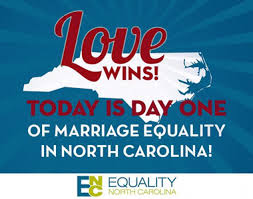
Religion and the definition of marriage remain intertwined in the present, just as in the past. Historically, disputes over the definition of marriage concerned marriage, divorce and remarriage. Dispute over these issues in the court of King Henry VIII of England in the 16th century caused upheaval in the Church and English society. Heads rolled, literally, in the process. In the present, there is an ongoing dispute over the definition of marriage or the redefinition of marriage to allow same sex couples to marry. As I view the movement for same sex marriage, defined as marriage equality, in the United States, North Carolina is a focal point. Amendment 1 to the state constitution, enacted in 2012 following a ballot measure, defined marriage as the union of one man to one woman. Amendment 1 was struck down on October 10, 2014 by U.S. District Court Judge Max O. Cogburn, Jr.  It is now lawful for same sex couples to marry in North Carolina, much to the dismay of opponents of marriage equality, including Charles L. Worley and Billy Graham, who object on religious grounds. Heads are rolling, though not literally, in North Carolina now that Amendment 1 is no longer in force. Continue reading