Category Archives: History

I really feel like knife skills – not just in the kitchen, but in life – are really critical. — Timothy Ferriss

knifeNP0130-ASa (12).jpg

Humans have survived and become the dominant species on Earth as they are living, intelligent beings who apply their ingenuity in making and using tools. From the Stone Age on, humans fashioned an array of tools, of which blades were and are a primary implement. In the Stone Age, there were individuals who mastered the craft of knapping flint to form knives, spears and arrowheads for hunting and butchering game. In time, humans mastered metallurgy, fashioning knives, swords, spears and arrowheads first from bronze and finally iron. In ancient Mesoamerica, Mayans, Aztecs, Incas, fashioned blades from obsidian. In the present day, knives are mostly made from a blend of carbon steel and stainless steel. Knives are a common household item found in the kitchens in every home. Together with their use as common household items, knives are still used for hunting and warfare. With a sharp edge and pointed tip, the knife has to be handled with care. It can inflict a nasty wound if handled carelessly or with malice. Continue reading

No studies have been done to link gun legislation to declining firearms-related deaths, but you can draw your own conclusions. — Heidi Rathjen

liberalprohibition

I try to tune out the white noise that is generated by assorted gun prohibitionists as I learned there is nothing to gain in engaging in futile quarrels with them. Certainly, it bothers me when they spout their nonsensical assertions and point their fingers at hunters, sport shooters and collectors, spewing vitriol and denouncing them as the enemies of humankind. I always knew there were people who disapproved of gun ownership and hunting, but thought of it as their problem. If you do not like guns, do not keep them and if you disapprove of hunting, do not go hunting and if you are a landowner, you are free to post your property against hunting. If only it were that simple. In reality, however, Canada’s gun owners find themselves in a very precarious position. Beginning with the passage of the Criminal Law Amendment Act, 1968-69 (S.C. 1968-69, c. 38) in 1969, continuing with amendments to the Criminal Code of Canada, Bill C-51 in 1978, Bill C-17 in 1991 and Bill C-68 in 1995, Canada’s gun owners are now saddled with the Canadian Firearms Act. In the span of 26 years, Canada’s gun owners have seen their freedoms to own and use their property for lawful and safe past-times such as hunting and sport shooting, drastically curtailed and the character of the gun owner defamed brazenly by an array of public and non-governmental associations. Continue reading

“If the Liberal leader wants my guns, Mr. Speaker, he can pry them from my cold, dead hands.” — Blaine Calkins

EagleEddie imagesRW913JBA

Continue reading

Security is the mother of danger and the grandmother of destruction — Thomas Fuller

japannotMontague_Placard

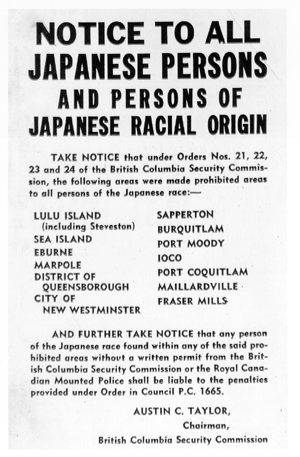
The Canadian Firearms Program, a component of the Canadian Firearms Act, a stupid law, drafted by the Liberal government led by Prime Minister Jean Chretien and enacted in 1995, burdens peaceful and law-abiding hunters, sport shooters and gun collectors with oppressive regulations. Moreover, it enables belligerent and defiant bureaucrats in the Royal Canadian Mounted Police (RCMP) to arbitrarily order the prohibition and confiscation of legally acquired and owned firearms. The decision to proceed with this policy was rooted in the moral panic that arose following the mass murder of fourteen women at an engineering school in Montreal in 1989. Moral panic is defined as “an intense feeling expressed in a population about an issue that appears to threaten the social order.” (Jones, M, and E. Jones as cited in Wikipedia)  Following this tragedy, Canadian gun owners were singled out as a menace to the social order. This was not the first time in Canadian history that a federal government responded to a moral panic in pushing forward with stupid legislation, against the counsel of advisors from within its ranks. A stupid law that resulted in the oppressive regulation and confiscation of property from a segment of the population in Canadian society who were unjustly deemed to threaten the social order. Continue reading

The bedfellows politics made are never strange. It only seems that way to those who have not watched the courtship. — Marcel Achard

Mathison-ElectropsychometerHgh-River-RCMP-Gun-Seizures

The following comment was posted as a response to my recent post on the current state of firearms laws in Canada.

I think male homosexuality repellent, and therefore do not follow those issues closely. Because I am a genuine (which is to say, 19th century, tolerant, John-Stuart-Mill-type liberal) I believe that things which are none of my business are, you know, none of my business: You do not need, nor would receive, my approval, much less “celebration” for whatever passes for your lifestyle choice. But whatever consenting adults want to do that does not harm or threaten others is NONE OF MY BUSINESS. It is most certainly none of government’s business, and I believed that, and supported homosexual rights, from the times when homosexuality was an imprisonable felony in Canada.
I am heartened to see therefore, that with your lifestyle, you account responsible arms ownership on the list of things that are None Of Government’s Business.
When the government wants to prosecute those who harm or threaten others, they have my entire support. When they want to persecute those whose lifestyle choices are contrary to contemporary fashion, the resistance, subversion, and defiance are called for.

Continue reading

The Firearms Act is about licensing and registration, not confiscation. — Former Justice Minister Anne McLellan, July 31, 1998.

gun-typescdn_flag_bg

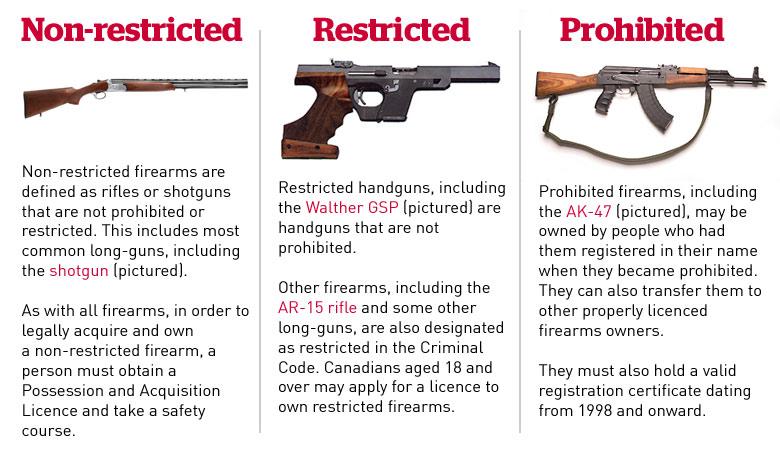
I bought my first gun in a private sale, back in 1977 when I was sixteen. As it happens, 1977 was a turning point in the regulatory framework for gun owners in Canada; it was the last of the good old days for gun owners in Canada. The familiar classification system for firearms was in effect (non restricted, restricted and prohibited). This was enacted in 1969 with the passage of Criminal Law Amendment Act, 1968-69 (S.C. 1968-69, c. 38), which, coincidentally, also decriminalized homosexuality. In 1977 it was unlawful to sell guns to individuals of unsound mind or those under prohibition orders, otherwise Canadians were free to own and use guns for hunting, sport shooting and collecting without having the state on their back. As the Minister Justice, Pierre Elliott Trudeau, observed in shepherding the Criminal Law Amendment Act, 1968-69 through parliament, “obviously, the state’s responsibility should be to legislate rules for a well-ordered society. It has no right or duty to creep into the bedrooms of the nation.” (as cited in Wikipedia) In 1977, just as the state had no business in bedrooms of the nation, neither did the state have any business in the basements and gun cabinets of the nation.

Continue reading

We are living at a time when creeds and ideologies vary and clash. But the gospel of human sympathy is universal and eternal. — Samuel Hopkins Adams

whatIsSB1062Hundreds_rally_against_SB1062_in_Flagsta_1360360000_3123610_ver1_0_640_480

Is religious liberty under threat in the United States? This is an interesting question and bears examination. The controversy over the passage of SB 1062 in Arizona and the decision by the Governor, Jan Brewer, to veto the legislation has many people insisting their religious liberty is threatened and determined to stiffen their resistance to this perceived threat. Regarding religious liberty in US society, the National Council of the Churches of Christ in the USA, in 1944 (then Federal Council of Churches of Christ), formed the following definition:

Religious liberty shall be interpreted to include freedom to worship according to conscience and to bring up children in the faith of their parents; freedom for the individual to change his religion; freedom to preach, educate, publish and carry on missionary activities; and freedom to organize with others, and to acquire and hold property, for these purposes. (as cited in Wikipedia)

At present, these are fundamental freedoms guaranteed in US law. Is there any reason to believe they are at risk? Continue reading

A hallucination is a fact, not an error; what is erroneous is a judgment based upon it. — Bertrand Russell

Fran_alanjpgGender-Gap

Gender neutrality or gender-neutralism or the gender neutrality movement is a topic that keeps cropping up in discussions across the blogosphere. These terms describe “the idea that policies, language, and other social institutions should avoid distinguishing roles according to people’s sex or gender, to avoid discrimination arising from the impression that there are social roles for which one gender is more suited than the other.” (Wikipedia) At face value, this looks quite reasonable. Historically, the division of labour in the Western world was based on sex. Men worked outside the home and were mobilized in times of war to fight; whereas, women worked in the home and acted as a reserve labour force when the men were away fighting in wartime. In the present, men and women work alongside one another in the labour force and the military. Sex or gender-based segregation is mostly a thing of the past, but for a very long time, it was a reality. Some occupations and past-times were denied to women because they were deemed unsuitable for women. Continue reading

Piety is not a goal but a means to attain through the purest peace of mind the highest culture. — Johann Wolfgang von Goethe (1749-1832)

Quebecpiety

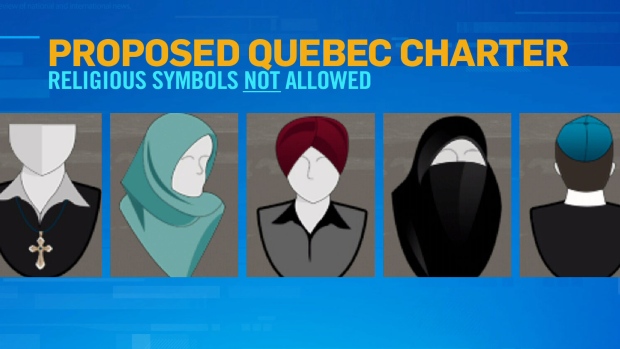
Years ago, I remembered while discussing theology with a group of friends, one in the group referred to himself as a pious atheist. I was taken aback by his comment as piety and atheism were not terms I associated with one another. Piety is most commonly associated with religious beliefs and practices. Since then, I gave this notion a great deal of thought: is secular piety a possibility? This question is worth considering in that how one expresses their piety in an increasingly secular society has become a contentious issue of late; as is evidenced by the controversy surrounding the proposed Quebec Charter of Values (Charte de la laïcité or Charte des valeurs québécoises). The stated aim of the charter is to ensure there is a clear separation of religion and state and that public employees have religious neutrality. What this means is wearing ostentatious religious symbols or garb on the job will be prohibited. Continue reading

Apologies for the White Privilege. I can’t help it. ― T.J. Bowes

meme-privilegewhite-privilege

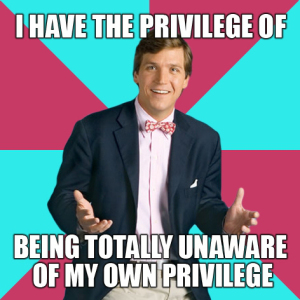
It is Christmas morning and I am just in from a morning dog run with my friend and hunting buddy, Jason Quinn, his dog Nos and my dog Hera. As I was driving home, I started thinking about a concept I see used quite liberally in discussions over the blogosphere, namely, white privilege. The term, white privilege, is defined as follows:

the set of societal privileges that white people benefit from beyond those commonly experienced by people of color in the same social, political, or economic spaces (nation, community, workplace, income, etc.). The term denotes both obvious and less obvious unspoken advantages that white individuals may not recognize they have, which distinguishes it from overt bias or prejudice […] It can be compared and/or combined with the concept of male privilege. (Wikipedia)

As a white man from a family with solid working class roots, I can honestly say I never stopped to think about the fact that I have a white skin or that in having a white skin somehow endows with me with privileges that are denied those with a different skin colour. Continue reading