Despite Rowling’s proposition being a non sequitur, she is correct that “woman is not an idea in a man’s head.” The majority of men, rational men at least, know that the definition of a woman is an adult human female. The definition of a woman she refers to in her topsy-turvy proposition is that of feminists who subscribe to queer theory and their half-baked metaphysics that spawned gender identity and expression. The belief that people have gendered souls is a feminist invention made into a sacred cow by the Woke with their triune doctrine of Equity, Diversity and Inclusion (more aptly known as Division, Iniquity and Exclusion). Yes, it was queer feminists such as Judith Butler and barbara findlay (she insists on spelling her name without capital letters) who fashioned gender identity and expression.
A recurring theme in ancient Greek mythology is that you cannot outrun your fate. I think about that idea when I look back on my life and how, throughout it, people assumed that I was a homosexual. In grade school, a woman who lived across the street from my family was hired by my parents to prepare lunch for my siblings and me when we came home from school. I recall how she said that I would end up a confirmed bachelor. A confirmed bachelor was code for a homosexual historically. In middle school, I had a fleeting romance with a girl. When my seventh-grade teacher learned of our liaison, she expressed surprise; she never imagined me being interested in girls. In high school, I asked my brother if he would sound out a girl I fancied to see if she was interested in me. He reported that when the girl realized what he was up to, she retorted, “He’s a fairy!” When I joined the Canadian Army as a Reservist at eighteen, I entered the classroom one day at the Armoury and found a caricature of me as a pink bunny drawn on the blackboard captioned with anti-gay slurs. To their credit, the other recruits told me it was intended as a joke–that they liked me. Still, I wondered why people thought I was a homosexual.
I declined an audition recently. The audition call was for an actor to play a senior gay man, a closeted gay man married to a lesbian who had children and grandchildren. They enthusiastically come out late in life, embracing their “queerness” in all its grotesque flamboyance. The role is a lead for a series of ten episodes. I am okay with playing a gay man on screen, provided I can play him straight. By that, I mean playing a man who is gay. I am uncomfortable playing a gay man as a caricature, even in jest. That resembles a black actor playing a minstrel show role in jest. Mainly as I am on record for criticism of queer culture, I think that queer culture is demeaning and detrimental to the well-being and happiness of gay men and boys. I said in the note explaining my decision to drop the audition that the role was outside my character type. My character type is the mature father figure. As an older gay man, I do not want to risk being typecast as an older, flamboyant homosexual.
I had a similar experience to the one dramatized in the video. It was in the late spring, early summer of 1980. I had graduated from high school and eagerly looked forward to enrolling at Queen’s University in the Fall. I served as a Reservist in the Canadian Army in an artillery regiment in Ottawa and made friends with another young man I met in the unit. We became fast friends. I made friends with that man and others in my regiment. Still, I was ribbed, called the “Regimental Fag” in the banter among the ranks. When I came to the Christmas Party in 1979 with a young woman for my date, I was asked, “So, you like girls?” We spent time alone together at his mother’s house. We sat on the living room floor and listened to Beatles records on the stereo. I remember my overwhelming desire for him; I wanted to throw my arms around him and kiss him. I did not understand why I felt that way, which was horrifying. I dared not try it as that would have gone badly for me (assuming he was not gay or did not return my feelings). Had I been singled out as a homosexual in 1980, it would have meant dismissal from the Service. I would likely have lost my friends and become the butt of salacious gossip.
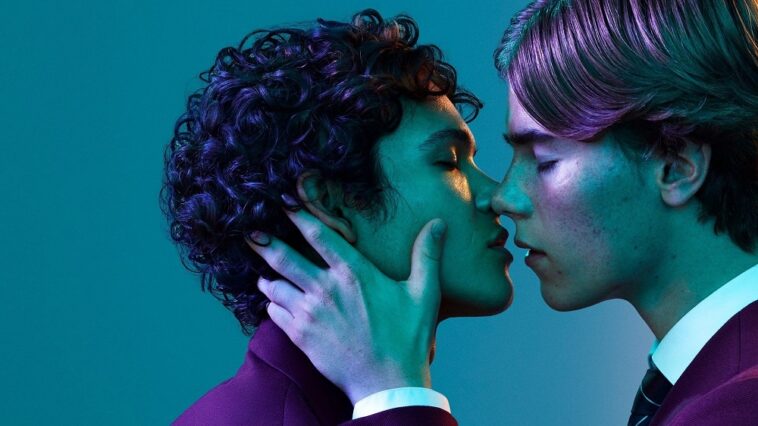
This is what a gay high school boy looked like in 1979.
I like gay romance in print and on film. The positive portrayal of romance and intimacy between two men or high school boys is lovely. Gay youth and men exist and have the same need for love and companionship as the heterosexual majority. Especially given that in Western society, intimacy between men was criminalized for a long time–it was considered “gross indecency” and punishable by imprisonment. Beyond that, public prejudice was prevalent throughout the 20th century. I remember it well. Recently, I met up with a man I knew in high school. We had not seen each other since graduation in 1980. We met through a mutual friend and ex of mine. I had no idea that my high school buddy was gay. We are both in our sixties and retired. I am happily partnered, and he is single. It was good to see him again.
Joe Locke and Kit Connor as Charlie and Nick in Heartstopper.
I watched season two of the charming Netflix series Heartstopper. I liked it despite it being aimed at a much younger audience. What drew me to the series was the gay storyline; the romance between the two protagonists, the high school boys Nick and Charlie. The series is a drama, although it pulls its punches. The boys never go past kissing and cuddling in their relationship. Also, Nick is bisexual, and Charlie is gay. It is cute and appealing to its teenage audience. I like that a teenage gay romance is portrayed as a positive thing. Coincidentally, the actors who play Nick and Charlie are, like the characters they play, gay and bisexual. Kit Connor, who plays Nick, declared his bisexuality. Joe Locke, who plays Charlie, is openly gay. That the young actors are gay and bisexual is interesting. It is nice that they are free to be themselves.
Humans are a sexually dimorphic species. They come in two sexes: male and female, and I appreciate and celebrate the difference. I like men. What is not to enjoy about men? That said, having seen journal articles and YouTube videos giving detailed instructions on how gay men can interact with a transman’s pussy (to use the vernacular), I am puzzled at the absurdity of the claims.
Listening to a true believer in gender identity and gender expression explain why they believe reminds me of when I was a pious Roman Catholic. I am sure I sounded much the same to non-believers when I explained why I had taken the leap of faith to practice Roman Catholicism. I accepted the theological arguments, the authority of Scripture, and the Apostolic Tradition that compose Roman Catholicism. I attended mass daily, said my prayers, and tried to do good and avoid doing evil. I regularly examined my conscience and tried to turn away from sin. It was reasonable to me at the time. Though I tried to be true to my faith, lingering doubt remained. Eventually, I realized that I could not continue as it was hypocritical of me. I stopped going to mass. I no longer believe in the claims of Christianity.
Central to the story is the romance between two high school boys.
I discovered an enchanting Netflix series, a drama called Young Royals. I found it browsing titles with the keywords gay romance. The series is Swedish, the cast are Swedes, and the dialogue is in Swedish. The conversation is dubbed into English with subtitles inserted to translate text messages, emails, and the like. The premise of the series rests on the protagonist, Prince Wilhelm, the younger son of the Swedish Royal family and his desire to live an everyday life. His elder brother, Prince Erik, the Crown Prince, is heir to the throne and groomed for his role as King. Wilhelm is the spare. As much as he wants an everyday life, his mother, Queen Kristina of Sweden, reminds him that his life as a prince is a privilege, not a burden.
On that premise, Prince Wilhelm tries to fit in at the posh boarding school he is sent to; he wants to be like the other students. But, at the same time, he has to keep up appearances and avoid bringing shame on his family and the institution of the monarchy. The plot thickens when Wilhelm is smitten by a classmate, Simon, a student of Swedish and South American ethnicity and a commoner. Simon returns his feelings, and romance blossoms. Unfortunately, the untimely death of Crown Prince Erik in a car crash forces Wilhelm to step into the role of Crown Prince. That only tightens the restrictions on how he conducts his personal life. When a cousin clandestinely shoots a video of Wilhelm and Simon in bed together and uploads it to social media, the proverbial shit hits the fan.
Yes, the subplots deal with issues that are universal for humanity: namely, honour, shame, duty, class distinctions, love, friendship, betrayal, dysfunction, drug and alcohol addiction, and the lengths families will go to avoid scandal. For example, the royal family covers up the scandal of Crown Prince Wilhelm’s romance with Simon with a disingenuous denial that it is Wilhelm in the video. Another student is sacrificed to keep the Crown Prince out of an incident involving illicit drug use at the school. Avoiding shame and maintaining personal honour are powerful motivations, not just for royals.
There is much to like about Young Royals. The casting is superb. What struck me is that they chose actors and actresses who did not have the perfect Nordic features. That is not to say they are unattractive; instead, they look like the people watching the series. One usually expects the cast in teen drama series to have perfect complexions and chiselled figures. Instead, the characters look like people you see in everyday life. The characters are not larger than life, as is the reality of royal families in continental Europe; Crown Prince Wilhelm and the rest of his extended family dress and carry themselves as middle-class Swedes. The actors and actresses play their roles superbly.
Season two of Young Royals started in November. I eagerly anticipated watching new episodes. The idea of a Crown Prince who is gay and wants an everyday life, including his love affair with another boy, a commoner, confronting the realities of royal duties, including taking a wife and producing an heir to the throne, intrigues me. The second season maintained the quality established in the first six episodes of season one. Netflix will conclude the series with a third and final season in the new year. It is wise to end the series this way. There is only so far the writers can take the storyline before it gets stale. Also, the cast are rapidly outgrowing their roles. I hope the final season is as good as the first two and brings a resolution to the story.
The quotation by Judy Rebick at the start of the Wikipedia article on lesbian feminism prompted me, in part, to discuss the detrimental effect of the infiltration of feminism on the gay rights movement. “According to Judy Rebick, a leading Canadian journalist and feminist activist, lesbians were and always have been “the heart of the women’s movement,” while their issues were “invisible” in the same movement.” (Cited in Wikipedia) Rebick is an American ex-pat who lives in Toronto. I could write at great length about her impropriety, but I digress. What I remember about Rebick is what she said in an interview in 1990 regarding feminism. She said, in short, that feminism was dominated and too focused on the interests of middle-class heterosexual white women. It needed to be more inclusive, broaden its scope to include lesbians and non-white women, and take up the cause of gay rights. When I heard that, I was aghast. “Whoa there, Medusa,” I thought, “stay in your own lane! No one asked for your help. Gay men are doing just fine in standing up for their civil rights.” Continue reading →






 Geoffrey & Mika