Recently, Mika and I attended a meeting of gay and lesbian Catholics. Several people of all ages were in attendance. We had a very interesting discussion and it was very nice meeting these people. Among those present was a young gay man, Jesse, who has faith in Christ and the Roman Catholic Church. Jesse, like so many gay people, just wants to find conjugal love and companionship with someone who happens to be the same sex. Jesse took the time to write a heartfelt letter to Pope Francis, explaining who he is, that he is gay, leading a very normal life, hoping to have married life with a man someday and asking for acceptance in the Church. He expressed some concern he might face excommunication for what he wrote, but we assured him this is not very likely. What he can realistically expect is a polite reply from the appropriate branch of the Vatican bureaucracy thanking him for his letter and reminding him that as Roman Catholic it is expected that he abstain from sex outside of marriage. That the Church does not accept same sex relationships at present leaves him in a bind.
Continue reading
Category Archives: Law and Legislation
Tap, Tap, Tap…

Tap, tap, tap is the gesture Shane Bitney Crone and Thomas Lee Bridegroom, a young gay couple, devised to show affection in public without revealing they were gay. As the day draws nearer to the premiere screening of Bridegroom: A Love Story, Unequaled, at the Tribeca Film Festival, April 23, 2013, more details, including this one, of their life together are coming to light. The more I learn about them, the more I recognize the similarities in my own life. The struggle for acceptance they experienced is all too familiar. Shane disclosed in an interview that both he and Tom “tried to pray the gay away. We tried to ignore our feelings and our natural attractions, to fight biology and live by society’s “norms.” But it just isn’t possible.”(Huffpost) When I read these words, it struck a chord. I was astonished. This is exactly how I felt during my adolescence in the latter half of the 1970s when gay liberation was just getting underway. It was a very lonely time for me, as there were no gay youth groups and homosexuality was still largely condemned as unnatural, immoral, disgusting, etc. In spite of the negative attitudes against homosexuality prevalent at the time, feelings of same sex attraction were manifesting themselves in me and I was horrified. I tried to ignore them. At the time people said it was a phase, a symptom of adolescence, of raging hormones and the like and not to worry: it would pass.
Continue reading

Sapientia et Doctrina Stabilitas = Wisdom and knowledge shall be the stability of thy times–Queen’s University Motto
Mika and I are Queen’s grads. I graduated in 1986 with a B.A. in sociology. Mika graduated in 1996 with a B.Sc. in mathematics and computer science. The years I spent at Queen’s were a lot of fun for the most part. Political correctness was yet to take hold. Frosh week, was a drunken and ribald festival in which we were expected to use vulgarity liberally. I remember suffering quite a culture shock when my mother and father left me on campus. I have never cared for vulgarity personally and until I met with my Gael group later that day I was on the brink of calling and asking them to take me home. Once I was settled into my Gael group, no. 9–our group chant was “Number Nine is doing fine, the rest of you are fucking swine”–I began to feel better and joined in the ribald fun that continued for the rest of the week. Early into my first year at Queen’s, some students organized a game they called “Kill.” The game consisted of players who had completed an entry form giving their address on campus or in the student ghetto. Players were given an information sheet indicating where their victim might be found and to make a kill you used a toy pistol that fired plastic projectiles. To authenticate the kill there had to be a 2-3 witnesses who were acquainted with the victim. I made my first kill before I was gunned down outside my drama class. When you were killed, you gave the information form of the victim you were stalking to your assassin and the game continued. Somehow, in the current climate across college and university campuses, I do not think this game is played anymore. Continue reading
Jack Miner
The newest addition to our library collection is a copy of Jack Miner on Current Topics (first published in 1929). Mika found a copy in the Ex Libris book store at the Ottawa Public Library and thoughtfully purchased it, knowing I would like it. Jack Miner (1865-1944), born in Ohio, but settled in Canada in 1878, was a deeply religious man and pioneering conservationist. Miner was not a trained biologist, he had no formal education and was illiterate until he was in his thirties. He was Christian and subscribed to a literal interpretation of Scripture, believing “God put birds and animals here for man’s use and for man to control.” He founded a bird sanctuary on his farm in 1904, which exists to this day, and contributed to the effort to determine the migratory paths of wild ducks and geese in live trapping and banding them. He manufactured his own hand-stamped aluminum bands adding with his address Bible passages: “Keep yourselves in the love of God—Jude 1-21” and “With God all things are possible—Mark 10-27”. Bands recovered from birds after they were shot by hunters indicated where the birds had traveled.
In this book he discusses the Migratory Bird Treaty Act of 1918 (MBTA) which was signed between the United States and Great Britain (acting on behalf of the Dominion of Canada), which effectively ended market hunting, but allows for the hunting of game species for private consumption. He puts forward his case for the conservation of wildlife resources through education and wise use. He includes two chapters detailing his admiration for the Canada goose, proposing it be designated as Canada’s national bird. That he was not a trained biologist shows through in the chapter in which he shares his dislike of crows, referring to them as “cannibals” and “murderers.” He trapped and killed them in droves, believing he was protecting more “desirable” species of birds and mammals. In keeping with his religious beliefs he tended to anthropomorphize wildlife in ascribing human morality to animal behaviour, noting, for example, that Canada geese mate for life and never seeing a pair divorce.
He is remembered for banding wild ducks and geese, having banded over 50,000 wild ducks and 40,000 Canada geese. His efforts in banding waterfowl popularized the procedure leading to its standardization and is still in use as a tool for wildlife biologists today. After his death, the Government of Canada enacted the National Wildlife Week Act to be observed the week of Jack Miner’s birth, April 10 each year. He was a simple and pious man whose passion for migratory birds inspired him to help lay the foundation of the modern conservation movement and for those who love the natural world he is worth remembering.
Posted by Geoffrey and Mika
Pride and prejudice
In Canadian law, enshrined in the Constitution Act and in federal statutes, Northwest Territories Act, the Yukon Act and the Nunavut Act, what is known as separate school boards are allowed to operate along side the public school boards. The law allows for separate school boards to accommodate members of the Christian faith, either Catholic or Protestant, where their numbers make them a minority–this right does not apply to faiths outside Christianity–in the provinces of Alberta, Ontario and Saskatchewan and in the Northwest Territories, Yukon and Nunavut. In practice, most separate school boards serve Catholic populations. Both public and separate school boards are funded by provincial an territorial governments respectively and are subject to legislation governing curriculum. While there are separate, that is Catholic, school boards in these provinces and territories, they operate under the auspices of the provincial or territorial civil authority. The Catholic Church does not have a constitutional, legal, or proprietary interest in the separate school boards. In recent history there is an ongoing controversy over Catholic teachings on homosexuality and their place in the separate school curriculum in the Province of Ontario. Continue reading
Franky and Johnny
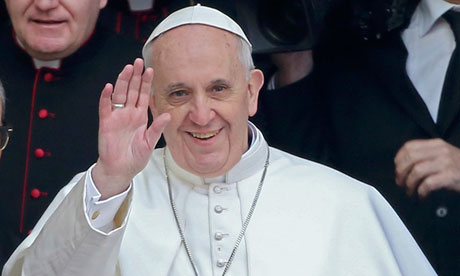
The election of Jorge Mario Bergoglio as Pope Francis I on March 13, 2013, strikes me as impressive in that he makes me think of one of his predecessors, Angelo Giuseppe Roncalli (1881-1963), who became Pope John XXIII (1958-1963). Like Pope John, he comes across as a humble and personable man. In choosing his regnal name, Pope John commented, “I choose John … a name sweet to us because it is the name of our father, dear to me because it is the name of the humble parish church where I was baptized, the solemn name of numberless cathedrals scattered throughout the world, including our own basilica [St. John Lateran]. Twenty-two Johns of indisputable legitimacy have [been Pope], and almost all had a brief pontificate. We have preferred to hide the smallness of our name behind this magnificent succession of Roman Popes.” (As cited in Wikipedia) As for Pope Francis, his choice of regnal name is inspired by Saint Francis of Assisi whom he admires as “the man of poverty, the man of peace, the man who loves and protects creation. These days we don’t have a very good relationship with creation, do we?” he said. “He is the man who gives us this spirit of peace, the poor man.” (As cited in Wikipedia)
If one of those bottles should happen to fall…
I have a passion for the study of history and for music. I love learning about the past and listening to music from across the ages. Occasionally the two passions become congruent as is the case of the opera by Francis Poulenc (1899-1963), “Dialogues des carmélites” (Dialogues of the Carmelites), composed in 1956. The opera is a fictionalized account of an order of Carmelite nuns who were executed during the Reign of Terror in the French Revolution and are remembered as the Martyrs of Compiègne. Continue reading
Coffee: that “Muslim drink”
Coffee, a hot beverage brewed from the ground beans of the Coffea plant, is a beverage I relish. I take two mugfuls of black coffee every morning, savouring the flavour as I sip it from my mug. The consumption of coffee is a pleasure so many people enjoy every day across the world. Coffee drinking originated in the Arab world in the 15th century and remains integral to Arab culture. Coffee was introduced to Europe in the 16th century by Venetian merchants who had trade relations with North Africa, Egypt and the Middle East. Coffee was approved as a Christian beverage by Pope Clement VIII (1536-1605) in 1600, having been frowned upon by some Christians as a “Muslim drink.” Kudos to His Holiness Pope Clement for doing so, as this delectable beverage and its consumption would play a role in transforming European society from the remnants of the social order of the Middle Ages to modernity. Continue reading
Freedom to Read Week 2013
Today, Sunday February 24, 2013 kicks off Freedom to Read Week in Canada (February 24 – March 2, 2013). As such, it is apropos to say a few words about censorship in Canada. Geoffrey is a librarian; Mika is a bibliophile. Between them they have a personal library collection of approximately 5000 volumes. Having the freedom to read is is something to cherish and not take lightly. Section 2.(b) of the Canadian Charter of Rights and Freedoms lists as “Fundamental Freedoms” guarantees “freedom of thought, belief, opinion and expression, including freedom of the press and other media of communication.” In spite of these guarantees in law, the reality is in Canada, a society founded on the principles of pluralism and liberalism, efforts to censor in the form of book challenges are all too common. Public libraries and school libraries are where most book challenges take place. For more information on Freedom to Read Week in Canada 2013, check out this website: www.freedomtoread.ca. By all means enjoy your freedom to read and never take this freedom for granted.
Posted by Geoffrey and Mika
To go against conscience is neither right nor safe. I cannot, and I will not recant. Here I stand. I can do no other, so help me God. Amen. — Martin Luther
Freedom of conscience is a cornerstone of Western Civilization. However, history demonstrates that freedom of conscience often carries a high price. The quotation listed as the title of this post is attributed to Martin Luther (1483-1546), who is said to have spoken these words at the Diet of Worms on April 18, 1521. What he really said is as follows:
Unless I am convinced by Scripture and plain reason – I do not accept the authority of the popes and councils, for they have contradicted each other – my conscience is captive to the Word of God. I cannot and will not recant anything for to go against conscience is neither right nor safe. God help me. Amen.
His protest against abuses in the Church, particularly the sale of indulgences, brought him to make this declaration, written down in his “95 Theses” in 1517. Before his appearance at the Diet of Worms, his “95 Theses” was forwarded to Rome, where several sentences, upon examination, were condemned as heretical. After ignoring a warning from Pope Leo X, Luther was excommunicated on January 3, 1521. Excommunication in 16th-century Europe meant proscription. You were made an outlaw; that is, you no longer had the protection of the law; it was forbidden for anyone to offer you food and shelter, and you could be killed on sight without consequence. As it was the responsibility of civil authority to enforce the law, Luther was offered the chance to recant at the Diet of Worms, which was the general assembly of the estates of the Holy Roman Empire with Emperor Charles V presiding. He refused, putting his life on the line in doing so. He was offered protection from Prince Frederick III, Elector of Saxony, and continued his efforts, which led to the Protestant Reformation.
Continue reading