Reason obeys itself, and ignorance submits to whatever is dictated to it. — Thomas Paine


I learned what male genital cutting was in high school in health class. The teacher handed out mimeographed copies of pages from a textbook that had crude illustrations. He did this by mistake and hurriedly told us to ignore them, but the cat was out of the bag. Once I knew what it was, I began to think about it. I finally understood why other boys I knew over the years, particularly when I lived in England in the late 1960s with my family, looked different. A couple of years later, while one of my aunts visited, a news story came on the television about male genital cutting. She spoke up about how it could not be done to her firstborn son at birth because of complications following his birth, and that they never saw the need for it later. She had a second son years later, and he was left intact. I remember how pained my father looked when she related that to us. My mother was absent from the conversation, leaving the impression that she was behind it for my brother and me. As I grew older, I came to deeply resent what was done to me.


Hannah Arendt developed the concept of the banality of evil: “Evil comes from a failure to think. It defies thought for as soon as thought tries to engage itself with evil and examine the premises and principles from which it originates, it is frustrated because it finds nothing there. That is the banality of evil.” I am reminded of this when I note the dismay of Intactivists when Facebook posts pop up where a newborn boy is subject to involuntary genital cutting for any reason or no reason. I also note the angry reactions of the parents who do not care for the criticism or condemnation for doing this to their newborn sons. Yes, there is no shortage of people who see nothing wrong with it and will tell you to mind your own business. That and they retort, “Don’t choose it for your son if that’s how you feel!” I watch with interest as Eric Clopper, Attorney at Law and Founder & President of Intact Global, mounts a constitutional challenge in Oregon for the protection of boys from involuntary genital cutting. I stand with him and hope for the best as he and his team of lawyers proceed with the challenge. The challenge is based on the constitutional guarantee of legal equal protection. As the involuntary genital cutting of girls is prohibited in US law (in several states, not federally), the reasoning is that boys deserve equal protection. Though I am neither a lawyer nor a legal scholar, as a well-informed layman, I expect the challenge will be an uphill battle.

The thing to remember is that gay is a demographic, not a coherent community. I am a gay man, a free thinker and a skeptic. I am proudly Anglo-Saxon; both sides of my family came from the British Isles, my father’s family from England and my mother’s from Ireland. Short of taking a DNA test, it is anyone’s guess what blend of ethnicities may be in my ancestry. However, that is neither here nor there. The fact remains that I am a middle-aged, gay white man. That said, those characteristics are irrelevant. Above all else, I am an individual. I am the man I am today because of my childhood and adolescence circumstances. I grew up in Canada in the latter half of the 20th century. I remember the Centennial celebrations in 1967 on Canada’s 100th birthday. I learned to take pride in my heritage, and the freedoms and opportunities afforded me as a Canadian. Still, growing up gay in my generation had its challenges. Continue reading

Listening to a true believer in gender identity and gender expression explain why they believe reminds me of when I was a pious Roman Catholic. I am sure I sounded much the same to non-believers when I explained why I had taken the leap of faith to practice Roman Catholicism. I accepted the theological arguments, the authority of Scripture, and the Apostolic Tradition that compose Roman Catholicism. I attended mass daily, said my prayers, and tried to do good and avoid doing evil. I regularly examined my conscience and tried to turn away from sin. It was reasonable to me at the time. Though I tried to be true to my faith, lingering doubt remained. Eventually, I realized that I could not continue as it was hypocritical of me. I stopped going to mass. I no longer believe in the claims of Christianity.

Jacinda Ardern, Prime Minister of New Zealand, posing with Justin Trudeau, Prime Minister of Canada and Sadiq Khan, Lord Mayor of London.
I remember in 1968, my mother enrolled me in a class at the Holy Family parish in Kingston, Ontario. The class was to prepare me for my First Communion. I was seven years old, and in the class, I received my first lessons from the Roman Catholic Church in its perceived need that I learn humility. I have fleeting memories of the classes–on the whole, I think I enjoyed attending them. After our lesson, we got to play games like hide and seek. One night we got to watch That Darn Cat. The experience that lingers in my memory was delivered by the young woman who taught the course. She told us that Jesus, as a boy did not talk back to his parents and teachers; neither did he fight with other children. I think the children in the class took this lesson to heart. The experience was not unreasonable in and of itself–Christianity, Roman Catholic, Orthodox and Protestant, teaches that we should try to be like Jesus. Knowing that I talked back to my parents on occasion and got into scraps with my siblings left me feeling a little abashed–so I did my best to follow the example set by the boy Jesus. I learned at that early age that I am not perfect–that despite it, I should strive to do good and avoid doing evil. At the time, I did not appreciate that it was easy for the boy, Jesus, as He was Divine, unlike the rest of the children in the class and me. Continue reading

Growing up I really enjoyed reading books of fairy tales, folklore, legends and myths. I especially enjoyed the books of ancient Greek myths I found at school. These were adaptations of the stories suitable for children, not the original texts in translation, of course. Of these stories, the one featuring Eris, the goddess of strife and discord, and the apple of discord was a favourite. In short, in the story the apple of discord is a golden apple with the inscription “for the fairest” the goddess Eris threw among the gods. Just who among the gods was fairest was open to question and led to disagreement between the goddesses Athena, Hera and Aphrodite over who among them was the fairest. What started as petty bickering between the three goddesses over this question ultimately brought about the Trojan War. The moral of the story as Timothy and Susan B. Gall note in The Lincoln library of Greek & Roman mythology refers to “the core, kernel, or crux of an argument, or a small matter that could lead to a bigger dispute.” (as cited in Wikipedia) What made me think of this story in the present is the discord generated by Motion 103 Systemic racism and religious discrimination, introduced in parliament on December 5, 2016 by the backbench Liberal MP from Mississauga Iqra Khalid and passed on March 23, 2017. Continue reading
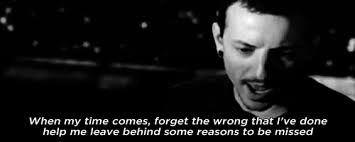

When the news broke on July 20, 2017, of the death by suicide of Chester Bennington, lead singer of the band Linkin Park, my immediate thought was “surely this is another hoax, like the bogus announcements over the internet of the deaths of Clint Eastwood and William H. Macy.” Sadly, it is true. Chester Bennington took his own life at the age of forty-one; this came as a horrible shock to his family, friends, bandmates and millions of adoring fans. He was in the prime of life, at the top of his game as a professional performer, between tours with his band in promoting their new album One More Light. It seemed he had everything to live for, yet he decided to end his life–this is, undoubtedly, hard for many to understand and who are left wondering why. I can only surmise that despite the fame and success he enjoyed in life, despair got him better, and he decided he could not go on living. Despair is part of being human and how human beings cope with it or not varies according to the individual. Continue reading


“Do you think religion inherently good?” This was a rhetorical question posed to the class when I was a student at Queen’s University in 1986. The class was in a course in the history of Christianity. The question was posed by Professor William P. Zion who was on the faculty of the department of religious studies and the Queen’s Theological College. He was also a Russian Orthodox Priest, Father Basil. We were young students who never stopped to think about this. Professor Zion answered the question for us, telling us, “no, religion is not inherently good.” He cited the fact that historically Christians gathered to watch people burned at the stake as a witness to their faith. Professor Zion had a bit of fun with the class in posing this question, but what made me recall this memory is the fact that the majority of humanity practices some kind of religion. I appreciate and understand the appeal of religion for people. I was a pious Roman Catholic myself for several years. Interestingly, it was Father Basil who supported and encouraged me to accept my gayness and continue practicing my faith. I concur with Professor Zion in that I do not think religion is inherently good. This puts me in a bind at times as I interact with people of various faiths, who view their faith as inherently good, right and desirable, both personally and informally in my daily life. Continue reading
There is a great deal of discussion about Kim Davis, the clerk for Rowan County, Kentucky, jailed by U.S. District Court Judge David Bunning who found her in contempt of court on September 3, 2015. She defied the court order to issue marriage licenses as required in her capacity as County Clerk. Davis refuses to issue marriage licenses in protest of the Supreme Court of the United States ruling in Obergefell v. Hodges on June 26, 2015 that made same-sex marriage lawful across the United States. She justifies her refusal to issue marriage licenses on the grounds of her religious objection to same-sex marriage. As she stated: “to issue a marriage license which conflicts with God’s definition of marriage, with my name affixed to the certificate, would violate my conscience.” (New York Times) The question here is whether her refusal to issue marriage licenses is genuinely a matter of faith and conscientious objection to same-sex marriage or, as many of her critics allege, simply a cynical ploy on her part to draw attention to herself and feather her own nest in the process. Is this nothing more than religious hypocrisy on her part? Continue reading