There is hardly a political question in the United States which does not sooner or later turn into a judicial one. — Alexis de Tocqueville

WALLACERoy-Moore-Quote-Seperation-of-church-and-state

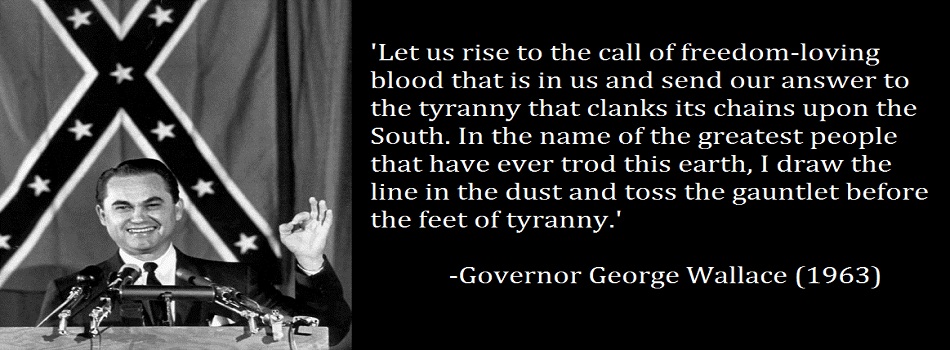
Despite gains in the movement for marriage equality in the United States, such as the repeal of the Defense of Marriage Act (DOMA) and Proposition 8 by the Supreme Court of the United States in 2013 and the repeal of Amendment 1 in North Carolina by a U.S. District Court in 2014, resistance rooted in cynical appeals to populism and the tyranny of the majority rears its head in Alabama. This is manifest in the looming showdown between Judge Roy Moore of the Alabama Supreme Court and the Supreme Court of the United States (SCOTUS) following the repeal of the Alabama Sanctity of Marriage Amendment, in a ruling handed down by Justice Callie V. Granade  of the United States District Court for the Southern District of Alabama on January 23, 2015. This is not unlike the showdown that took place between Governor George C. Wallace and President John F. Kennedy in 1963 when Governor Wallace defied the SCOTUS ruling in Brown v. Board of Education, handed down in 1954 that declared segregation unconstitutional. In both cases, support for segregation and for a ban on same sex marriage was overwhelming and Wallace and Moore insisted their respective stands on the issues was justified in that they represented the opinion of the majority of voters in Alabama. Continue reading

The Lord is my Shepherd and he knows I’m gay. — Troy Perry

triintylawaustin

The issues of gay rights, religious liberty, and religion in Canada and the United States remain contentious. While the destigmatization of homosexuality is a welcome trend in Canada and the United States, it is by no means a fait accompli. Lawful discrimination on religious grounds against gay people remains an issue, notably in secondary and post-secondary education, as religious institutions operate and have sole proprietorship of their high schools, colleges and universities. The issue of lawful discrimination against gay people on religious grounds and opposition to it from the wider society is highlighted by recent events concerning Trinity Western University in Langley, British Columbia and Lutheran High North (a high school ) in Houston, Texas. Both schools have moral codes founded on their interpretation of Christianity that bar sexual activity outside marriage and between persons of the same sex. The schools stand firm in their opposition to homosexuality in the face of controversy and maintain they are within their rights to do so. In either case, presumably, a gay student is welcome to attend, provided they abide by the respective schools’ moral codes. It is legal in both Canada and the United States, but is it tolerable, and what is the appropriate response for those who take issue with these school policies? Continue reading

Politics is just like show business. You have a hell of an opening, coast for a while, and then have a hell of a close. — Ronald Reagan

mcpherson_ormiston200-ab72c2b3f36c4abd5f445045134658a87b6914f9-s800-c15anitasarkeesian1

There’s no business like show business, least of all in the United States. Americans love celebrity, flamboyance, sensationalism and showmanship whether it is in the entertainment industry, politics, business, journalism or religion. I am reminded of this in looking at the careers of  Aimee Semple McPherson and Anita Sarkeesian, two women from Canada, who found fame and fortune in the United States by means of shameless self-promotion, partnership with men endowed with shrewd business acumen, and through a masterful use of electronic media to broadcast their simplified and sensationalized messages to a wide and receptive audience. How they differ is that Aimee Semple McPherson found fame as a prominent Pentecostal evangelist in the first half of the 20th century; whereas, Anita Sarkeesian thrives in the present, promoting herself as a “pop culture critic.” Sarkeesian’s message is aimed at people who subscribe to the temporal ideologies of feminism and social justice. Despite these differences, if you look closely at the career of Aimee Semple McPherson and compare it to that of Anita Sarkeesian you will notice there are striking similarities, particularly as to the question of the character of both Aimee Semple McPherson and Anita Sarkeesian. Continue reading

Art is permitted to survive only if it renounces the right to be different, and integrates itself into the omnipotent realm of the profane. — Theodor Adorno

charlie-hebdo-cover-paris-shooting-012emile

The religious and the secular came to a head at the offices of the newspaper Charlie Hebdo in Paris when Saïd Kouachi and Chérif Kouachi, French citizens of North African ancestry, armed with Kalashnikov rifles opened fire, killing 12 people and wounding 11 in an Islamist terror attack. The attackers were heard shouting “Allahu akbar,” and “the Prophet has been avenged.” Charlie Hebdo, a satirical newspaper published weekly, produces satire in the form of caricatures, scrappy opinion pieces and jokes from a left-wing perspective. Among the targets of its brand of satire are the three Abrahamic faiths: Roman Catholicism (Christianity), Islam and Judaism. The caricatures published in Charlie Hebdo quite often consist of crude representations of religious figures such as Pope Benedict and Mohammed. Not surprisingly, this offends many people and generates controversy. The publishers of Charlie Hebdo were prepared to die to defend their right to freedom of expression; whereas, the Islamist attackers were prepared to kill to defend their faith. In the aftermath of the terror attack, differences of opinion concerning the right of freedom of expression and of religious liberty came to the fore. What was it that motivated the publishers of Charlie Hebdo and the Islamist attackers that resulted in this atrocity? Continue reading

I love to be individual, to step beyond gender. — Annie Lennox

a2-psych-gender-dysphoria-5-638joshua-alcorn

The suicide of Joshua Alcorn on December 28, 2014, marked the tragic end of his young life. He was seventeen years old. His death attracted worldwide attention as he published a suicide note on Tumblr in which he related the stress of suffering from gender dysphoria. This stress was too much for him to bear, so he opted for suicide. He adopted the name Leelah in his suicide note. He leaves behind his grieving parents, younger siblings and the rest of those who knew and loved him. Details are emerging as to the stress he endured and the degree of dysfunction in his family. He came from a Christian family. His parents (Doug and Carla Alcorn) did not understand what he was experiencing and essentially told him to “pray it away.” He said in his suicide note that his parents sent him to conversion therapy for treatment. Compounding this tragedy was the lynch mob mentality that took hold. Doug and Carla Alcorn experienced harassment, even a call from activist Dan Savage that they face prosecution. Is this warranted? Continue reading

At 93, I never thought we would have to debate the definition of marriage — Billy Graham

ThomasMoreCarolina

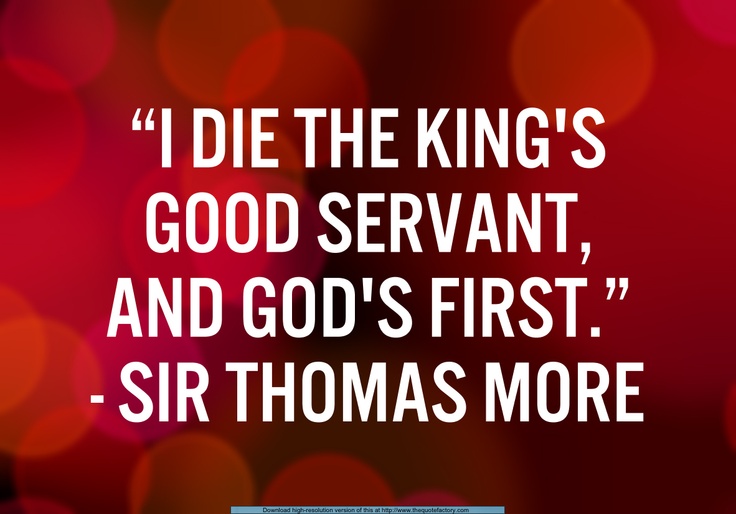
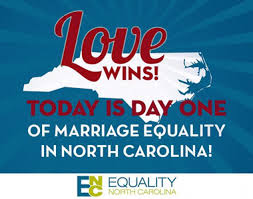
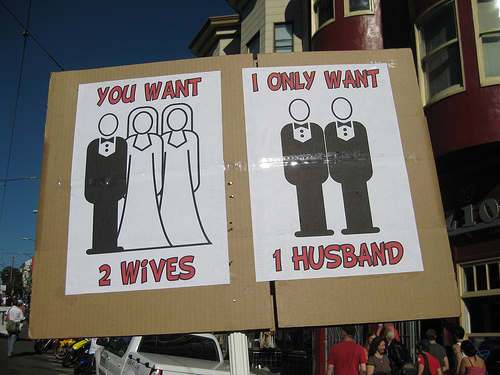
Religion and the definition of marriage remain intertwined in the present, just as in the past. Historically, disputes over the definition of marriage concerned marriage, divorce and remarriage. Dispute over these issues in the court of King Henry VIII of England in the 16th century caused upheaval in the Church and English society. Heads rolled, literally, in the process. In the present, there is an ongoing dispute over the definition of marriage or the redefinition of marriage to allow same sex couples to marry. As I view the movement for same sex marriage, defined as marriage equality, in the United States, North Carolina is a focal point. Amendment 1 to the state constitution, enacted in 2012 following a ballot measure, defined marriage as the union of one man to one woman. Amendment 1 was struck down on October 10, 2014 by U.S. District Court Judge Max O. Cogburn, Jr.  It is now lawful for same sex couples to marry in North Carolina, much to the dismay of opponents of marriage equality, including Charles L. Worley and Billy Graham, who object on religious grounds. Heads are rolling, though not literally, in North Carolina now that Amendment 1 is no longer in force. Continue reading

True Islam taught me that it takes all of the religious, political, economic, psychological, and racial ingredients, or characteristics, to make the Human Family and the Human Society complete. — Malcolm X

territory iraq graphic blast in tikrit PAPER ISIS CORRECTEDimages

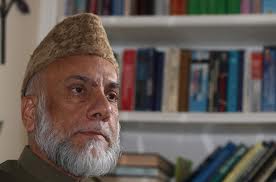
Imam  Syed Soharwardy is a respected Muslim cleric and scholar, chairman of the Al-Madinah Calgary Islamic Assembly and founder and president of the Islamic Supreme Council of Canada. His research interests in Islam consist of “Islamic beliefs, challenges for Muslims in the western world, conflicts within the Muslim community and interreligious conflict.” (Wikipedia) On August 22, 2014, Soharwardy drew attention to himself in announcing he was embarking on a 48 hour fast to protest the murder of James Foley, an American journalist, by the Islamic State of Iraq and Syria (ISIS) earlier in the week. In condemning the killing of James Foley, Soharwardy also made a bold statement declaring there is nothing Islamic in what ISIS represents, asserting:

I want to create awareness about the nature of their work — they are using Islam, they are quoting Qur’an, they look like Muslims, they pray like Muslims but they are not Muslim. They are deviant people, and they are doing exactly everything which goes against Islam. (CBC News Calgary)

In making this assertion, Soharwardy raises an interesting question. Do the actions of ISIS have nothing to do with Islam? Continue reading

The despotism of custom is everywhere the standing hindrance to human advancement. — John Stuart Mill

1967_wolfenden-reportmill

The publication of the Wolfenden Report in 1957 was a landmark in the movement that led to the destigmatization of homosexuality across the Western world in that it brought about the decriminalization of male homosexuality in England and Wales in 1967. The repeal of the Criminal Law Amendment Act 1885 (48 & 49 Vict. c.69) accomplished this. Section 11 of the Act, in particular the clause known as the Labouchere Amendment, applied to male homosexuality. In short, the clause provided for a term of imprisonment “not exceeding two years”, with or without hard labour, for any man found guilty of “gross indecency” with another male, whether “in public or in private”. In 1953 the Home Secretary, David Maxwell Fyffe, referred to male homosexuality as a “plague over England,” and vowed to wipe it out. In 1954, the Departmental Committee on Homosexual Offences and Prostitution was convened with John Wolfenden appointed chairman. Continue reading

The emphasis must be not on the right to abortion but on the right to privacy and reproductive control. — Ruth Bader Ginsburg

hobby-lobby_zps8425ff5a2RNS-HOBBY-LOBBY-SCOTUS

Controversy rages on in U. S. society over the issues of religious liberty and sexuality. The right to marry, the destigmatization of homosexuality and reproductive freedom are issues that, historically and in the present, conflict with deep-seated religious beliefs and traditions in U.S. society. While the U.S. Congress and State Legislatures addressed these issues, especially in passing legislation to guarantee religious liberty, disputes concerning religious freedom and sexuality more often are settled by the courts. In 1967 the Supreme Court of the United States (SCOTUS) ruled state bans on interracial marriage were unconstitutional in Loving v. Virginia. In 2013, SCOTUS struck down the Defense of Marriage Act (DOMA) and refused to hear the appeal of Proposition 8 in California. This removed legal barriers to same-sex marriage. Homosexuality was decriminalized in the U.S. in 2003 when SCOTUS ruled on Lawrence v. Texas. Most recently, the decision handed down by SCOTUS in Burwell v. Hobby Lobby is generating heated discussion in the media and blogosphere. In this instance, SCOTUS ruled on a dispute between the issues of religious liberty and reproductive rights. Continue reading

I have always believed that I should have had no difficulty in causing my rights to be respected. — Eli Whitney

Screen-shot-2012-12-13-at-11_21_32-PMmqdefault

Equality between the sexes, particularly the equality and participation of women is something we value in Canadian society. This is enshrined in Canadian law in the Canadian Charter of Rights and Freedoms in Section 15 Equality Rights, which expressly prohibits discrimination based on sex and allows for the legislation of affirmative action laws designed for the “amelioration of conditions of disadvantaged individuals or groups including those that are disadvantaged because of race, national or ethnic origin, colour, religion, sex, age or mental or physical disability.” (Canadian Charter of Rights and Freedoms). Moreover, since 1971 among the departments of the government of Canada, you will find that of the Status of Women Canada. The mandate of Status of Women Canada is to promote “equality for women and their full participation in the economic, social and democratic life of Canada.” (Status of Women Canada) Yes, the status of women is taken very seriously in Canadian society, but what of the status of men? Continue reading