Tag Archives: canadian charter of rights and freedoms

For every complex problem there is an answer that is clear, simple, and wrong. — H. L. Mencken

The Liberal Party of Canada, the governing Party in 2016, rewrote the Canadian Human Rights Act to include gender identity and expression as prohibited grounds of discrimination. It was puzzling at the time, as they could not define gender identity conclusively. The Canadian Human Rights Act defines gender identity as follows:

Gender identity is each person’s internal and individual experience of gender. It is their sense of being a woman, a man, both, neither, or anywhere along the gender spectrum. A person’s gender identity may be the same as or different from the gender typically associated with their sex assigned at birth. For some persons, their gender identity is different from the gender typically associated with their sex assigned at birth; this is often described as transgender or simply trans. Gender identity is fundamentally different from a person’s sexual orientation. (Canadian Human Rights Act)

Basically, it is an individual’s belief in something that cannot be observed or measured. It is a subjective sense of self, based on irrational ideas; it can be anything you want or nothing at all. That is entirely up to the individual. That in itself is fine. Canadian law guarantees the right to freedom of belief and conscience—as it should. That being the case, belief in gender identity was guaranteed in existing law. Also, existing Canadian law prohibits discrimination based on religion. The thing to remember is that while you are free to believe in gender identity, you are also free not to. From what I surmise, belief in gender identity asserts that we have gendered souls which can be either male, female, or anything in between. Hence, people who are sure of their sex, male or female, are called “cisgender,” as their gender identity and sex align. “Transgender” people are those whose sex and gender identity do not align; they sometimes say that they were born in the wrong body. Again, that is a matter of personal belief and conviction, and no one is stopping anyone from holding these beliefs. Jordan Peterson warned at the time the Liberal government revised the Canadian Human Rights Act to include gender identity and expression, that it would result in compelled speech. His concerns were dismissed, mockingly. Unfortunately, state institutions like the public service, military, police, and schools have been compelled to adopt the belief in gender identity as dogma. Yes, the Party, the Liberal Party of Canada, decreed that in Canada, 2+2=5, in that gender identity is grounded in reality because they say so. Not only that, but anyone who dissents is a heretic whose rejection of the doctrine must be singled out and sanctioned. In short, Canadians are expected to bend the knee to this particular belief system, which runs contrary to Canadian law, notably the Canadian Charter of Rights and Freedoms. I do not understand why the Liberal Party of Canada is so determined to overlay this doctrine of gender identity on Canadians. It is as if they want to impose a new state religion. In doing so, they sowed division among Canadians, resulting in bitter conflict. It is as if the Party declared in fact and established in law that not only do angels exist, but how many angels can fit on the head of a pin, so that the public can quarrel over how many angels do fit on the head of a pin or if angels even exist.

I look at things logically, and the law of non-contradiction, a fundamental law of logic, states that contradictory propositions cannot both be true at the same time and in the same sense. The Liberal Party of Canada decided that it is possible to be male and female at the same time and in the same sense. We saw an example of how this played out in the recent mass shooting in Tumbler Ridge, British Columbia, where the RCMP and the state-funded news media insisted that the suspect was female despite having been born male. Of course, to most people viewing the news reports from the RCMP spokesman, who initially used the term “gunperson” and female in referring to the suspect, when it was quickly revealed that he was an 18-year-old male who had decided to identify as female four years prior. They insisted on referring to him as “she/her” in their statements. The police and court records will show that he was a she, despite the reality that he was male, because in existing Canadian law, whether an individual is male or female is determined by self-identification, and frankly, that is absurd. No, the reality is that 2+2=4, and sex is observable, measurable, and immutable. In this instance, eight people, two adults and six children, died, and twenty-seven were injured, some critically. The RCMP and the state-funded media feel compelled to walk on eggshells so as not to “misgender” the suspect who died at the scene for fear of being condemned for heresy against doctrine. Their priority should be enforcing the law and reporting on current events objectively, without being compelled to adhere to the tenets of any particular belief system, and without looking ridiculous in the process.

Posted by Geoffrey
What matters most is not ‘what’ you are, but ‘who’ you are. ― DaShanne Stokes


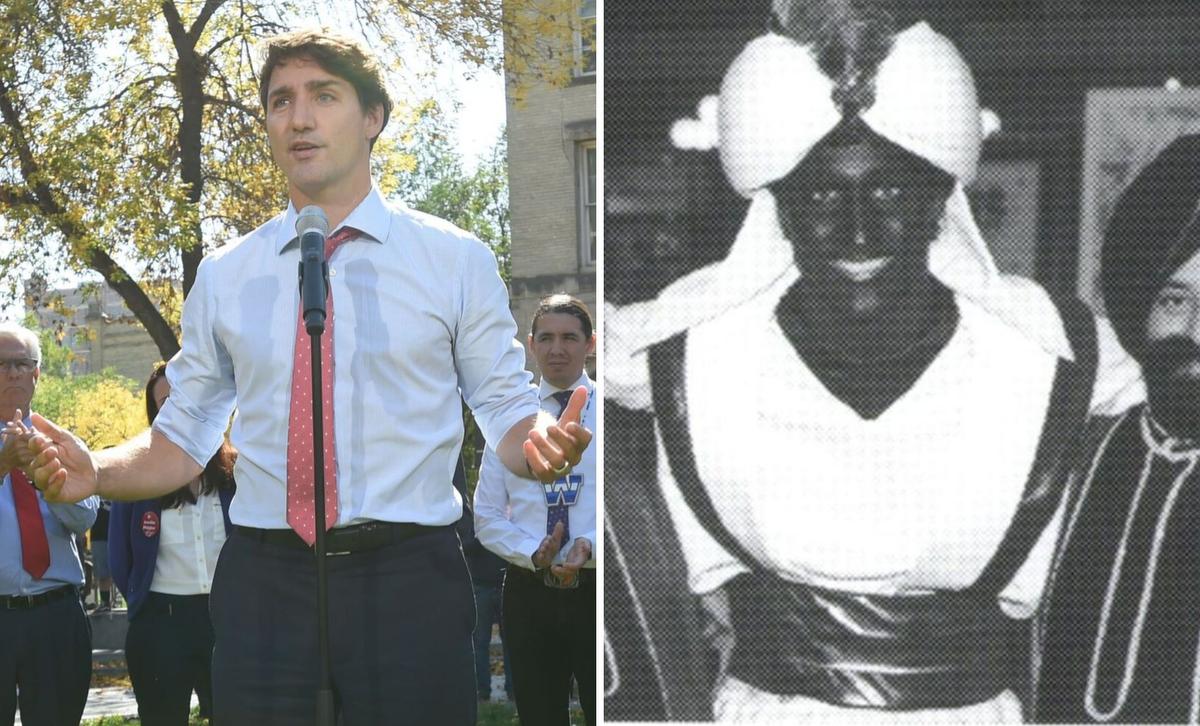
Blackface diptych

The Right Honourable Prime Minister of Canada Justin Trudeau.


A general election is scheduled for Canadians on October 21st. The governing Liberal Party with Justin Trudeau as its frontman seeks re-election. I think it likely the Trudeau Liberals will win re-election, and if so, this is bad news for Canadians. Since taking office in 2015, the Liberal government with the prancing popinjay that is Justin Trudeau consistently sowed division among Canadians. The Liberal government promoted its globalist agenda in pitting Canadians against one another via the imposition of identity politics on Canadians. Yes, the Liberals, with Justin Trudeau as their spokesman, pushed the belief that group identity matters more than individuality and the content of character in each of us as individuals. In doing so, the Liberal government instilled division rather than unity among Canadians since taking office in 2015. In 2019, Canadians are set against each other according to superficial differences such as race, ethnicity, religious affiliation, sex, sexual orientation and the like. Not only that but the Liberal government set a standard of political correctness to which not even the sanctimonious Justin Trudeau can adhere. Continue reading

I am a Canadian. — John Diefenbaker

Diefenbakercitizenship

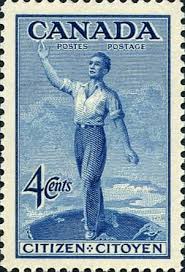
“I am a Canadian,” is the opening phrase in a notable quotation from the Right Honourable John Diefenbaker (1895-1979) 13th Prime Minister of Canada serving from June 21, 1957, to April 22, 1963. The entire quote reads as follows:

“I am Canadian, a free Canadian, free to speak without fear, free to worship God in my own way, free to stand for what I think right, free to oppose what I believe wrong, free to choose those who govern my country. This heritage of freedom I pledge to uphold for myself and all mankind.” (John Diefenbaker, House of Commons Debates, 1 July 1960)

Yes, John Diefenbaker was a proud Canadian–not only that he was a proud Canadian nationalist. As Prime Minister, Diefenbaker advanced the cause of Canadian nationalism. He envisioned:

One Canada, one Canada, where Canadians will have preserved to them the control of their own economic and political destiny. Sir John A. Macdonald gave his life to this party [Conservative]. He opened the West. He saw Canada from east to west. I see a new Canada – a Canada of the North! (John Diefenbaker, Winnipeg Manitoba, 12 February 1958)

Diefenbaker lived during the first century of Canada’s existence. He witnessed the development by which Canada gained independence from Britain. Until 1931, with the passage of the Statute of Westminster, the British government managed Canada’s international affairs. Diefenbaker saw Canada fight in two world wars and Canadians suffer through the Great Depression. He proudly saw the passage of the Canadian Citizenship Act in 1947. Canadians have much to be proud of in their history.

While Diefenbaker saw all that is good in Canada and being Canadian, he did not overlook the problematic moments in Canadian history. Canadian society was not without issues of unjust discrimination and prejudice. Diefenbaker observed:

From my earliest days, I knew the meaning of discrimination. Many Canadians were virtually second-hand citizens because of their names and racial origin. Indeed, it seemed until the end of World War II that the only first-class Canadians were either of English or French descent. As a youth, l determined to devote myself to assuring that all Canadians, whatever their racial origin, were equal and declared myself to be a sworn enemy of discrimination. (John Diefenbaker, Nowlan Lecture, 6)

Diefenbaker knew of the head tax charged on Chinese immigrants. The head tax, enacted in 1885, remained in effect until 1923. Chinese immigrants to Canada were charged (at its worst) $500 for admission to Canada as landed immigrants. From 1923 to 1947 Chinese immigration to Canada was banned. He knew of the internment of Japanese-Canadians in World War II. He was well aware of the Catholic-Protestant divide in Christendom that existed well into the 20th-century in Canada. I remember my mother telling me that my father had to convert to Roman Catholicism to marry her in 1960. My father’s family is Anglican. It is hard to believe such tribal divisions existed in Canada historically, but it is the reality.

Diefenbaker envisioned Canada as a nation organized according to the values of liberalism and pluralism. In shaping his vision of Canadian society, Diefenbaker was inspired, in part, by the passage of the Universal Declaration of Human Rights in 1948. The Universal Declaration of Human Rights was a Canadian-led effort. John Humphrey, a professor of law at McGill University, became director of the United Nations Division on Human Rights in 1946. Humphrey produced the first draft of the declaration. When Diefenbaker became Prime Minister in 1957, he set out to enact a piece of legislation–following up the passage of the Universal Declaration of Human rights–called the Canadian Bill of Rights. In addressing the historical issues of unjust discrimination and prejudice in Canada’s history, the Canadian Bill of Rights asserts in part:

 It is hereby recognized and declared that in Canada there have existed and shall continue to exist without discrimination by reason of race, national origin, colour, religion or sex, the following human rights and fundamental freedoms, namely,

  • (a) the right of the individual to life, liberty, security of the person and enjoyment of property, and the right not to be deprived thereof except by due process of law;

  • (b) the right of the individual to equality before the law and the protection of the law;

  • (c) freedom of religion;

  • (d) freedom of speech;

  • (e) freedom of assembly and association; and

  • (f) freedom of the press.

The Canadian Bill of Rights was superseded by the passage of the Constitution Act in 1982 with the entrenched Canadian Charter of Rights and Freedoms.

To his credit, John Diefenbaker laid the groundwork for our national identity as Canadians. Despite what so many people think currently, nationalism is not a dirty word. As I grew up the values of liberalism and pluralism–the proposition on which Canadian identity is built–that John Diefenbaker advocated were instilled in me. I remember the Centennial celebrations in 1967 fondly; the swell of national pride Canadians felt in celebrating Canada’s first 100 years as a nation. I am proudly Canadian. I am not ashamed of my European heritage–my ancestry goes back to the British Isles. In keeping with Diefenbaker’s vision, I view the people with whom I interact as individuals and judge them according to the content of their character. I reject the notion that expressing Canadian nationalism is racist, that it is a declaration of white supremacy. No, Canada is not a “post-national state.” Canadians are well within their rights to stand up for their national interest, and Canadian law guarantees them their right to speak up and do so.

I hope Canadians will not lose sight of the fact that Canada is a great place to live and Canadian citizenship is worth fighting for. Yes, John Diefenbaker got it right when he advanced the cause of Canadian nationalism and Canadians would do well to remember as they face the challenges of life in the 21st-century.

Posted by Geoffrey


Opposition brings concord. Out of discord comes the fairest harmony. — Heraclitus

maxresdefaulteris__goddess_of_strife__discord_and_chaos__smite__by_mitchumhody-d8ky9dqGrowing up I really enjoyed reading books of fairy tales, folklore, legends and myths. I especially enjoyed the books of ancient Greek myths I found at school. These were adaptations of the stories suitable for children, not the original texts in translation, of course. Of these stories, the one featuring Eris, the goddess of strife and discord, and the apple of discord was a favourite. In short, in the story the apple of discord is a golden apple with the inscription “for the fairest” the goddess Eris threw among the gods. Just who among the gods was fairest was open to question and led to disagreement between the goddesses Athena, Hera and Aphrodite over who among them was the fairest. What started as petty bickering between the three goddesses over this question ultimately brought about the Trojan War. The moral of the story as Timothy and Susan B. Gall note in The Lincoln library of Greek & Roman mythology refers to “the core, kernel, or crux of an argument, or a small matter that could lead to a bigger dispute.” (as cited in Wikipedia) What made me think of this story in the present is the discord generated by Motion 103 Systemic racism and religious discrimination, introduced in parliament on December 5, 2016 by the backbench Liberal MP from Mississauga Iqra Khalid and passed on March 23, 2017. Continue reading

I have always believed that I should have had no difficulty in causing my rights to be respected. — Eli Whitney

Screen-shot-2012-12-13-at-11_21_32-PMmqdefault

Equality between the sexes, particularly the equality and participation of women is something we value in Canadian society. This is enshrined in Canadian law in the Canadian Charter of Rights and Freedoms in Section 15 Equality Rights, which expressly prohibits discrimination based on sex and allows for the legislation of affirmative action laws designed for the “amelioration of conditions of disadvantaged individuals or groups including those that are disadvantaged because of race, national or ethnic origin, colour, religion, sex, age or mental or physical disability.” (Canadian Charter of Rights and Freedoms). Moreover, since 1971 among the departments of the government of Canada, you will find that of the Status of Women Canada. The mandate of Status of Women Canada is to promote “equality for women and their full participation in the economic, social and democratic life of Canada.” (Status of Women Canada) Yes, the status of women is taken very seriously in Canadian society, but what of the status of men? Continue reading

As long as teachers give tests, there will always be prayer in schools. — Unknown

9jMzRN92011-08-02_prayer-in-school

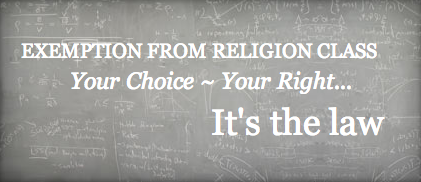
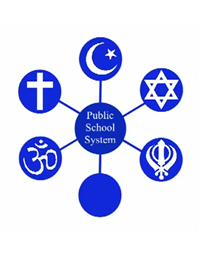
The issue of the practice of religion and religious education in Ontario schools has been a contentious issue throughout their history. The first Board of Education was established in Upper Canada (what became the Province of Ontario) in 1823. In 1824 the Board of Education was allotted funds to provide  for the “moral and religious instruction of the more indigent and remote settlements.” (The school system of Ontario) While Christianity was the dominant religion in Ontario in the 19th century there were sectarian divisions, notably those between Protestant and Roman Catholic, but there was also division between the various Protestant denominations, Anglican, Methodist, Presbyterian, for example. These divisions created strife and hard feelings regarding the provision of moral and religious instruction in Ontario schools. By the 1840s Egerton Ryerson (1803-1882), a Methodist clergyman and champion of public education, proposed “common schools” to educate children of all faiths. This was really quite forward thinking of Ryerson, but the divisions in Christendom at the time were so pronounced this was not possible. Continue reading