I declined an audition recently. The audition call was for an actor to play a senior gay man, a closeted gay man married to a lesbian who had children and grandchildren. They enthusiastically come out late in life, embracing their “queerness” in all its grotesque flamboyance. The role is a lead for a series of ten episodes. I am okay with playing a gay man on screen, provided I can play him straight. By that, I mean playing a man who is gay. I am uncomfortable playing a gay man as a caricature, even in jest. That resembles a black actor playing a minstrel show role in jest. Mainly as I am on record for criticism of queer culture, I think that queer culture is demeaning and detrimental to the well-being and happiness of gay men and boys. I said in the note explaining my decision to drop the audition that the role was outside my character type. My character type is the mature father figure. As an older gay man, I do not want to risk being typecast as an older, flamboyant homosexual.
I had a similar experience to the one dramatized in the video. It was in the late spring, early summer of 1980. I had graduated from high school and eagerly looked forward to enrolling at Queen’s University in the Fall. I served as a Reservist in the Canadian Army in an artillery regiment in Ottawa and made friends with another young man I met in the unit. We became fast friends. I made friends with that man and others in my regiment. Still, I was ribbed, called the “Regimental Fag” in the banter among the ranks. When I came to the Christmas Party in 1979 with a young woman for my date, I was asked, “So, you like girls?” We spent time alone together at his mother’s house. We sat on the living room floor and listened to Beatles records on the stereo. I remember my overwhelming desire for him; I wanted to throw my arms around him and kiss him. I did not understand why I felt that way, which was horrifying. I dared not try it as that would have gone badly for me (assuming he was not gay or did not return my feelings). Had I been singled out as a homosexual in 1980, it would have meant dismissal from the Service. I would likely have lost my friends and become the butt of salacious gossip.
This is what a gay high school boy looked like in 1979.
I like gay romance in print and on film. The positive portrayal of romance and intimacy between two men or high school boys is lovely. Gay youth and men exist and have the same need for love and companionship as the heterosexual majority. Especially given that in Western society, intimacy between men was criminalized for a long time–it was considered “gross indecency” and punishable by imprisonment. Beyond that, public prejudice was prevalent throughout the 20th century. I remember it well. Recently, I met up with a man I knew in high school. We had not seen each other since graduation in 1980. We met through a mutual friend and ex of mine. I had no idea that my high school buddy was gay. We are both in our sixties and retired. I am happily partnered, and he is single. It was good to see him again.
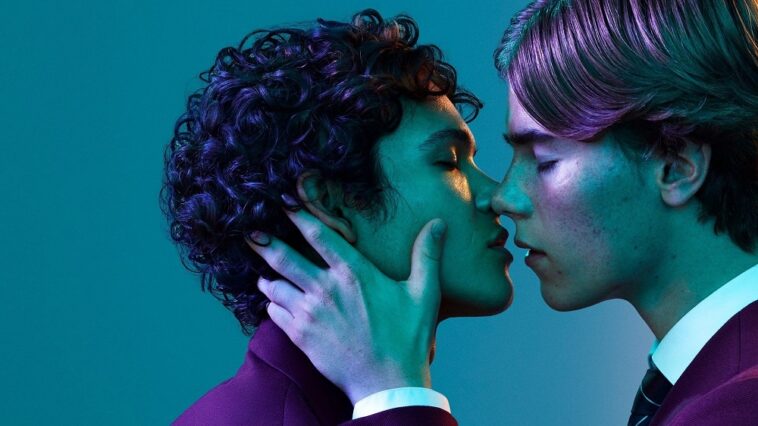
Joe Locke and Kit Connor as Charlie and Nick in Heartstopper.
I watched season two of the charming Netflix series Heartstopper. I liked it despite it being aimed at a much younger audience. What drew me to the series was the gay storyline; the romance between the two protagonists, the high school boys Nick and Charlie. The series is a drama, although it pulls its punches. The boys never go past kissing and cuddling in their relationship. Also, Nick is bisexual, and Charlie is gay. It is cute and appealing to its teenage audience. I like that a teenage gay romance is portrayed as a positive thing. Coincidentally, the actors who play Nick and Charlie are, like the characters they play, gay and bisexual. Kit Connor, who plays Nick, declared his bisexuality. Joe Locke, who plays Charlie, is openly gay. That the young actors are gay and bisexual is interesting. It is nice that they are free to be themselves.
Central to the story is the romance between two high school boys.
I discovered an enchanting Netflix series, a drama called Young Royals. I found it browsing titles with the keywords gay romance. The series is Swedish, the cast are Swedes, and the dialogue is in Swedish. The conversation is dubbed into English with subtitles inserted to translate text messages, emails, and the like. The premise of the series rests on the protagonist, Prince Wilhelm, the younger son of the Swedish Royal family and his desire to live an everyday life. His elder brother, Prince Erik, the Crown Prince, is heir to the throne and groomed for his role as King. Wilhelm is the spare. As much as he wants an everyday life, his mother, Queen Kristina of Sweden, reminds him that his life as a prince is a privilege, not a burden.
On that premise, Prince Wilhelm tries to fit in at the posh boarding school he is sent to; he wants to be like the other students. But, at the same time, he has to keep up appearances and avoid bringing shame on his family and the institution of the monarchy. The plot thickens when Wilhelm is smitten by a classmate, Simon, a student of Swedish and South American ethnicity and a commoner. Simon returns his feelings, and romance blossoms. Unfortunately, the untimely death of Crown Prince Erik in a car crash forces Wilhelm to step into the role of Crown Prince. That only tightens the restrictions on how he conducts his personal life. When a cousin clandestinely shoots a video of Wilhelm and Simon in bed together and uploads it to social media, the proverbial shit hits the fan.
Yes, the subplots deal with issues that are universal for humanity: namely, honour, shame, duty, class distinctions, love, friendship, betrayal, dysfunction, drug and alcohol addiction, and the lengths families will go to avoid scandal. For example, the royal family covers up the scandal of Crown Prince Wilhelm’s romance with Simon with a disingenuous denial that it is Wilhelm in the video. Another student is sacrificed to keep the Crown Prince out of an incident involving illicit drug use at the school. Avoiding shame and maintaining personal honour are powerful motivations, not just for royals.
There is much to like about Young Royals. The casting is superb. What struck me is that they chose actors and actresses who did not have the perfect Nordic features. That is not to say they are unattractive; instead, they look like the people watching the series. One usually expects the cast in teen drama series to have perfect complexions and chiselled figures. Instead, the characters look like people you see in everyday life. The characters are not larger than life, as is the reality of royal families in continental Europe; Crown Prince Wilhelm and the rest of his extended family dress and carry themselves as middle-class Swedes. The actors and actresses play their roles superbly.
Season two of Young Royals started in November. I eagerly anticipated watching new episodes. The idea of a Crown Prince who is gay and wants an everyday life, including his love affair with another boy, a commoner, confronting the realities of royal duties, including taking a wife and producing an heir to the throne, intrigues me. The second season maintained the quality established in the first six episodes of season one. Netflix will conclude the series with a third and final season in the new year. It is wise to end the series this way. There is only so far the writers can take the storyline before it gets stale. Also, the cast are rapidly outgrowing their roles. I hope the final season is as good as the first two and brings a resolution to the story.
The quotation by Judy Rebick at the start of the Wikipedia article on lesbian feminism prompted me, in part, to discuss the detrimental effect of the infiltration of feminism on the gay rights movement. “According to Judy Rebick, a leading Canadian journalist and feminist activist, lesbians were and always have been “the heart of the women’s movement,” while their issues were “invisible” in the same movement.” (Cited in Wikipedia) Rebick is an American ex-pat who lives in Toronto. I could write at great length about her impropriety, but I digress. What I remember about Rebick is what she said in an interview in 1990 regarding feminism. She said, in short, that feminism was dominated and too focused on the interests of middle-class heterosexual white women. It needed to be more inclusive, broaden its scope to include lesbians and non-white women, and take up the cause of gay rights. When I heard that, I was aghast. “Whoa there, Medusa,” I thought, “stay in your own lane! No one asked for your help. Gay men are doing just fine in standing up for their civil rights.” Continue reading →
Here is a photo of my friend and hunting buddy Jason and me. Jason is a family man and a man’s man; he is happily married and has a six-year-old daughter. Not long after we became hunting buddies some years ago, I told him I am gay. His response was, “and that will affect our hunting how?” Since then, our friendship and hunting partnership flourished. It was under Jason’s guidance I took up whitetail deer hunting. Hitherto, I was first and foremost a gamebird hunter. Upon taking up deer hunting with Jason as my mentor, I took four deer to date, starting in the 2012 season with a nice doe, a nine-point buck in 2016, a spike horn buck in 2017, and an eight-point buck in 2020. As a result, I have a presence online as a gay hunter. I publish a blog, Geoffrey’s Hunting Diary, subtitled “memoirs of a gay huntsman.” In addition, I have a YouTube channel called The Gay Huntsman. Those who view my videos and read my blog posts find the emphasis on hunting and not that I am gay. Yes, Jason gets it; my sexual orientation is irrelevant–it has no bearing on our shared passion for hunting and our friendship.Continue reading →
Though I always knew I was gay, it was not until the spring of 1989 that I accepted the reality. It was after a weekend visit with my friend and confessor, Father Basil Zion, a Russian Orthodox priest on the faculty of Religious Studies at Queen’s University, my alma mater. It was Father Basil who convinced me I should be true to myself. With newfound confidence, I took my first tentative steps out of the closet. I did not declare my homosexuality to the world at large. I made my first visit to the GO Centre, the gay community centre in Ottawa at the time. I started reading the local gay newspaper. Things were off to a good start, but my confidence took a hit when I read an article in the newspaper on a murder trial in Texas that sent a chill down my spine. In December 1988, Richard Lee Bednarski, an 18-year-old college student, was convicted of the murder of two gay men, Tommy Lee Trimble, 34, and Lloyd Griffin, 27. Berdanski was sentenced to thirty years in prison for his crime. It looked as though justice was seen to be done at face value–even though his crime merited a life sentence. However, in handing down his judgement, District Judge Jack Hampton openly expressed his disdain for the victims as they were gay.
In Hampton’s view, the fact that the victims were gay made it a lesser degree of murder. That and their killer was a good boy, a college student with no criminal record–it was only his first murder after all. He reached his conclusion despite the evidence that “he (Bednarski) and a group of North Mesquite High School students drove to Dallas’ Oak Lawn area to harass homosexuals the night of May 15.” The motive for his crime was the harassment of gay men. (AP News) As Hampton mused following the trial,
″These two guys that got killed wouldn’t have been killed if they hadn’t been cruising the streets picking up teen-age boys. […] I don’t much care for queers cruising the streets picking up teen-age boys […] I’ve got a teen-age boy. […] These homosexuals, by running around on weekends picking up teen-age boys, they’re asking for trouble. […] They really are.” (AP News)
The news report was a grim reminder that many still view gay men as predators who target adolescent boys for sex. As I said in previous posts, growing up gay, the onus on gay men my age was to prove to the broader society we are not perverts. Yes, the stigma of being a gay man lingered well into the 1980s. In fact, in 1980, when I served as a Reservist in the Canadian Army, I remember a fellow Reservist who spoke openly about going with friends to “roll the faggots” at Majors Hill Park in Ottawa. Also, in the spring and summer of 1989, several men were murdered in Ottawa. Their attackers killed them because they thought they were gay. At least one of the murdered men was not gay, not that it matters. The police investigated the murders, and charges were laid against the assailants who went to prison.
Looking back, I was not comfortable accepting my homosexuality as living with the stigma of being a gay man remained a heavy burden. Over time, however, through the hard work of brave gay individuals and the gay rights and human rights groups who supported them, gay men threw off the stigma. Life is good for gay men these days, but they should not forget their troubled history. As free and equal citizens, we must focus on our issues as gay men and not allow our movement to become diluted with causes, notably feminism and transgenderism, that have no bearing on our history and the present. As we exercise our right to life, liberty and the pursuit of happiness, certainly we can sympathize with those around us but not at the expense of our interest in the consolidation of the gains of the gay rights movement.
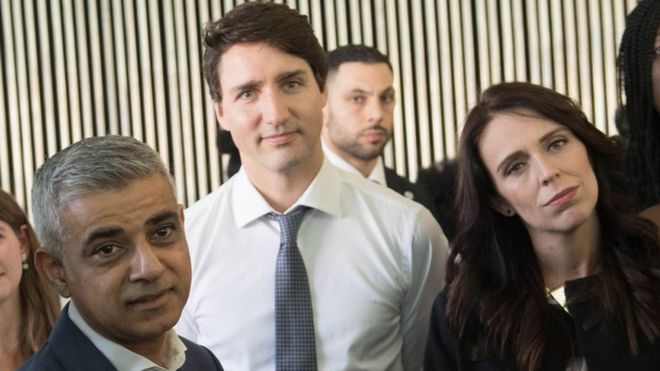
Jacinda Ardern, Prime Minister of New Zealand, posing with Justin Trudeau, Prime Minister of Canada and Sadiq Khan, Lord Mayor of London.
I remember in 1968, my mother enrolled me in a class at the Holy Family parish in Kingston, Ontario. The class was to prepare me for my First Communion. I was seven years old, and in the class, I received my first lessons from the Roman Catholic Church in its perceived need that I learn humility. I have fleeting memories of the classes–on the whole, I think I enjoyed attending them. After our lesson, we got to play games like hide and seek. One night we got to watch That Darn Cat. The experience that lingers in my memory was delivered by the young woman who taught the course. She told us that Jesus, as a boy did not talk back to his parents and teachers; neither did he fight with other children. I think the children in the class took this lesson to heart. The experience was not unreasonable in and of itself–Christianity, Roman Catholic, Orthodox and Protestant, teaches that we should try to be like Jesus. Knowing that I talked back to my parents on occasion and got into scraps with my siblings left me feeling a little abashed–so I did my best to follow the example set by the boy Jesus. I learned at that early age that I am not perfect–that despite it, I should strive to do good and avoid doing evil. At the time, I did not appreciate that it was easy for the boy, Jesus, as He was Divine, unlike the rest of the children in the class and me. Continue reading →
An accusation was levelled at me last year when I publicly rejected the notion that gay became “queer.” The charge, in short, is that I am a selfish gay man. Now that gay rights are secured–the removal of the stigma of being gay, the freedom to live openly, to participate fully in society, and the right to marry among them–I am content to “pull the ladder up after me.” That I reject “queer theory” is true; I made no secret of that. In particular, I object to the conflation of the transgender ideology with male homosexuality–notably gay rights advocacy. In a recent essay, I discussed the emergence of a movement called the LGB Alliance–an initiative to separate the T from the LGB. The problem I found with the LGB Alliance is that it is part of a struggle among feminists–a quarrel over whether transgender women are women or not and if there is a place for transgender women in the feminist movement. I stand by what I wrote in my earlier essay: feminist causes have no bearing on gay men’s issues, no more than does the transgender ideology. The gay rights movement and transgender ideology are unrelated and neither the twain should meet. Continue reading →