Tag Archives: homophile

When I joined the military it was illegal to be homosexual, then it became optional, and now it’s legal. I’m getting out before the Democrats make it mandatory. — Sgt. Harry Berres, USMC

A gay Marine greets his husband upon his return from a deployment.

The Netflix series “Boots” is not “woke garbage,” as the United States Department of Defence alleged. No, while it is fiction, it is good storytelling. I admit, when I saw the trailer and the still images, a part of me rolled my eyes. I suspected it might be a cheesy rom-com featuring queeny ephebes prancing through the United States Marine Corps boot camp. On the contrary, the protagonist, Cameron Cope, is a gay seventeen-year-old high school graduate who chose military service, specifically the Marines, because his good friend had enlisted, and he wanted a change. The story is set in 1990, when male homosexuality was grounds for refusal in enlistment and grounds for discharge. He was reminded of that upon arrival at Parris Island, where a sign at the entrance for induction listed reasons for disqualification that included homosexuality. He kept his homosexuality to himself, though those around him suspected that he was gay.

The U.S. Department of Defense was clear when it issued the following regulation to clarify its stand in 1981:

(DOD Directive 1332.14 (Enlisted Administrative Separations), January 1981)

Homosexuality is incompatible with military service. The presence in the military environment of persons who engage in homosexual conduct or who, by their statements, demonstrate a propensity to engage in homosexual conduct, seriously impairs the accomplishment of the military mission. The presence of such members adversely affects the ability of the armed forces to maintain discipline, good order, and morale; to foster mutual trust and confidence among service members; to ensure the integrity of the system of rank and command; to facilitate assignment and worldwide deployment of service members who frequently must live and work in close conditions affording minimal privacy; to recruit and retain members of the armed forces; to maintain the public acceptability of military service; and to prevent breaches of security.

Under this regulation, persons having homosexual proclivities were deemed unfit for military service and either refused induction into military service or quietly mustered out with either a general, undesirable or dishonorable discharge if found out after having been inducted. The consequences of the three types of discharge varied in degree of severity. Still, in each, the individual was ineligible for veterans’ benefits and could face discrimination in employment in civilian life. That was the reality in 1990. The Don’t Ask, Don’t Tell policy in the United States Military was not enacted until 1993. So, serving in the U.S. Military in 1990 as a gay man meant you had to conceal the truth about yourself on pain of serious consequences.

As the story unfolded, it was revealed that one of the drill instructors, Staff Sergeant Sullivan, a seasoned Marine with a distinguished service record and a recipient of the Silver Star, was a gay man. Despite his impeccable record, he came under investigation when a man, a Major in the Marine Corps, with whom he had a romance, was outed and dismissed from the service. Despite the support of his commanding officer and enlisted colleagues, he chose to nearly beat a man to death in a bar fight, knowing it would result in a dishonorable discharge from the service. In his estimation, a conviction of aggravated assault of a civilian was preferable to being outed and dismissed in disgrace as a homosexual. The tragedy in his case was that had he held on another three years, he could have continued his career in the Marines—the U.S. Department of Defense is correct in pointing out that in 2025, gay men are free to serve openly. The Don’t Ask, Don’t Tell policy and the general ban on gays serving in the military were lifted in 2011. “Boots,” however, is set in 1990, when gay men did not have the option of serving with discretion, let alone openly. So, no, “Boots” is not “woke garbage,” it is well-written and superbly acted by the stellar cast. I highly recommend watching the series.

Posted by Geoffrey

Accept the things to which fate binds you, and love the people with whom fate brings you together, but do so with all your heart. — Marcus Aurelius

A recurring theme in ancient Greek mythology is that you cannot outrun your fate. I think about that idea when I look back on my life and how, throughout it, people assumed that I was a homosexual. In grade school, a woman who lived across the street from my family was hired by my parents to prepare lunch for my siblings and me when we came home from school. I recall how she said that I would end up a confirmed bachelor. A confirmed bachelor was code for a homosexual historically. In middle school, I had a fleeting romance with a girl. When my seventh-grade teacher learned of our liaison, she expressed surprise; she never imagined me being interested in girls. In high school, I asked my brother if he would sound out a girl I fancied to see if she was interested in me. He reported that when the girl realized what he was up to, she retorted, “He’s a fairy!” When I joined the Canadian Army as a Reservist at eighteen, I entered the classroom one day at the Armoury and found a caricature of me as a pink bunny drawn on the blackboard captioned with anti-gay slurs. To their credit, the other recruits told me it was intended as a joke–that they liked me. Still, I wondered why people thought I was a homosexual.

Continue reading

The despotism of custom is everywhere the standing hindrance to human advancement. — John Stuart Mill

1967_wolfenden-reportmill

The publication of the Wolfenden Report in 1957 was a landmark in the movement that led to the destigmatization of homosexuality across the Western world in that it brought about the decriminalization of male homosexuality in England and Wales in 1967. The repeal of the Criminal Law Amendment Act 1885 (48 & 49 Vict. c.69) accomplished this. Section 11 of the Act, in particular the clause known as the Labouchere Amendment, applied to male homosexuality. In short, the clause provided for a term of imprisonment “not exceeding two years”, with or without hard labour, for any man found guilty of “gross indecency” with another male, whether “in public or in private”. In 1953 the Home Secretary, David Maxwell Fyffe, referred to male homosexuality as a “plague over England,” and vowed to wipe it out. In 1954, the Departmental Committee on Homosexual Offences and Prostitution was convened with John Wolfenden appointed chairman. Continue reading

We can only see a short distance ahead, but we can see plenty there that needs to be done. — Alan Turing (1912-1954)

enhanced-buzz-15299-1379589344-0IMG_1283

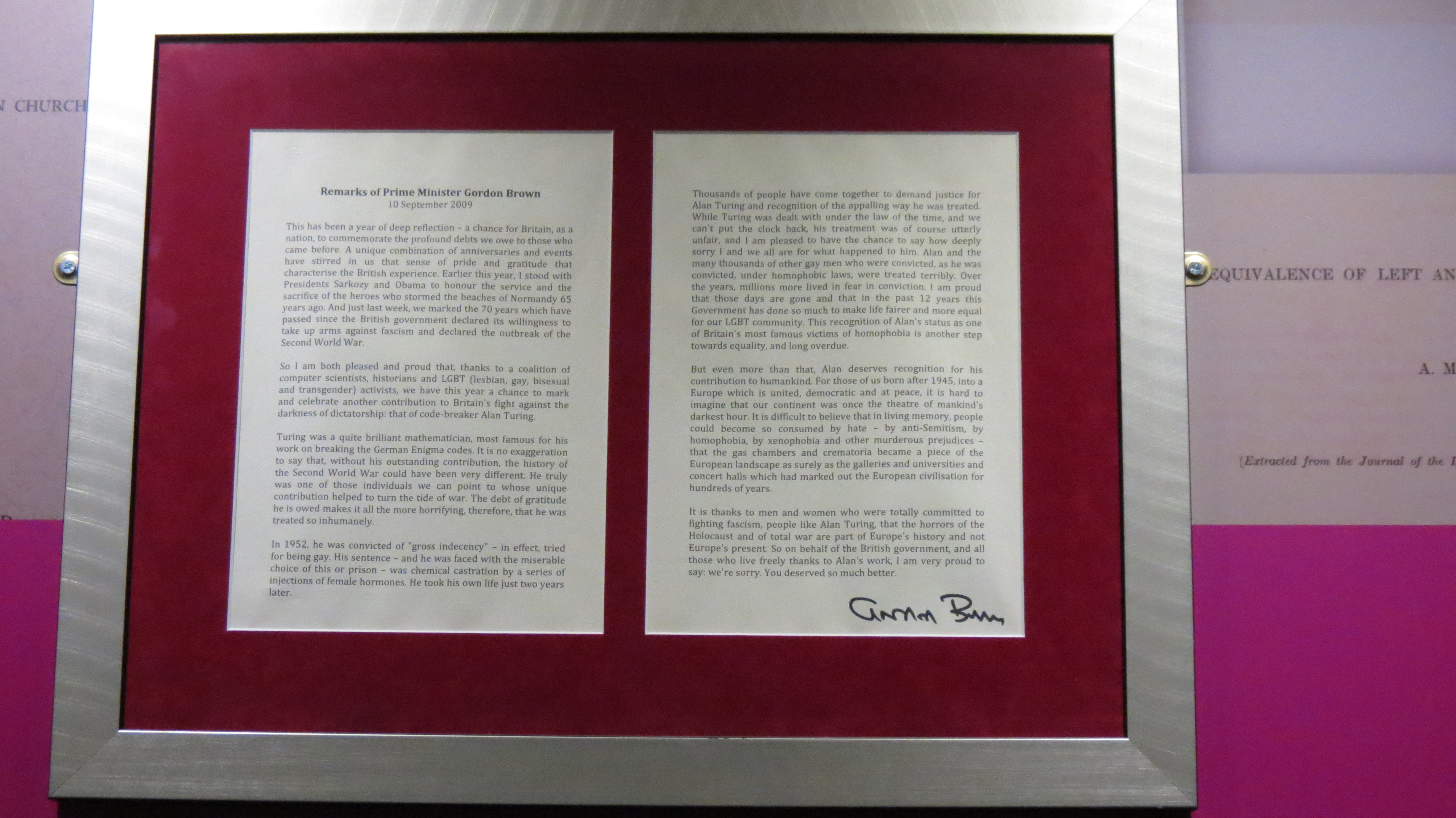
While Mika and I were enjoying our two weeks holiday in England last month among the sites we toured was Bletchley Park. This was especially of interest to Mika as he has a degree in computer science and mathematics from Queen’s University. Bletchley Park was the seat of British Intelligence, Government Code and Cypher School (GC&CS or GCCS, later renamed Government Communications Head Quarters GCHQ), during the Second World War where Axis radio transmissions were intercepted and decrypted. Those who worked there in the strictest secrecy and security made an invaluable contribution to the Allied war effort. Of those who worked at Bletchley Park during the Second World War was a mathematician and pioneering computer scientist named Alan Turing. It is held that “Turing’s brilliant ideas in solving codes, and developing computers to assist break them, may have saved more lives of military personnel in the course of the war than any other.” (Turing Biography) He is commemorated at Bletchley Park for his service to his King and country with a sculpture and a copy of the Letter of Apology from the British Government for the injustice he suffered following the war for having been identified as a “known homosexual,” an injustice that ruined his career, reputation, health and led to his suicide. Continue reading

If God had wanted me otherwise, He would have created me otherwise. — Johann von Goethe (1749-1832)

gay-cure-apppray_gay-17607

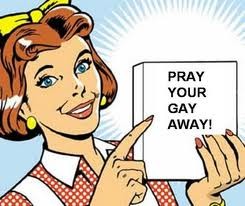
Recruitment is defined among other things as “the action of finding new people to join an organization or support a cause.” (Oxford Dictionaries) It is so common to come across the claim that gays recruit others into being gay, that you choose to be gay, that someone lured your into this “lifestyle.” Speaking on behalf of myself, I can say that no one recruited me into being gay. Same-sex attraction manifests itself naturally in me. It is who I am. During my formative years in the latter half of the 1970s, the only impression I had of homosexuality was not good. Aside from a steady stream of disparaging, anti-gay jokes, remarks and slurs commonly in use at the time), there were a series of news reports about police raids on bathhouses in Toronto, culminating in Operation Soap in 1981. The impression of the “gay lifestyle” presented to me came up short if it was intended to win me as a recruit.  I have written about my experience in how I came to accept that I am gay in previous posts, see Tap, Tap, Tap…, for example. It was a long and challenging process that dragged on over several years. I tried desperately to ignore, suppress, will even pray away the feelings of same-sex attraction. For a long time, I really wanted the gayness to go away. Continue reading

Pride and prejudice

The Mitred Minuetgsa

In Canadian law, enshrined in the Constitution Act and in federal statutes, Northwest Territories Act, the Yukon Act and the Nunavut Act, what is known as separate school boards are allowed to operate along side the public school boards. The law allows for separate school boards to accommodate members of the Christian faith, either Catholic or Protestant, where their numbers make them a minority–this right does not apply to faiths outside Christianity–in the provinces of Alberta, Ontario and Saskatchewan and in the Northwest Territories, Yukon and Nunavut. In practice, most separate school boards serve Catholic populations. Both public and separate school boards are funded by provincial an territorial governments respectively and are subject to legislation governing curriculum. While there are separate, that is Catholic, school boards in these provinces and territories, they operate under the auspices of the provincial or territorial civil authority. The Catholic Church does not have a constitutional, legal, or proprietary interest in the separate school boards. In recent history there is an ongoing controversy over Catholic teachings on homosexuality and their place in the separate school curriculum in the Province of Ontario. Continue reading

Franky and Johnny

Pope Francisaba6c816e5ca297930e58a07200ccfc8_M

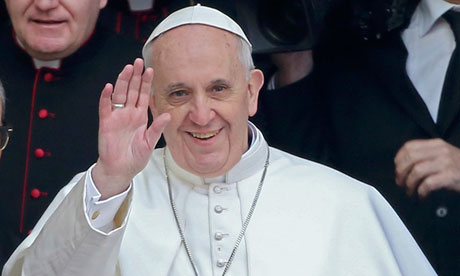
The election of Jorge Mario Bergoglio as Pope Francis I on March 13, 2013, strikes me as impressive in that he makes me think of one of his predecessors, Angelo Giuseppe Roncalli (1881-1963), who became Pope John XXIII (1958-1963). Like Pope John, he comes across as a humble and personable man. In choosing his regnal name, Pope John commented, “I choose John … a name sweet to us because it is the name of our father, dear to me because it is the name of the humble parish church where I was baptized, the solemn name of numberless cathedrals scattered throughout the world, including our own basilica [St. John Lateran]. Twenty-two Johns of indisputable legitimacy have [been Pope], and almost all had a brief pontificate. We have preferred to hide the smallness of our name behind this magnificent succession of Roman Popes.” (As cited in Wikipedia) As for Pope Francis, his choice of regnal name is inspired by Saint Francis of Assisi whom he admires as “the man of poverty, the man of peace, the man who loves and protects creation. These days we don’t have a very good relationship with creation, do we?” he said. “He is the man who gives us this spirit of peace, the poor man.” (As cited in Wikipedia)

Continue reading

Before Stonewall: The Challenge and Progress of Homosexual Law Reform

IMG_0466

In the past few weeks the British parliament passed legislation to move forward in allowing same sex couples to marry in England and Wales. The Marriage (Same Sex Couples) Bill for England and Wales received its first reading on 24 January 2013. On 5 February 2013, the House of Commons debated the bill, and later approved the legislation on second reading in a 400–175 vote. Hitherto, civil unions were allowed between same sex couples under the law since 2005. This is very welcome news indeed. Certainly English society has come a long way from when homosexual sex between consenting adults were decriminalized in 1967. Still, there is determined opposition to amending the law to allow same sex marriage, most notably from religious institutions. The Catholic Church in England and Wales together with the Church of England are campaigning against this legislation. The Muslim Council of Britain and the Rabbinical Council of the United Synagogue are also opposed. The more things change, the more they stay the same it seems. Continue reading