Tag Archives: Intellectual freedom

Conservatives believe in the ties that bind us. Society is stronger when we make vows to each other and we support each other. I don’t support gay marriage in spite of being a conservative. I support gay marriage because I am a conservative. — David Cameron

RainbowLeaves2.jpgConservative_Party_of_Canada-logo-617795D556-seeklogo.com

Mika and I are supporters of the Conservative Party of Canada. While we support the government led by Prime Minister Harper, we do not have membership in the Conservative Party of Canada, nor do we donate money to the Party. Neither do we agree with every position taken by the Conservative government, and where instances of wrongdoing are exposed, we think those responsible should suffer the consequences. You may find it odd that a gay couple identifies as conservative, but we see ourselves moderate centre-right politically in our outlook and values. We value personal liberty, religious liberty (freedom of conscience), intellectual freedom, equality of opportunity and the pursuit of happiness. In our opinion, the Conservative Party of Canada, under the leadership of Prime Minister Stephen Harper, currently best represents these values. Continue reading

The caliphate is the sign of Islamic unity, and the manifestation of the connection between the Islamic peoples, and an Islamic symbol which the Muslims are obligated to think about, and to be concerned with its issue — Imam Hasan al-Banna

CaliphateTurkish-Islamic-Union002175-003_772

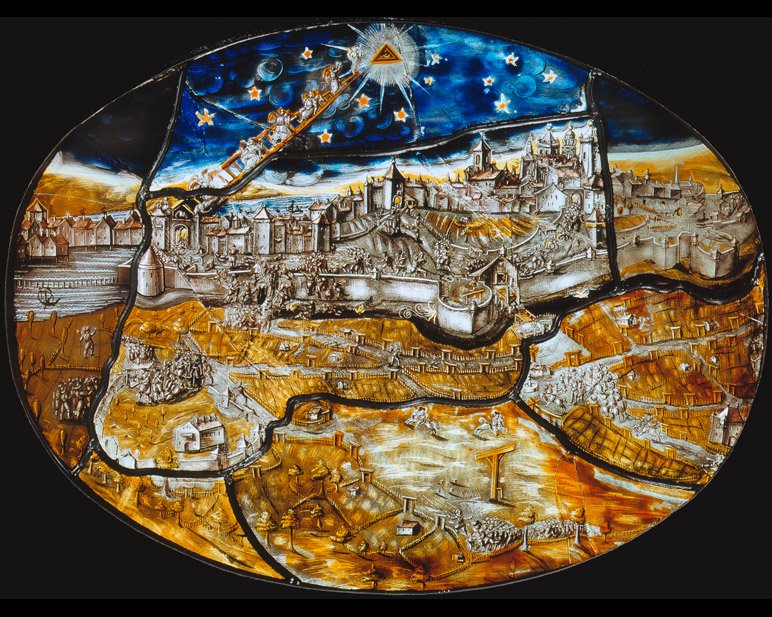
In previous essays I discussed the topic of religion and state in the Western world, notably the role of Christianity, Catholic and Protestant, in the development of Western civilization. For centuries the Catholic Church had authority in temporal affairs and collected taxes in much of Europe. Following the Reformation in the 16th century there were instances where Protestant Churches had authority in temporal affairs. Geneva under the rule of John Calvin (1509-1564), the founder of Calvinism, was governed according to the Ecclesiastical Ordinances which were administered by the Consistory. The Enlightenment in the 18th century introduced new thinking in the natural rights of man and the place of religion in society. Enlightenment thinkers valued religious liberty, but also favoured a strict separation between religion and the state. By the end of the 18th century there were the American and French Revolutions which introduced constitutional law and separation of church and state. In the 19th century the last vestiges of church authority in temporal affairs were swept away with capture of Rome and the Papal States in the drive to unify Italy as a nation. Constitutional guarantees of religious liberty and separation of religion and state make religious pluralism an integral part of Western societies in the present, while Christianity remains the dominant faith, people are free to practice any religion they wish or none at all. How does the history and development of the Islamic world then compare to that of the Western world? Continue reading

“The law of humanity ought to be composed of the past, the present, and the future, that we bear within us; whoever possesses but one of these terms, has but a fragment of the law of the moral world.” — Edgar Quinet (1803-1875)

ujquote4lateran3

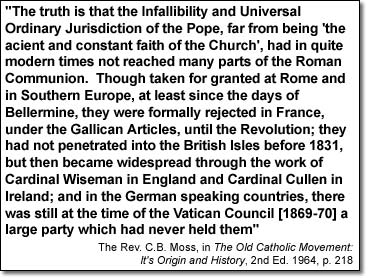
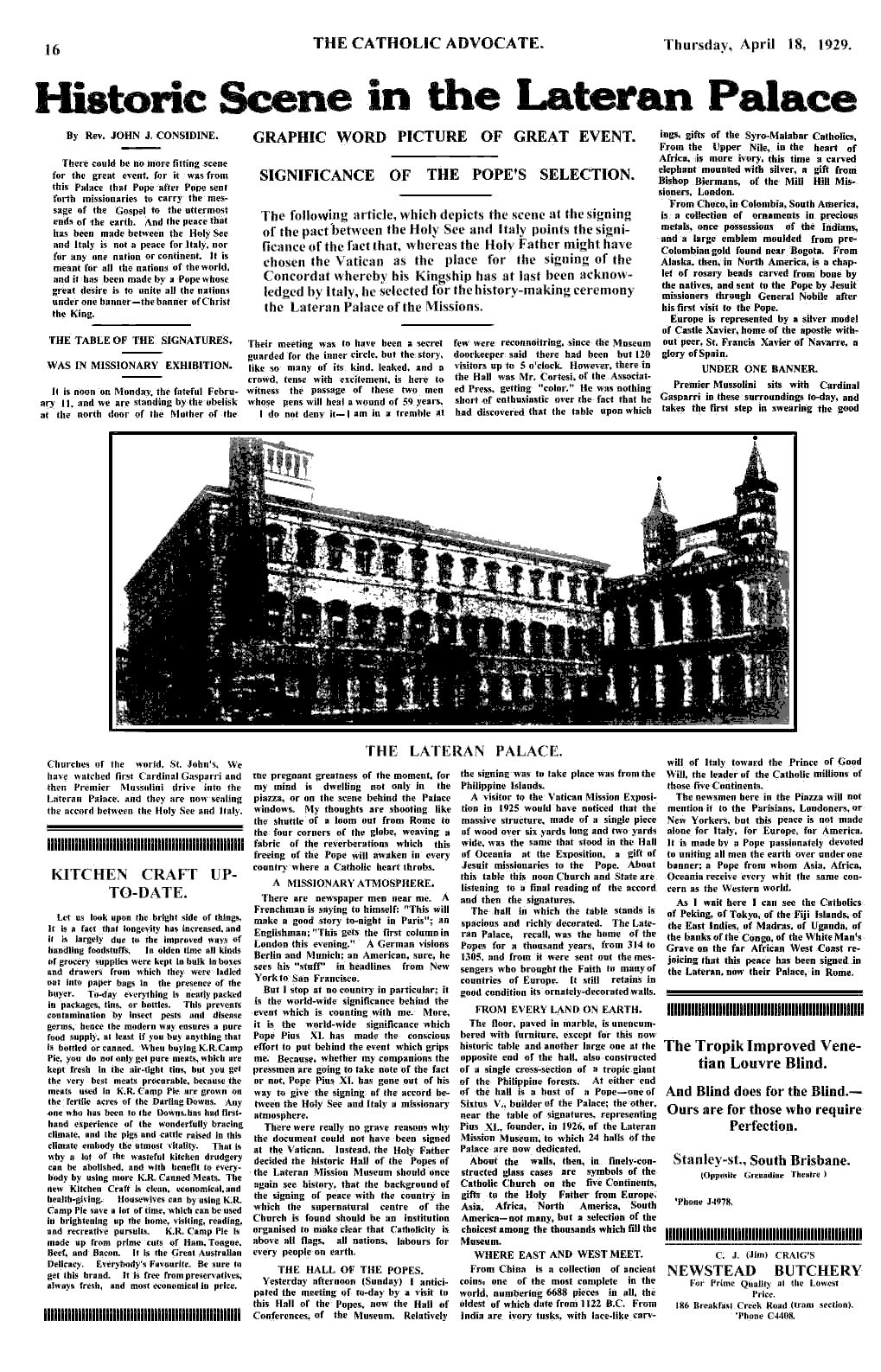
The papacy was in a very precarious position when Pope Pius IX convened the First Vatican Council on June 29, 1868. The drive for Italian unification was underway, with a revolution in 1848 that led to the exile of Pius IX in the castle of Gaeta in the Kingdom of the Two Sicilies from November 24, 1848, until his return to Rome in April 1850. The revolutionaries declared the Roman Republic comprised of the Papal States and in accordance with the ideals of the Enlightenment religious liberty and tolerance was enshrined in the new constitution by article 7 of the Principi fondamentali. Prior to this development only Christianity and Judaism were allowed by law to be practiced in the Papal States. The independence of the pope as head of the Catholic Church was guaranteed by article 8 of the Principi fondamentali. While providing constitutional guarantees of religious liberty and papal authority over the Catholic Church, the framers of the Constitution of the Italian Republic curtailed the temporal authority of the Pope which was referred to as an “historical lie, a political imposture, and a religious immorality” by a reform-minded priest, Abbé Arduini. (as cited in Wikipedia) However, by June 1849 the Roman Republic was overthrown by French military intervention and Pius IX restored in office, returning to Rome and reclaiming governance of the Papal States. Continue reading

Tell the Devil to go to Hell

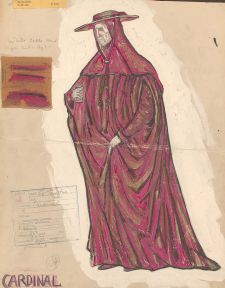
faust_and_mephistopheles_by_meliagaunce-d5fjlimdr_faustus_costume

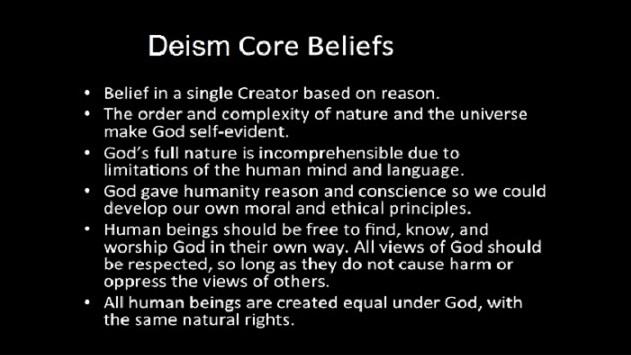
Tell the devil to go to hell,” good advice given to me by a priest who heard my confession at St. Mary’s Cathedral. I was a student at Queen’s University and practicing Roman Catholic in the 1980s. My confessor was speaking figuratively, of course. Neither he nor I believed to “tell the devil to go to hell” involves addressing the creature sporting horns, a tail and cloven hooves. The devil, in the context of our discussion, was a metaphor for humanity’s evils. My confessor told me that I should heed the dictates of my conscience to choose to good and avoid doing evil. What made me think of this was Pope Francis’s thoughts in a sermon, in which he intimated that atheists are redeemed. That is, they do not face damnation when they choose to do good and avoid doing evil. This sermon raises an interesting point. I understood that in practicing Roman Catholicism, redemption and sanctification are granted via the grace of God through faith in Christ. I am no longer a practicing Roman Catholic, though not an atheist. I am a Deist. I listen to the dictates of my conscience in trying to do good and avoid doing evil, in effect telling the devil to go to hell. And until hearing the news of Pope Francis’ homily, understood, from the perspective of Catholic teaching, I am putting my soul at risk of damnation. Continue reading

Sapientia et Doctrina Stabilitas = Wisdom and knowledge shall be the stability of thy times–Queen’s University Motto

522085_528346907180414_1651874656_nqueen's free speech wall5

Mika and I are Queen’s grads. I graduated in 1986 with a B.A. in sociology. Mika graduated in 1996 with a B.Sc. in mathematics and computer science. The years I spent at Queen’s were a lot of fun for the most part. Political correctness was yet to take hold. Frosh week, was a drunken and ribald festival in which we were expected to use vulgarity liberally. I remember suffering quite a culture shock when my mother and father left me on campus. I have never cared for vulgarity personally and until I met with my Gael group later that day I was on the brink of calling and asking them to take me home. Once I was settled into my Gael group, no. 9–our group chant was “Number Nine is doing fine, the rest of you are fucking swine”–I began to feel better and joined in the ribald fun that continued for the rest of the week. Early into my first year at Queen’s, some students organized a game they called “Kill.” The game consisted of players who had completed an entry form giving their address on campus or in the student ghetto. Players were given an information sheet indicating where their victim might be found and to make a kill you used a toy pistol that fired plastic projectiles. To authenticate the kill there had to be a 2-3 witnesses who were acquainted with the victim. I made my first kill before I was gunned down outside my drama class. When you were killed, you gave the information form of the victim you were stalking to your assassin and the game continued. Somehow, in the current climate across college and university campuses, I do not think this game is played anymore. Continue reading

Why I am not an atheist

I was, for a time, a very pious Roman Catholic. I attended mass every day, said my prayers, studied theology, and accepted the authority of the Sacred Scriptures and the Apostolic Tradition. Throughout it all, however, doubt always nagged at me. I remember following the Easter Sunday mass at the Mother House of Sisters of Providence of Saint Vincent DePaul (my great aunt Olive was a member of the order), joining in with a priest reciting Revelation 11:15, “And He shall reign forever and ever.” The priest added emphatically, “Yes, forever and ever.” “Oh wow, you really believe that?” was the first thought that crossed my mind. Doubt was ever present while I tried to practice Roman Catholicism. Some years later, at a suburban parish at the Easter Vigil, a woman behind me was pouring candies from a bag into her children’s hands while the priest was busy reciting the words for the lighting of the Sacred Fire. The sound of the candies pouring out of the bag was an annoying distraction, and it was following this that seemingly out of nowhere, doubt struck, and I found myself wondering, “What on Earth am I doing here? Do I really believe any of this?” I left the Vigil as I felt it wasn’t very good of me to stay.

Continue reading

Freedom to Read Week 2013

ftr_2011_header

Today, Sunday February 24, 2013 kicks off Freedom to Read Week in Canada (February 24 – March 2, 2013). As such, it is apropos to say a few words about censorship in Canada. Geoffrey is a librarian; Mika is a bibliophile. Between them they have a personal library collection of approximately 5000 volumes. Having the freedom to read is is something to cherish and not take lightly. Section 2.(b) of the Canadian Charter of Rights and Freedoms lists as “Fundamental Freedoms” guarantees “freedom of thought, belief, opinion and expression, including freedom of the press and other media of communication.” In spite of these guarantees in law, the reality is in Canada, a society founded on the principles of pluralism and liberalism, efforts to censor in the form of book challenges are all too common. Public libraries and school libraries are where most book challenges take place. For  more information on Freedom to Read Week in Canada 2013, check out this website: www.freedomtoread.ca. By all means enjoy your freedom to read and never take this freedom for granted.

Posted by Geoffrey and Mika

To go against conscience is neither right nor safe. I cannot, and I will not recant. Here I stand. I can do no other, so help me God. Amen. — Martin Luther

lossy-page1-558px-Martin_Luther_by_Cranach-restoration.tifmarkedfor-death-geert-wilders

Freedom of conscience is a cornerstone of Western Civilization. However, history demonstrates that freedom of conscience often carries a high price. The quotation listed as the title of this post is attributed to Martin Luther (1483-1546), who is said to have spoken these words at the Diet of Worms on April 18, 1521. What he really said is as follows:

Unless I am convinced by Scripture and plain reason – I do not accept the authority of the popes and councils, for they have contradicted each other – my conscience is captive to the Word of God. I cannot and will not recant anything for to go against conscience is neither right nor safe. God help me. Amen.

His protest against abuses in the Church, particularly the sale of indulgences, brought him to make this declaration, written down in his “95 Theses” in 1517. Before his appearance at the Diet of Worms, his “95 Theses” was forwarded to Rome, where several sentences, upon examination, were condemned as heretical. After ignoring a warning from Pope Leo X, Luther was excommunicated on January 3, 1521. Excommunication in 16th-century Europe meant proscription. You were made an outlaw; that is, you no longer had the protection of the law; it was forbidden for anyone to offer you food and shelter, and you could be killed on sight without consequence. As it was the responsibility of civil authority to enforce the law, Luther was offered the chance to recant at the Diet of Worms, which was the general assembly of the estates of the Holy Roman Empire with Emperor Charles V presiding. He refused, putting his life on the line in doing so. He was offered protection from Prince Frederick III, Elector of Saxony, and continued his efforts, which led to the Protestant Reformation.
Continue reading

I do not agree with what you have to say, but I’ll defend to the death your right to say it.–Voltaire

Image

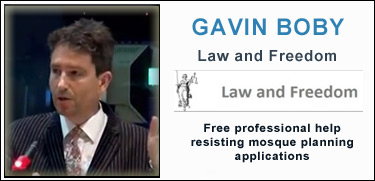
Gavin Boby, a lawyer from the United Kingdom, and leader of the Law and Freedom Foundation is on a speaking tour in Canada. He is due to speak at the Ottawa Public Library tomorrow evening. Mr. Boby is a controversial figure as the Law and Freedom Foundation provides a free legal service for those who oppose mosque developments. Through his foundation he claims to have stopped the construction of 16 out of 17 mosques across Britain. Mr. Boby objects to the construction of mosques on the grounds that mosques act as bridgeheads within Western society for the advance of Islam. Mr. Boby maintains:

A mosque is not merely a place of worship. Islamic doctrine requires the application of Islamic law within its geographical reach. As homosexuals, Jews, and those attached to freedom of speech discover, Islamic law claims supremacy over the conduct of Muslims and non-Muslims alike. It mandates violence against those who resist it. British common law is clear that there can be no justification for: the preaching of sedition; claims that women, Jews, homosexuals or non-Muslims are inferior and can be abused; the call for persecution or murder of Muslim apostates. Continue reading

“The only thing worse than being talked about is not being talked about.” — Oscar Wilde

Image

There is no such thing as bad publicity it is often said. Is this so? Personally, I think there is such a thing as bad publicity. Let me recount a recent incident by way of an illustration. A student at Carleton University, where I am employed, Arun Smith is his name, has generated a great deal of publicity for himself in pulling a truly stupid, petulant stunt on campus, basically an act of petty vandalism. A campus group, Carleton Students for Liberty, set up an installation in the University Centre, calling it the “Free Speech Wall” on Monday January 21st. Passersby were free to jot down their thoughts. Mr. Smith, a student politician seeking election to the Carleton University Students’ Association, took exception to the installation and destroyed it over night. He proudly confessed to doing so on his facebook page claiming free speech ““illusory concept” and that “not every opinion is valid, nor deserving of expression.” This has since been picked up by the press and blogosphere giving the previously obscure Mr. Smith considerable public attention. The bulk of this attention has been less than flattering to say the least, but this does not concern the erudite, ahem, (he has been studying as an undergraduate student seven years now), Mr. Smith. Presumably he thinks he stands to gain from his new found ignominy. He may well have increased his standing among the politically correct elements on the Carleton campus, but across the wider society both on and off the campus, judging by the comments left on the restored installation, he is seen as a fool.

Posted by Geoffrey