
Gay men have long been seen as a novelty, a standard deviation in the demographic where most of humanity is heterosexual. Attitudes toward male homosexuality varied throughout history. In Antiquity, for the Etruscans, Greeks, and Romans, it was a part of life. They understood that people were sexual, so same-sex liaisons were common and depicted in their artwork. With the development of the Abrahamic faiths, Judaism, Christianity, and Islam, male homosexuality was viewed in a critical light. Eventually, it was condemned in the Abrahamic faiths and in the wider society. Gay men lived and died through centuries where, at best, they were tolerated, sometimes, and at worst, persecuted and imprisoned. By the eighteenth century in England, the argument was advanced by the British philosopher, Jeremy Bentham, for the decriminalisation of homosexual behaviour between consenting adults in private, in his essay Offences Against Oneself. He wrote the essay around 1785, but it was published posthumously in 1931. Bentham thought homosexuality, as Jeffrey Weeks notes, “an ‘imaginary offence’ dependent on changing concepts of taste and morality.” (Wolfenden and beyond: the remaking of homosexual history) Bentham thought through the issue and reasoned:
To what class of offences shall we refer these irregularities of the venereal appetite which are stiled [sic] unnatural? When hidden from the public eye there could be no colour for placing them any where else: could they find a place any where it would be here. I have been tormenting myself for years to find if possible a sufficient ground for treating them with the severity with which they are treated at this time of day by all European nations: but upon the principle utility I can find none. (Offences Against Oneself)
However, in England and Wales, the passage of the Criminal Law Amendment Act 1885 (48 & 49 Vict. c.69) included Section 11, in particular the clause known as the Labouchere Amendment, which applied to male homosexuality. In short, the clause provided for a term of imprisonment “not exceeding two years”, with or without hard labour, for any man found guilty of “gross indecency” with another male, whether “in public or in private”. The Labouchere Amendment was enforced sparingly and selectively. However, the consequences of arrest and conviction could be devastating. John Gielgud very nearly saw his career as an actor come to an abrupt end in 1953 when a scandal arose over his arrest for ‘persistently importuning male persons for immoral purposes’ (he was caught trying to pick up a man in a public washroom). He was fined £10, and news of the arrest reached the press, causing him a most personal humiliation and the refusal of a visa to travel to the United States with his company to perform Shakespeare’s The Tempest. Gielgud was fortunate that the theatre-going public forgave his momentary indiscretion, and he continued his acting career both in the United Kingdom and the United States. Also, in 1953, the Home Secretary, David Maxwell Fyffe, referred to male homosexuality as a “plague over England,” and vowed to wipe it out. The Labouchere Amendment was repealed in English law in 1967—interestingly, a backbench Conservative Member of Parliament, Margaret Thatcher, broke ranks with the party to vote for its repeal. Since the decriminalisation of male homosexuality in England and Wales in 1967, many countries followed. It was decriminalised in Canada in 1969.
Now, in the twenty-first century, male homosexuality is seen by most as inconsequential. It is a natural expression of human sexuality. True, gay men remain a minority, but are free to take their place in society and live openly. Gay men marry and have families. They are represented in all occupations, and take part in a plurality of pastimes like anyone else. Unfortunately, for some, gay men remain a novelty. The series, Heated Rivalry, released by Crave, a Canadian streaming service, has become a worldwide hit with viewers. The series is based on novels by Rachel Reid, a Canadian author. I do not begrudge her success or the television series’s success, but what concerns me is that the story is pure fantasy. Yes, it is good writing and acting, absolutely, only it made me think of a quotation by Maria Von Trapp. When she saw the first production of The Sound of Music, she said, “That’s a nice story, but it’s not my story.” The story of two professional hockey players, one bisexual and the other gay, came from the imagination of a heterosexual woman. I am not saying there is anything wrong with that. Hardly, she is free to write stories about any characters she chooses. Though they say, “Art imitates life,” sometimes, particularly in romance novels, the lives of the characters are idealised beyond belief. The reality is that there is nothing novel about gay men living in the twenty-first century in most Western jurisdictions. There is no need to fashion romantic fantasies about how you imagine gay men live, how they feel, and what they think. The truth is, we are like everybody else, despite being a minority. There are plenty of openly gay professional athletes, including Jason Collins (an NBA player), Robbie Rogers (an NFL player), Tom Daley (a diver for the British Olympic team), Gus Kenworthy (a skier for the U.S. Olympic team), and Carl Nassib (an NFL player). I do not know much about the personal lives of these men, except for Tom Daley, whose private life is on the public record. Daley is married to his husband, Dustin Lance Black, and has two sons. They lead a conventional life like any other married couple. So, why are people so agog over a fantasy television series that treats the ordinary lives of gay men as something new and unusual?
An accusation was levelled at me last year when I publicly rejected the notion that gay became “queer.” The charge, in short, is that I am a selfish gay man. Now that gay rights are secured–the removal of the stigma of being gay, the freedom to live openly, to participate fully in society, and the right to marry among them–I am content to “pull the ladder up after me.” That I reject “queer theory” is true; I made no secret of that. In particular, I object to the conflation of the transgender ideology with male homosexuality–notably gay rights advocacy. In a recent essay, I discussed the emergence of a movement called the LGB Alliance–an initiative to separate the T from the LGB. The problem I found with the LGB Alliance is that it is part of a struggle among feminists–a quarrel over whether transgender women are women or not and if there is a place for transgender women in the feminist movement. I stand by what I wrote in my earlier essay: feminist causes have no bearing on gay men’s issues, no more than does the transgender ideology. The gay rights movement and transgender ideology are unrelated and neither the twain should meet. Continue reading →
Prejudice is defined as “an unfair and unreasonable opinion or feeling, especially when formed without enough thought or knowledge.” (Cambridge Dictionary) I experience prejudice as both a gay man and gun owner. You may be familiar with the crude caricature of a gay man: that of a limp-wristed, effeminate man who speaks with a lisp and has an incessant compulsion for sex. You may also be acquainted with the cartoonish stereotype of gun owners as lower class white men who are uncouth and certain to tell you the only way you will take his gun from him is “from my cold, dead hands.” Certainly, these are the extreme ends of these particular prejudices. There are occasions in my life when people directed anti-gay slurs at me and to a lesser extent snide remarks about my supposed lack of virility and questionable mental health for being a gun owner. Still, the prejudice I face as a gay man and gun owner that really concerns me is far more indistinct than loutish people who call me “queer” or “gun nut” because they just do not know any better. Continue reading →
The publication of the Wolfenden Report in 1957 was a landmark in the movement that led to the destigmatization of homosexuality across the Western world in that it brought about the decriminalization of male homosexuality in England and Wales in 1967. The repeal of the Criminal Law Amendment Act 1885 (48 & 49 Vict. c.69) accomplished this. Section 11 of the Act, in particular the clause known as the Labouchere Amendment, applied to male homosexuality. In short, the clause provided for a term of imprisonment “not exceeding two years”, with or without hard labour, for any man found guilty of “gross indecency” with another male, whether “in public or in private”. In 1953 the Home Secretary, David Maxwell Fyffe, referred to male homosexuality as a “plague over England,” and vowed to wipe it out. In 1954, the Departmental Committee on Homosexual Offences and Prostitution was convened with John Wolfenden appointed chairman. Continue reading →
I try to tune out the white noise that is generated by assorted gun prohibitionists as I learned there is nothing to gain in engaging in futile quarrels with them. Certainly, it bothers me when they spout their nonsensical assertions and point their fingers at hunters, sport shooters and collectors, spewing vitriol and denouncing them as the enemies of humankind. I always knew there were people who disapproved of gun ownership and hunting, but thought of it as their problem. If you do not like guns, do not keep them and if you disapprove of hunting, do not go hunting and if you are a landowner, you are free to post your property against hunting. If only it were that simple. In reality, however, Canada’s gun owners find themselves in a very precarious position. Beginning with the passage of the Criminal Law Amendment Act, 1968-69 (S.C. 1968-69, c. 38) in 1969, continuing with amendments to the Criminal Code of Canada, Bill C-51 in 1978, Bill C-17 in 1991 and Bill C-68 in 1995, Canada’s gun owners are now saddled with the Canadian Firearms Act. In the span of 26 years, Canada’s gun owners have seen their freedoms to own and use their property for lawful and safe past-times such as hunting and sport shooting, drastically curtailed and the character of the gun owner defamed brazenly by an array of public and non-governmental associations. Continue reading →
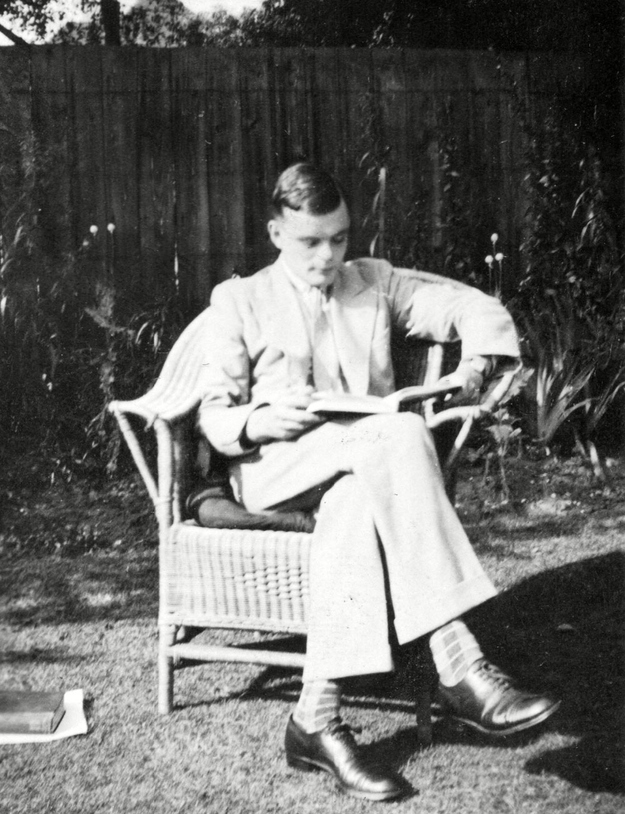
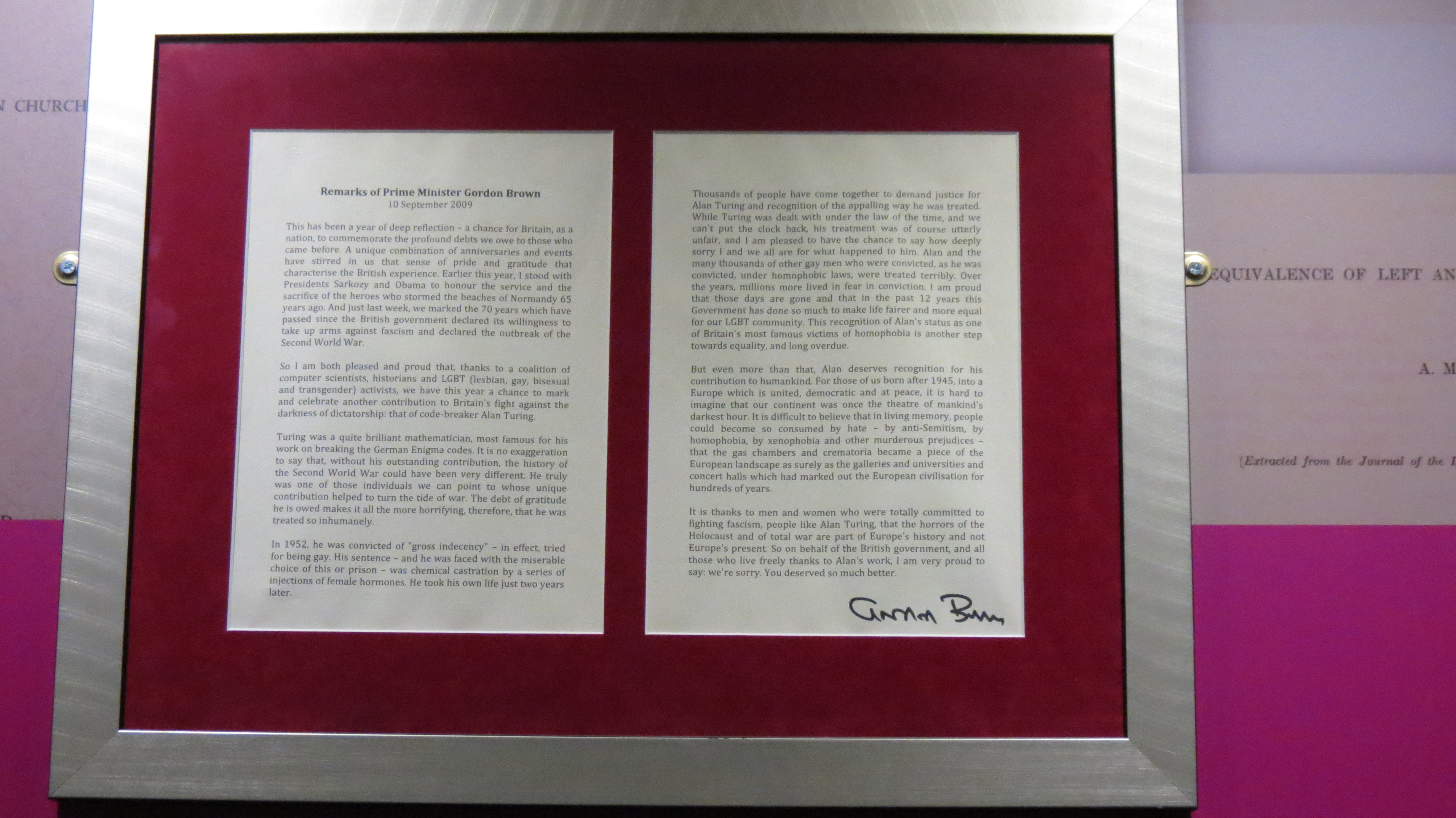
While Mika and I were enjoying our two weeks holiday in England last month among the sites we toured was Bletchley Park. This was especially of interest to Mika as he has a degree in computer science and mathematics from Queen’s University. Bletchley Park was the seat of British Intelligence, Government Code and Cypher School (GC&CS or GCCS, later renamed Government Communications Head Quarters GCHQ), during the Second World War where Axis radio transmissions were intercepted and decrypted. Those who worked there in the strictest secrecy and security made an invaluable contribution to the Allied war effort. Of those who worked at Bletchley Park during the Second World War was a mathematician and pioneering computer scientist named Alan Turing. It is held that “Turing’s brilliant ideas in solving codes, and developing computers to assist break them, may have saved more lives of military personnel in the course of the war than any other.” (Turing Biography) He is commemorated at Bletchley Park for his service to his King and country with a sculpture and a copy of the Letter of Apology from the British Government for the injustice he suffered following the war for having been identified as a “known homosexual,” an injustice that ruined his career, reputation, health and led to his suicide. Continue reading →