Tag Archives: Prejudice

I am the Love that Dare not Speak its Name. ― Alfred B. Douglas

This self-portrait, taken in Havelock, New Brunswick, shows the simplicity of the intimacy shared by Leonard Olive Keith (1891-1950) and Joseph Austin “Cub” Coates (1899-1965), who lived and loved in the first half of the 20th century. They were two men in love in Canada when male homosexuality was a crime in Canadian law, and public prejudice against male homosexuality was openly expressed. It was as simple as it is in the present. Some men are romantically and sexually attracted to men. It is a natural expression of human sexual attraction and behaviour. To those who knew and loved them, they were Len and Cub, a homosexual couple. To those who reviled male homosexuals, they were beneath contempt. They were what we call normal gays in the 21st century. Len was a harness racing driver who opened a garage after serving as an engineer in the Canadian Army in World War I. Cub was a mechanic who served as an engineer in the Canadian Army in World War I and volunteered for service in the Canadian Army in World War II. They were ordinary men who had a sense of duty, served their King and country as volunteers in the Great War, and found love and companionship in each other’s company. Despite their discretion, suspicion over their relationship in Havelock drove them apart in the 1920s. Len moved to the United States, where he lived out his days. Cub married in 1940. That fate was not unusual for gay men in Canada in the 20th century.

Continue reading

A sound discretion is not so much indicated by never making a mistake as by never repeating it. — Christian Nestell Bovee

Life for gay youth in the Heartstopper universe is generally reasonable. The protagonists, Nick Nelson and Charlie Spring—Nick is bisexual, and Charlie is gay—find each other and become boyfriends despite elements of antigay prejudice that linger. They initially feel the need for discretion in their relationship. Naturally, they yearn for privacy also. The scene where Nick’s mum walked in on them as they got close and personal in Nick’s room illustrated the point. It made me think of what life was like for me as a young gay man in the 1980s. I was a student at Queen’s University in Kingston, Ontario, Canada, in the first half of the 1980s. It was the height of the AIDS crisis, and gay men were the most affected. There was a moral panic; people did not know for sure how HIV was transmitted and feared exposure to the virus. It was seen as a gay plague, something that gay men brought on themselves for their unprincipled ways. Trust me, it was not a good time to be a gay man. Discretion was necessary because the consequences would be dire if you were outed.

Continue reading

Double standards do not diminish the reality of the truth. — T. Allen

The Ottawa Public Library is on board with International Pride Month in 2024, which is fine. Public libraries have a mandate to promote literacy, and librarians have a mandate to uphold intellectual freedom, freedom of expression, and freedom to read. Among the activities at the Ottawa Public Library is facilitating a Q&A and book signing for a transgender author named Kai Cheng Thom. The description of the event promises attendees, “This highly engaged, practically focused presentation will leave you with: 1) A simple but powerful psychological framework for understanding love and resilience as a practice, 2) 3 simple tools that you can use to resolve conflict and engage in meaningful conversations with people who may hold bigoted or prejudiced beliefs, 3) A visualization practice for self-care and personal development.” (Ottawa Public Library)

Continue reading

Being gay is like being left-handed. Some people are, most people aren’t and nobody really knows why. It’s not right or wrong, it’s just the way things are. — Unknown

I watched a documentary in the 1990s. It was about the investigation into the molestation and murder of a prepubescent boy in England in the 1970s. It was in the 1970s, so suspicion immediately fell on gay men. The police opened an investigation and right away approached known homosexuals and entered gay bars, asking men to come to the station for questioning. The men were photographed, and detailed notes were taken of the interviews. At one point, a gay man was accused by another of the crime. Once the accused realized that he was under suspicion, he told the detectives interviewing him that he was saying nothing without his solicitor present. It turned out that the accusation was wrongful and levelled against him by another man who had a grudge. Eventually, the culprit was found and confessed when presented with evidence against him. He was not a gay man and had no previous suspicion of sexual interference with boys. He said that the boy struggled during and after the assault and that he had not meant to kill him. The man was convicted of the crimes of manslaughter and sexually assaulting the boy. He was imprisoned for his crimes. With the case closed, the police destroyed the evidence they collected in their investigation: the photos and notes from the interviews of the gay men.

Continue reading

Accept the things to which fate binds you, and love the people with whom fate brings you together, but do so with all your heart. — Marcus Aurelius

A recurring theme in ancient Greek mythology is that you cannot outrun your fate. I think about that idea when I look back on my life and how, throughout it, people assumed that I was a homosexual. In grade school, a woman who lived across the street from my family was hired by my parents to prepare lunch for my siblings and me when we came home from school. I recall how she said that I would end up a confirmed bachelor. A confirmed bachelor was code for a homosexual historically. In middle school, I had a fleeting romance with a girl. When my seventh-grade teacher learned of our liaison, she expressed surprise; she never imagined me being interested in girls. In high school, I asked my brother if he would sound out a girl I fancied to see if she was interested in me. He reported that when the girl realized what he was up to, she retorted, “He’s a fairy!” When I joined the Canadian Army as a Reservist at eighteen, I entered the classroom one day at the Armoury and found a caricature of me as a pink bunny drawn on the blackboard captioned with anti-gay slurs. To their credit, the other recruits told me it was intended as a joke–that they liked me. Still, I wondered why people thought I was a homosexual.

Continue reading

Time makes us sentimental. Perhaps, in the end, it is because of the time that we suffer. — André Aciman

This is what a gay high school boy looked like in 1979.

I like gay romance in print and on film. The positive portrayal of romance and intimacy between two men or high school boys is lovely. Gay youth and men exist and have the same need for love and companionship as the heterosexual majority. Especially given that in Western society, intimacy between men was criminalized for a long time–it was considered “gross indecency” and punishable by imprisonment. Beyond that, public prejudice was prevalent throughout the 20th century. I remember it well. Recently, I met up with a man I knew in high school. We had not seen each other since graduation in 1980. We met through a mutual friend and ex of mine. I had no idea that my high school buddy was gay. We are both in our sixties and retired. I am happily partnered, and he is single. It was good to see him again.

Continue reading

What matters most is not ‘what’ you are, but ‘who’ you are. ― DaShanne Stokes


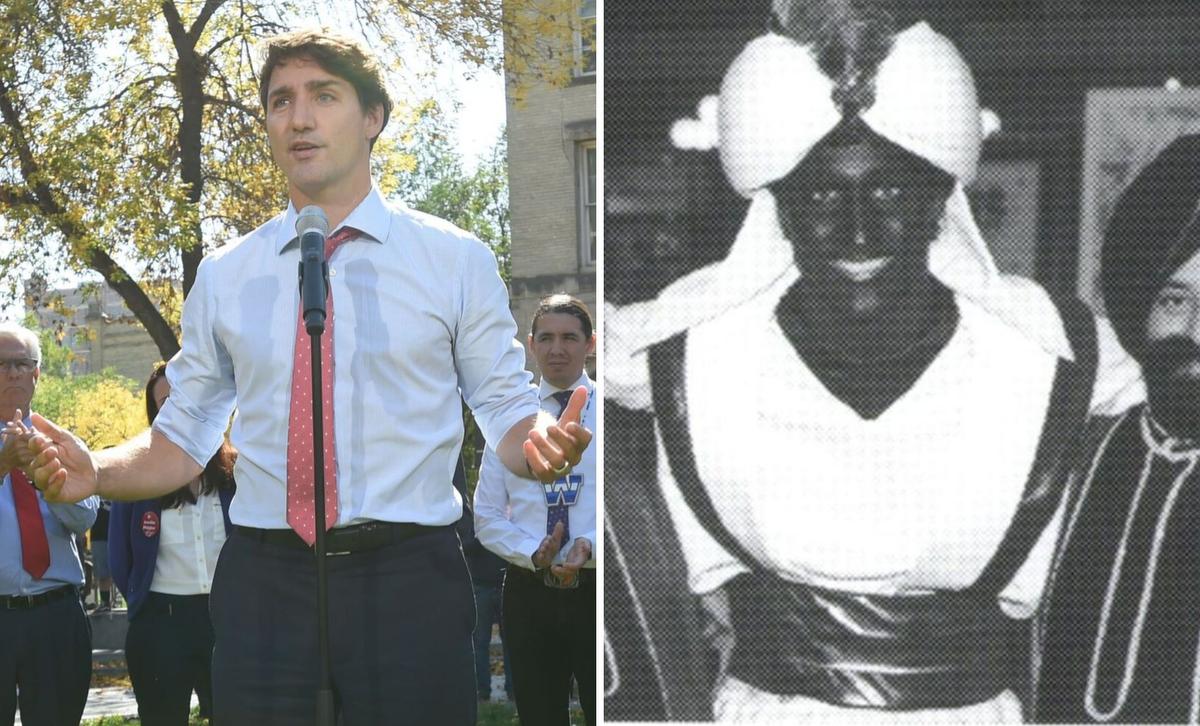
Blackface diptych

The Right Honourable Prime Minister of Canada Justin Trudeau.


A general election is scheduled for Canadians on October 21st. The governing Liberal Party with Justin Trudeau as its frontman seeks re-election. I think it likely the Trudeau Liberals will win re-election, and if so, this is bad news for Canadians. Since taking office in 2015, the Liberal government with the prancing popinjay that is Justin Trudeau consistently sowed division among Canadians. The Liberal government promoted its globalist agenda in pitting Canadians against one another via the imposition of identity politics on Canadians. Yes, the Liberals, with Justin Trudeau as their spokesman, pushed the belief that group identity matters more than individuality and the content of character in each of us as individuals. In doing so, the Liberal government instilled division rather than unity among Canadians since taking office in 2015. In 2019, Canadians are set against each other according to superficial differences such as race, ethnicity, religious affiliation, sex, sexual orientation and the like. Not only that but the Liberal government set a standard of political correctness to which not even the sanctimonious Justin Trudeau can adhere. Continue reading

I am a Canadian. — John Diefenbaker

Diefenbakercitizenship

“I am a Canadian,” is the opening phrase in a notable quotation from the Right Honourable John Diefenbaker (1895-1979) 13th Prime Minister of Canada serving from June 21, 1957, to April 22, 1963. The entire quote reads as follows:

“I am Canadian, a free Canadian, free to speak without fear, free to worship God in my own way, free to stand for what I think right, free to oppose what I believe wrong, free to choose those who govern my country. This heritage of freedom I pledge to uphold for myself and all mankind.” (John Diefenbaker, House of Commons Debates, 1 July 1960)

Yes, John Diefenbaker was a proud Canadian–not only that he was a proud Canadian nationalist. As Prime Minister, Diefenbaker advanced the cause of Canadian nationalism. He envisioned:

One Canada, one Canada, where Canadians will have preserved to them the control of their own economic and political destiny. Sir John A. Macdonald gave his life to this party [Conservative]. He opened the West. He saw Canada from east to west. I see a new Canada – a Canada of the North! (John Diefenbaker, Winnipeg Manitoba, 12 February 1958)

Diefenbaker lived during the first century of Canada’s existence. He witnessed the development by which Canada gained independence from Britain. Until 1931, with the passage of the Statute of Westminster, the British government managed Canada’s international affairs. Diefenbaker saw Canada fight in two world wars and Canadians suffer through the Great Depression. He proudly saw the passage of the Canadian Citizenship Act in 1947. Canadians have much to be proud of in their history.

While Diefenbaker saw all that is good in Canada and being Canadian, he did not overlook the problematic moments in Canadian history. Canadian society was not without issues of unjust discrimination and prejudice. Diefenbaker observed:

From my earliest days, I knew the meaning of discrimination. Many Canadians were virtually second-hand citizens because of their names and racial origin. Indeed, it seemed until the end of World War II that the only first-class Canadians were either of English or French descent. As a youth, l determined to devote myself to assuring that all Canadians, whatever their racial origin, were equal and declared myself to be a sworn enemy of discrimination. (John Diefenbaker, Nowlan Lecture, 6)

Diefenbaker knew of the head tax charged on Chinese immigrants. The head tax, enacted in 1885, remained in effect until 1923. Chinese immigrants to Canada were charged (at its worst) $500 for admission to Canada as landed immigrants. From 1923 to 1947 Chinese immigration to Canada was banned. He knew of the internment of Japanese-Canadians in World War II. He was well aware of the Catholic-Protestant divide in Christendom that existed well into the 20th-century in Canada. I remember my mother telling me that my father had to convert to Roman Catholicism to marry her in 1960. My father’s family is Anglican. It is hard to believe such tribal divisions existed in Canada historically, but it is the reality.

Diefenbaker envisioned Canada as a nation organized according to the values of liberalism and pluralism. In shaping his vision of Canadian society, Diefenbaker was inspired, in part, by the passage of the Universal Declaration of Human Rights in 1948. The Universal Declaration of Human Rights was a Canadian-led effort. John Humphrey, a professor of law at McGill University, became director of the United Nations Division on Human Rights in 1946. Humphrey produced the first draft of the declaration. When Diefenbaker became Prime Minister in 1957, he set out to enact a piece of legislation–following up the passage of the Universal Declaration of Human rights–called the Canadian Bill of Rights. In addressing the historical issues of unjust discrimination and prejudice in Canada’s history, the Canadian Bill of Rights asserts in part:

 It is hereby recognized and declared that in Canada there have existed and shall continue to exist without discrimination by reason of race, national origin, colour, religion or sex, the following human rights and fundamental freedoms, namely,

  • (a) the right of the individual to life, liberty, security of the person and enjoyment of property, and the right not to be deprived thereof except by due process of law;

  • (b) the right of the individual to equality before the law and the protection of the law;

  • (c) freedom of religion;

  • (d) freedom of speech;

  • (e) freedom of assembly and association; and

  • (f) freedom of the press.

The Canadian Bill of Rights was superseded by the passage of the Constitution Act in 1982 with the entrenched Canadian Charter of Rights and Freedoms.

To his credit, John Diefenbaker laid the groundwork for our national identity as Canadians. Despite what so many people think currently, nationalism is not a dirty word. As I grew up the values of liberalism and pluralism–the proposition on which Canadian identity is built–that John Diefenbaker advocated were instilled in me. I remember the Centennial celebrations in 1967 fondly; the swell of national pride Canadians felt in celebrating Canada’s first 100 years as a nation. I am proudly Canadian. I am not ashamed of my European heritage–my ancestry goes back to the British Isles. In keeping with Diefenbaker’s vision, I view the people with whom I interact as individuals and judge them according to the content of their character. I reject the notion that expressing Canadian nationalism is racist, that it is a declaration of white supremacy. No, Canada is not a “post-national state.” Canadians are well within their rights to stand up for their national interest, and Canadian law guarantees them their right to speak up and do so.

I hope Canadians will not lose sight of the fact that Canada is a great place to live and Canadian citizenship is worth fighting for. Yes, John Diefenbaker got it right when he advanced the cause of Canadian nationalism and Canadians would do well to remember as they face the challenges of life in the 21st-century.

Posted by Geoffrey


Prejudice is a burden that confuses the past, threatens the future and renders the present inaccessible. — Maya Angelou

hisbrotherlovebubba

Prejudice is defined as “an unfair and unreasonable opinion or feeling, especially when formed without enough thought or knowledge.” (Cambridge Dictionary) I experience prejudice as both a gay man and gun owner. You may be familiar with the crude caricature of a gay man: that of a limp-wristed, effeminate man who speaks with a lisp and has an incessant compulsion for sex. You may also be acquainted with the cartoonish stereotype of gun owners as lower class white men who are uncouth and certain to tell you the only way you will take his gun from him is “from my cold, dead hands.” Certainly, these are the extreme ends of these particular prejudices. There are occasions in my life when people directed anti-gay slurs at me and to a lesser extent snide remarks about my supposed lack of virility and questionable mental health for being a gun owner. Still, the prejudice I face as a gay man and gun owner that really concerns me is far more indistinct than loutish people who call me “queer” or “gun nut” because they just do not know any better. Continue reading

There is no odor so bad as that which arises from goodness tainted. — Henry David Thoreau

mistic_religiongoodevilsignpost

“Do you think religion inherently good?” This was a rhetorical question posed to the class when I was a student at Queen’s University in 1986. The class was in a course in the history of Christianity. The question was posed by Professor William P. Zion who was on the faculty of the department of religious studies and the Queen’s Theological College. He was also a Russian Orthodox Priest, Father Basil. We were young students who never stopped to think about this. Professor Zion answered the question for us, telling us, “no, religion is not inherently good.” He cited the fact that historically Christians gathered to watch people burned at the stake as a witness to their faith. Professor Zion had a bit of fun with the class in posing this question, but what made me recall this memory is the fact that the majority of humanity practices some kind of religion. I appreciate and understand the appeal of religion for people. I was a pious Roman Catholic myself for several years. Interestingly, it was Father Basil who supported and encouraged me to accept my gayness and continue practicing my faith. I concur with Professor Zion in that I do not think religion is inherently good. This puts me in a bind at times as I interact with people of various faiths, who view their faith as inherently good, right and desirable, both personally and informally in my daily life. Continue reading