“Every man has a right to utter what he thinks truth, and every other man has a right to knock him down for it. Martyrdom is the test.”–Samuel Johnson (1709-1784)

Polish_Righteous_Józef_and_Wiktoria_Ulmaglorification-of-martyrs

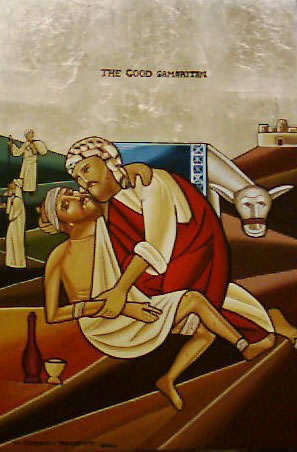
Martyrdom is a concept with which I have been familiar since I was very young. From my Roman Catholic background growing up I remember reading accounts of the lives of saints, many of whom were martyred in the most grisly fashions imaginable. In the summer of 1969 my family, myself, my three siblings, our mother and father and my mother’s parents toured Europe, traveling in a Volkswagen van. Among the sights we saw were a number of art galleries where I viewed a great many works of art depicting the martyrdom of various saints. The martyrdom of Saint Sebastian is one of the more memorable depictions I recall, but it was the depiction of one event in particular from the Bible that really made an impression on me: that of the Massacre of the Innocents. From the first time I heard that story read to me I was troubled by it. I struggled to understand why God would allow such an atrocity. In one version of the story, written for children, I remember reading that we should find solace  in that the mothers of the slain baby boys would have found comfort had they known their murdered sons were the first Christian martyrs. This raised a question for me I have pondered over the years: can children be martyrs? Continue reading

If you want a religion to make you feel really comfortable, I certainly don’t recommend Christianity. — C.S. Lewis (1898-1963)

2_cs_lewis_quotes_on_faith.SAslan

Christianity continues to appeal to me despite the fact I no longer practice the faith. My family was nominally Roman Catholic when I was growing up. I remember attending Sunday mass regularly as a small boy and being enrolled in classes to prepare me for my First Communion when I was in first grade. I never completed these classes as they were interrupted when my father was sent to work in England for two years and my mother, myself and my siblings went along also. I remember learning about Jesus in those early years of my life, that He is the Son of God, that as a child He never talked back to his parents or fought with other children, that He accepted crucifixion for our sins and our redemption. At the time I really had no reason not to believe. I trusted that what my parents and teachers were telling me was true. The two years we resided in England my siblings and I attended a private Christian school, Berkhampstead, in Cheltenham. On the whole I remember this as a positive experience. We had regular religious instruction given in a way that was pleasant and seemed quite reasonable. The best part of school for me at that age was when the teacher read to  us and Bible stories were as engaging as any other collection of tales. Continue reading

“After all, what’s a life, anyway? We’re born, we live a little while, we die.” ― E.B. White, Charlotte’s Web

66506_483152090378_1731430_nJuno1

In memory of my beloved Juno (May 21, 2008 – August 15, 2012)

“Each of us owes God a death.” So I heard Gwynne Dyer proclaim in an episode of his television series War. Death is a reality; it comes for us all. When I was a small boy I did not understand the reality of death. I remember, I must have been three years old and seeing my grandmother with some old baby clothes and toys she said were my aunt Lonny’s. My impression in seeing this was to imagine that people must grow up, then grow back down to being babies again. I asked my mother if this was so and she corrected me, telling me no, people grow, then they grow old and die. She added that nobody wants to die, but everyone has to. I did not really understand what it meant to die and did not give it much thought until I was a little older, maybe five years old when I asked my mother and father “what happens when you die?” They told me “your spirit goes up,” presumably to heaven. I still did not understand and was a little frightened by the prospect, but decided that must be a long way off so I would not worry about it. Continue reading

I believe the fear of the rope, as it is generally called among certain classes, is a very great deterrent. — Rayner Goddard, Baron Goddard (10 April 1877 – 29 May 1971)

PierrepointWands3

Mika and I are celebrating our fifteenth year together this month, August 2013. In all these years as a couple, we have never gone away together for a holiday. At long last, we are taking a holiday next month, a trip to England for two weeks. This will be Mika’s first visit to England. I lived in England from 1968-1970. I remember upon learning I would be travelling to England with my family imagining England was a land with castles where kings and queens resided and frequently ordered that people’s heads be chopped off. While this was true in the past, it happily was no longer the case by the late 1960s. In fact, capital punishment was no longer in use when I arrived in England with my family. Still, this is one facet of English history and law I find fascinating: the application of capital punishment. Judicial hanging was by far the most common form of execution in English history, although the cruel punishments of hanging, drawing and quartering, burning at the stake and beheading were practiced for centuries also. By the 20th century judicial hanging was the only method of execution (outside of the military where one could be shot at dawn) employed and the English had perfected its practice applying it liberally in executing people convicted of murder and high treason. Continue reading

Morality is simply the attitude we adopt towards people whom we personally dislike.–Oscar Wilde (1854-1900)

ClosetPhoto-By-Salon1

While attitudes toward gay people have changed a great deal for the better in my lifetime, prejudice and stereotypes remain. There is one stereotype in particular that kept me from coming out until later in life: that of the gay man as a predator from whom children must be protected. I am told I am good in my interaction with children and young people. I am gentle and soft-spoken and very easy going, and children generally like me. Because of this, it was suggested that I consider a career in teaching by one of my mentors at Queen’s University. I was reluctant to go into teaching because of this stereotype. I was confronted with this stereotype and the prejudice against gay men as teachers in 1986, the year I graduated from Queen’s. The Chairman of the Frontenac County Board of Education, in commenting on the amendment to the Ontario Human Rights Code which added sexual orientation to the list of prohibited grounds of discrimination, was dismayed that he no longer had any legal grounds to refuse to hire a teacher if he knew he was dealing with an “obvious faggot.” Continue reading

I am a conservative Republican, but I believe in democracy and the separation of church and state. The conservative movement is founded on the simple tenet that people have the right to live life as they please as long as they don’t hurt anyone else in the process. — Barry Goldwater

2012-02-15-goldwater_0billboard

In a previously published essay, I discussed the life and career of Barry Goldwater, the Republican Senator from Arizona and his support of gays serving in the US military. Beyond this, he was in favour of gay rights in all of US society. This support was based on his conviction that there be a strict separation between religion and state. Goldwater’s position on gay rights and the separation of religion and state put him at odds with many conservatives, particularly the religious constituency known as the Christian right that supports the GOP and various socially conservative causes in the United States. The Christian right is composed primarily of the Moral Majority, renamed Moral Majority Coalition in 2004, the Christian Coalition of America, Focus on the Family and the Family Research Council. The most prominent figures in the Christian Right are Jerry Falwell (deceased), Pat Robertson, James Dobson and Tony Perkins. Continue reading

Mallard hen with duckling

Sole survivor

By mid-July on the Rideau River this mallard hen has only one of her brood left. She will have started out with a brood of six to eight newly hatched ducklings in May-June, but ducklings fall prey to seagulls, snapping turtles and other predators very easily. Chances are the surviving duckling will not survive its first year of life. This is the reality in the natural world: 85% of the birds and animals born in spring do not last a year, but enough do last long enough to breed the following spring and perpetuate their species.

Photographed and posted by Geoffrey

Hera at nine months

Hera wallowing in a muddy puddle

Hera after a run on a hot, humid afternoon saw fit to plop down in a muddy puddle rather than kennel up when we returned to the car. She had cooled off in the Rideau River during the run. She looks quite pleased with herself.

Photographed and posted by Geoffrey

You don’t have to be straight to be in the military; you just have to be able to shoot straight. — Barry Goldwater (1909-1998)

66752_162144940601785_2132611037_ngoldwater1

The repeal of the Defense of Marriage Act (DOMA) in the United States is great news for gay couples who are employed by the federal government, particularly those who are serving in the US military. Interestingly, the ban on gays serving in the US military was lifted before the repeal of DOMA, and the effort to lift this ban was supported by what you might think was an unlikely advocate: none other than Barry Goldwater (1909-1998).  Goldwater was a staunch conservative, an anti-communist politician whose career in federal politics began in 1952 as a Senator for the State of Arizona and presidential candidate for the Republican Party in 1964, continuing until his retirement in 1987. He was forthright and transparent in his thoughts concerning gay rights in US society and gays serving in the US military, and not in the way you may be thinking.  Concerning gays serving in the military, he stated, “everyone knows that gays have served honorably in the military since at least the time of Julius Caesar. They’ll still be serving long after we’re all dead and buried. That should not surprise anyone.” He added:

The conservative movement, to which I subscribe, has as one of its basic tenets the belief that government should stay out of people’s private lives. Government governs best when it governs least – and stays out of the impossible task of legislating morality. But legislating someone’s version of morality is exactly what we do by perpetuating discrimination against gays. (Lifting ban on gays in military should be conservative cause)

Continue reading

Eastern kingbird

Eastern kingbird

Eastern kingbird keeping a wary eye on us as we passed by its nesting site in a shrub next to the Rideau River, July 1, 2013.

Photographed and posted by Geoffrey