Tag Archives: same sex relationships

It is a great plague to be too handsome a man. — Plautus

When I first viewed the photo, the portrait of the two young men struck me. Initially, I could not quite place why, but then it dawned on me. In the summer of 1980, I was a reservist in the Canadian Army. I served in the 30th Field Artillery Regiment based in Ottawa. It was the summer following my graduation from high school and before my enrollment at Queen’s University in Kingston. I went to Canadian Forces Base Petawawa to work as a driver in a transportation company through July and August. I worked with young men from other regiments who were posted there, too–we were in our late teens and early twenties.

Continue reading

A sound discretion is not so much indicated by never making a mistake as by never repeating it. — Christian Nestell Bovee

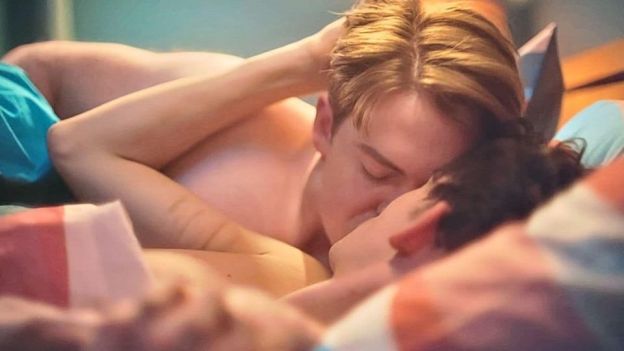
Life for gay youth in the Heartstopper universe is generally reasonable. The protagonists, Nick Nelson and Charlie Spring—Nick is bisexual, and Charlie is gay—find each other and become boyfriends despite elements of antigay prejudice that linger. They initially feel the need for discretion in their relationship. Naturally, they yearn for privacy also. The scene where Nick’s mum walked in on them as they got close and personal in Nick’s room illustrated the point. It made me think of what life was like for me as a young gay man in the 1980s. I was a student at Queen’s University in Kingston, Ontario, Canada, in the first half of the 1980s. It was the height of the AIDS crisis, and gay men were the most affected. There was a moral panic; people did not know for sure how HIV was transmitted and feared exposure to the virus. It was seen as a gay plague, something that gay men brought on themselves for their unprincipled ways. Trust me, it was not a good time to be a gay man. Discretion was necessary because the consequences would be dire if you were outed.

Continue reading

There’s this illusion that homosexuals have sex and heterosexuals fall in love. That’s completely untrue. Everybody wants to be loved. — Boy George

I recall when I was in university in 1982. I enrolled in a film studies class, and one of the films we watched was Pagan Rhapsody. There is a scene in the film where two men play a sex scene. Though the scene was as vanilla as possible–there was kissing and a little friendly groping (nothing graphic)–the student audience’s vocal expressions of disgust were notable. In 2024, male homosexuality was generally accepted as a natural expression of human intimacy and treated with sensitivity in film and television. Netflix series such as Young Royals and Heartstopper feature a gay romance and intimacy between high school boys in a way that leaves something to the viewers’ imagination. Both series are immensely popular with younger viewers. Things have changed since the screening of Pagan Rhapsody in 1982. Still, when it comes to public perceptions of intimacy between gay men, there are a lot of people who have an unsavoury fixation on what they imagine goes on when two men are intimate. I get expressions of disgust in the comments on blog posts I write on gay rights advocacy, where people say things like, “There’s nothing more disgusting than two men fucking each other in the ass,” and “Cocksucking is not a men’s issue.” I mean, that is beyond the pale.

Continue reading

I think gay men are more masculine than straight men. Because, guess what? They love other men! — Sir Ian McKellen

gladtobegay-badge-2go

I came across an article featuring an interview with Angela Davis Fegan, an artist and LGBTQ activist, in which Fegan condemned the gay rights movement for what she views as its domination by white, straight-acting gay men. She cited the campaign for same-sex marriage rights with its prescient concern for the legal and financial status of same-sex couples to illustrate her complaint. She asserted, “the push for marriage was largely about granting real estate and tax benefit rights to straight-acting, white, gay men.” (as cited in POPSUGAR) I am a masculine, white, gay man and view the gay rights movement and the legalization of same-sex marriage in particular as a good thing for all same-sex couples regardless of their sex, race or ethnicity. Fegan is not alone in her condemnation of the gay rights movement for the alleged domination by “white, straight-acting gay men.” Amrou Al-Kadhi, a gay drag performer, is critical of “the glorification of Olympic Poster boy Tom Daley and Academy Award winner Dustin Lance’s relationship. While it is a sign of progress that a gay relationship is celebrated nation wide, it is done in a manner that is “digestible” for a PG audience — a straight-acting Disney-fied gay couple (both attractive, white, masculine), giving gay men a pretty unobtainable ideal of success.” (as cited in i-D Magazine). Still, by made me think about why I took up with the gay rights movement as a masculine, white, gay man beginning in 1989. Continue reading

If a couple of gay guys want to throw the gayest, most fabulous wedding of all time, the only way it should offend you is if you weren’t invited. ― Orlando Winters

sweetcakesTennessee-No-Gays-Allowed-Sign-x400

“No shirt, no shoes, no service,” how often do I find a sign with these words posted when I approach the entrance to a restaurant or shop. There are hotels, bed & breakfasts, resorts and housing developments that refuse to allow children. I remember in 1968 my mother and father were asked by owners to leave their bed & breakfast in Cheltenham, England because other guests did not like that there were children on the premises. I remember back in 1987 when I was a student at Wilfrid Laurier University trying to find a place to live in Kitchener-Waterloo. It was a very tight market for student housing and for one of the ads I answered was told curtly by the voice on the telephone “we only take girls.” In 1989 back in Ottawa as I browsed ads in the newspaper for shared accommodation, I noticed more than a few that included the phrase “straight only.” People discriminate against others in the marketplace for various reasons, and in many cases, such as those listed above, it is lawful to do so, while in others it is not. The question is what is the appropriate response if you find yourself confronted with a situation when you think you are the butt of either unjust or unlawful discrimination. Continue reading

There is hardly a political question in the United States which does not sooner or later turn into a judicial one. — Alexis de Tocqueville

WALLACERoy-Moore-Quote-Seperation-of-church-and-state

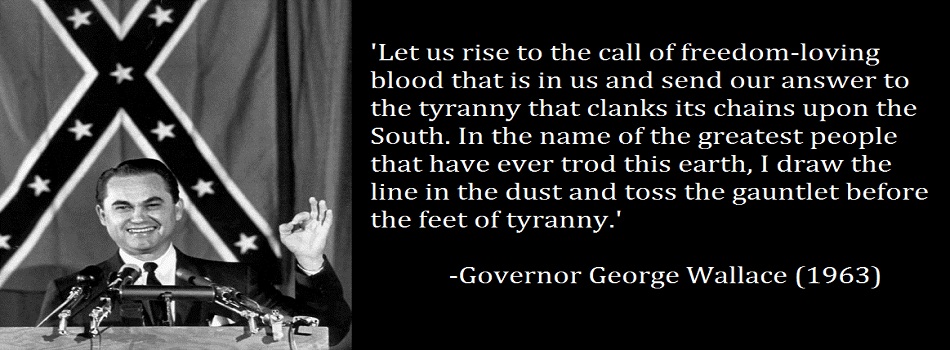
Despite gains in the movement for marriage equality in the United States, such as the repeal of the Defense of Marriage Act (DOMA) and Proposition 8 by the Supreme Court of the United States in 2013 and the repeal of Amendment 1 in North Carolina by a U.S. District Court in 2014, resistance rooted in cynical appeals to populism and the tyranny of the majority rears its head in Alabama. This is manifest in the looming showdown between Judge Roy Moore of the Alabama Supreme Court and the Supreme Court of the United States (SCOTUS) following the repeal of the Alabama Sanctity of Marriage Amendment, in a ruling handed down by Justice Callie V. Granade  of the United States District Court for the Southern District of Alabama on January 23, 2015. This is not unlike the showdown that took place between Governor George C. Wallace and President John F. Kennedy in 1963 when Governor Wallace defied the SCOTUS ruling in Brown v. Board of Education, handed down in 1954 that declared segregation unconstitutional. In both cases, support for segregation and for a ban on same sex marriage was overwhelming and Wallace and Moore insisted their respective stands on the issues was justified in that they represented the opinion of the majority of voters in Alabama. Continue reading

The Lord is my Shepherd and he knows I’m gay. — Troy Perry

triintylawaustin

The issues of gay rights, religious liberty, and religion in Canada and the United States remain contentious. While the destigmatization of homosexuality is a welcome trend in Canada and the United States, it is by no means a fait accompli. Lawful discrimination on religious grounds against gay people remains an issue, notably in secondary and post-secondary education, as religious institutions operate and have sole proprietorship of their high schools, colleges and universities. The issue of lawful discrimination against gay people on religious grounds and opposition to it from the wider society is highlighted by recent events concerning Trinity Western University in Langley, British Columbia and Lutheran High North (a high school ) in Houston, Texas. Both schools have moral codes founded on their interpretation of Christianity that bar sexual activity outside marriage and between persons of the same sex. The schools stand firm in their opposition to homosexuality in the face of controversy and maintain they are within their rights to do so. In either case, presumably, a gay student is welcome to attend, provided they abide by the respective schools’ moral codes. It is legal in both Canada and the United States, but is it tolerable, and what is the appropriate response for those who take issue with these school policies? Continue reading

At 93, I never thought we would have to debate the definition of marriage — Billy Graham

ThomasMoreCarolina

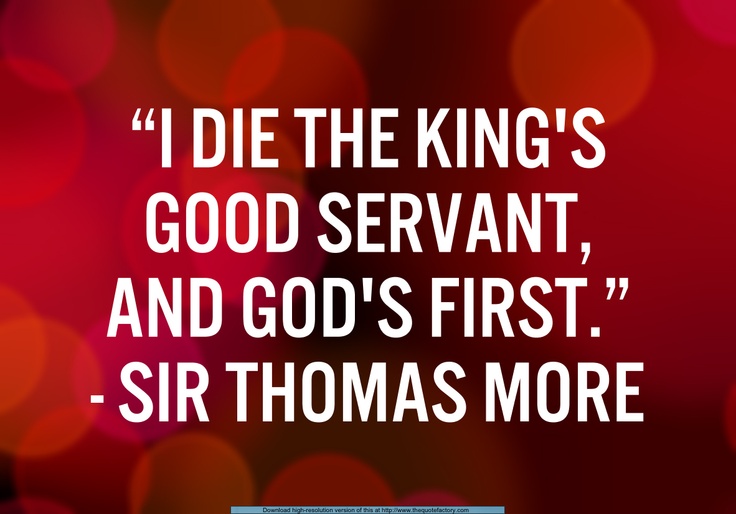
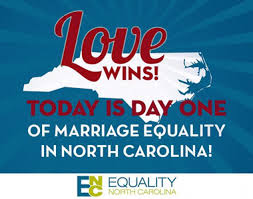
Religion and the definition of marriage remain intertwined in the present, just as in the past. Historically, disputes over the definition of marriage concerned marriage, divorce and remarriage. Dispute over these issues in the court of King Henry VIII of England in the 16th century caused upheaval in the Church and English society. Heads rolled, literally, in the process. In the present, there is an ongoing dispute over the definition of marriage or the redefinition of marriage to allow same sex couples to marry. As I view the movement for same sex marriage, defined as marriage equality, in the United States, North Carolina is a focal point. Amendment 1 to the state constitution, enacted in 2012 following a ballot measure, defined marriage as the union of one man to one woman. Amendment 1 was struck down on October 10, 2014 by U.S. District Court Judge Max O. Cogburn, Jr.  It is now lawful for same sex couples to marry in North Carolina, much to the dismay of opponents of marriage equality, including Charles L. Worley and Billy Graham, who object on religious grounds. Heads are rolling, though not literally, in North Carolina now that Amendment 1 is no longer in force. Continue reading

The despotism of custom is everywhere the standing hindrance to human advancement. — John Stuart Mill

1967_wolfenden-reportmill

The publication of the Wolfenden Report in 1957 was a landmark in the movement that led to the destigmatization of homosexuality across the Western world in that it brought about the decriminalization of male homosexuality in England and Wales in 1967. The repeal of the Criminal Law Amendment Act 1885 (48 & 49 Vict. c.69) accomplished this. Section 11 of the Act, in particular the clause known as the Labouchere Amendment, applied to male homosexuality. In short, the clause provided for a term of imprisonment “not exceeding two years”, with or without hard labour, for any man found guilty of “gross indecency” with another male, whether “in public or in private”. In 1953 the Home Secretary, David Maxwell Fyffe, referred to male homosexuality as a “plague over England,” and vowed to wipe it out. In 1954, the Departmental Committee on Homosexual Offences and Prostitution was convened with John Wolfenden appointed chairman. Continue reading

What will survive of us is love. — Phillip Larkin’s An Arundel Tomb

536072_486556508070130_1208265843_nGeoffrey and Mika in their library.

The story of the life and love shared by Thomas Lee Bridegroom and Shane Bitney Crone resonates with me to this day. I learned of their life together and the tragedy that befell them in viewing It could happen to you, the YouTube video produced by Shane Bitney Crone in memory of Thomas Lee Bridegroom, who died in a tragic accident on May 7, 2011. Though I do not know either of these men, I was so moved in a way that I normally am not upon hearing of a personal tragedy that strikes people who are strangers to me. Watching It could happen to you had a profound effect on me; I felt grief and outrage well up inside me upon learning of the injustice and iniquity that was heaped on Shane Bitney Crone following the death of his partner, Thomas Lee Bridegroom. As same sex couples could not marry in California at the time of Tom’s death, Shane had no legal standing as Tom’s partner and could do nothing as the Bridegroom family claimed Tom’s body, his assets and barred Shane from attending his funeral. This is so wrong and it happens to other couples. From the grief and outrage I experienced I was inspired to join in the effort to advocate for full civil rights for gay people, marriage rights in particular. Continue reading