Category Archives: Philosophy

“Every man has a right to utter what he thinks truth, and every other man has a right to knock him down for it. Martyrdom is the test.”–Samuel Johnson (1709-1784)

Polish_Righteous_Józef_and_Wiktoria_Ulmaglorification-of-martyrs

Martyrdom is a concept with which I have been familiar since I was very young. From my Roman Catholic background growing up I remember reading accounts of the lives of saints, many of whom were martyred in the most grisly fashions imaginable. In the summer of 1969 my family, myself, my three siblings, our mother and father and my mother’s parents toured Europe, traveling in a Volkswagen van. Among the sights we saw were a number of art galleries where I viewed a great many works of art depicting the martyrdom of various saints. The martyrdom of Saint Sebastian is one of the more memorable depictions I recall, but it was the depiction of one event in particular from the Bible that really made an impression on me: that of the Massacre of the Innocents. From the first time I heard that story read to me I was troubled by it. I struggled to understand why God would allow such an atrocity. In one version of the story, written for children, I remember reading that we should find solace  in that the mothers of the slain baby boys would have found comfort had they known their murdered sons were the first Christian martyrs. This raised a question for me I have pondered over the years: can children be martyrs? Continue reading

If you want a religion to make you feel really comfortable, I certainly don’t recommend Christianity. — C.S. Lewis (1898-1963)

2_cs_lewis_quotes_on_faith.SAslan

Christianity continues to appeal to me despite the fact I no longer practice the faith. My family was nominally Roman Catholic when I was growing up. I remember attending Sunday mass regularly as a small boy and being enrolled in classes to prepare me for my First Communion when I was in first grade. I never completed these classes as they were interrupted when my father was sent to work in England for two years and my mother, myself and my siblings went along also. I remember learning about Jesus in those early years of my life, that He is the Son of God, that as a child He never talked back to his parents or fought with other children, that He accepted crucifixion for our sins and our redemption. At the time I really had no reason not to believe. I trusted that what my parents and teachers were telling me was true. The two years we resided in England my siblings and I attended a private Christian school, Berkhampstead, in Cheltenham. On the whole I remember this as a positive experience. We had regular religious instruction given in a way that was pleasant and seemed quite reasonable. The best part of school for me at that age was when the teacher read to  us and Bible stories were as engaging as any other collection of tales. Continue reading

“After all, what’s a life, anyway? We’re born, we live a little while, we die.” ― E.B. White, Charlotte’s Web

66506_483152090378_1731430_nJuno1

In memory of my beloved Juno (May 21, 2008 – August 15, 2012)

“Each of us owes God a death.” So I heard Gwynne Dyer proclaim in an episode of his television series War. Death is a reality; it comes for us all. When I was a small boy I did not understand the reality of death. I remember, I must have been three years old and seeing my grandmother with some old baby clothes and toys she said were my aunt Lonny’s. My impression in seeing this was to imagine that people must grow up, then grow back down to being babies again. I asked my mother if this was so and she corrected me, telling me no, people grow, then they grow old and die. She added that nobody wants to die, but everyone has to. I did not really understand what it meant to die and did not give it much thought until I was a little older, maybe five years old when I asked my mother and father “what happens when you die?” They told me “your spirit goes up,” presumably to heaven. I still did not understand and was a little frightened by the prospect, but decided that must be a long way off so I would not worry about it. Continue reading

I am a conservative Republican, but I believe in democracy and the separation of church and state. The conservative movement is founded on the simple tenet that people have the right to live life as they please as long as they don’t hurt anyone else in the process. — Barry Goldwater

2012-02-15-goldwater_0billboard

In a previously published essay, I discussed the life and career of Barry Goldwater, the Republican Senator from Arizona and his support of gays serving in the US military. Beyond this, he was in favour of gay rights in all of US society. This support was based on his conviction that there be a strict separation between religion and state. Goldwater’s position on gay rights and the separation of religion and state put him at odds with many conservatives, particularly the religious constituency known as the Christian right that supports the GOP and various socially conservative causes in the United States. The Christian right is composed primarily of the Moral Majority, renamed Moral Majority Coalition in 2004, the Christian Coalition of America, Focus on the Family and the Family Research Council. The most prominent figures in the Christian Right are Jerry Falwell (deceased), Pat Robertson, James Dobson and Tony Perkins. Continue reading

“The law of humanity ought to be composed of the past, the present, and the future, that we bear within us; whoever possesses but one of these terms, has but a fragment of the law of the moral world.” — Edgar Quinet (1803-1875)

ujquote4lateran3

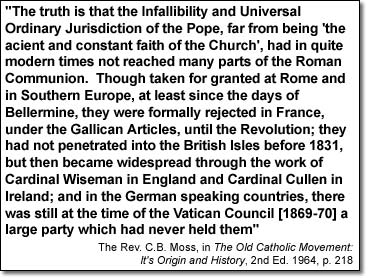
The papacy was in a very precarious position when Pope Pius IX convened the First Vatican Council on June 29, 1868. The drive for Italian unification was underway, with a revolution in 1848 that led to the exile of Pius IX in the castle of Gaeta in the Kingdom of the Two Sicilies from November 24, 1848, until his return to Rome in April 1850. The revolutionaries declared the Roman Republic comprised of the Papal States and in accordance with the ideals of the Enlightenment religious liberty and tolerance was enshrined in the new constitution by article 7 of the Principi fondamentali. Prior to this development only Christianity and Judaism were allowed by law to be practiced in the Papal States. The independence of the pope as head of the Catholic Church was guaranteed by article 8 of the Principi fondamentali. While providing constitutional guarantees of religious liberty and papal authority over the Catholic Church, the framers of the Constitution of the Italian Republic curtailed the temporal authority of the Pope which was referred to as an “historical lie, a political imposture, and a religious immorality” by a reform-minded priest, Abbé Arduini. (as cited in Wikipedia) However, by June 1849 the Roman Republic was overthrown by French military intervention and Pius IX restored in office, returning to Rome and reclaiming governance of the Papal States. Continue reading

Merrily rides the huntsman bold, Blithesome and gay rides he … — Brothers Grimm

66506_483152090378_1731430_n439px-St.Hubert_Ottawa_St.Patrick_RC_Basilica

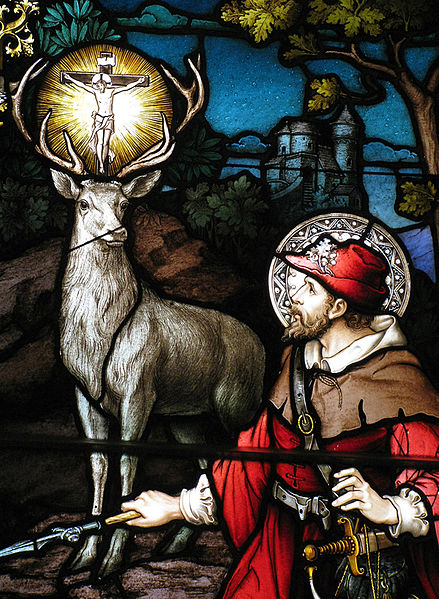
“Funny, you don’t look it” is a typical response when people learn I am a hunter. Aside from the fact I am gay, I am a gentle and thinking man. People find it hard to believe that I can choose to hunt down and kill a game bird or animal. Yes, hunting, unlike my gayness, is an ethical choice I make. It is a moral choice I keep to myself a great deal of the time as I find I have more venom spat at me for choosing hunting than for being gay. I concealed that I was gay and in a relationship with Mika from most of my hunting buddies. My hunting buddies are men and women from various ethnic and religious backgrounds. They are generally conservative. I feared I might lose them as friends and hunting buddies if they knew the truth, or at the very least, they would be uncomfortable knowing. It turns out they were not bothered in the least and are happy for me that I am in a long-term relationship with Mika. We remain friends and hunting buddies, taking to the field to pursue game and enjoy our sport. Everyone who takes up hunting has their reasons for doing so, but as for me, I have had a lifelong passion for hunting, the outdoors and wildlife. Continue reading

Tell the Devil to go to Hell

faust_and_mephistopheles_by_meliagaunce-d5fjlimdr_faustus_costume

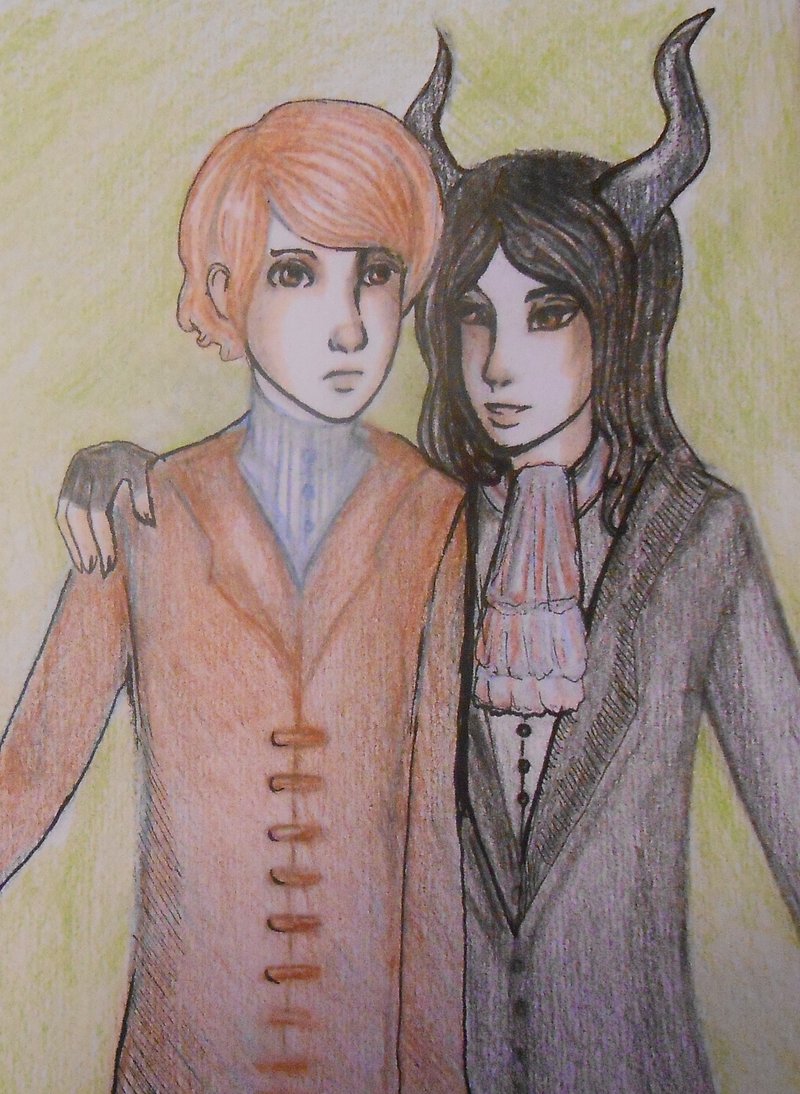
Tell the devil to go to hell,” good advice given to me by a priest who heard my confession at St. Mary’s Cathedral. I was a student at Queen’s University and practicing Roman Catholic in the 1980s. My confessor was speaking figuratively, of course. Neither he nor I believed to “tell the devil to go to hell” involves addressing the creature sporting horns, a tail and cloven hooves. The devil, in the context of our discussion, was a metaphor for humanity’s evils. My confessor told me that I should heed the dictates of my conscience to choose to good and avoid doing evil. What made me think of this was Pope Francis’s thoughts in a sermon, in which he intimated that atheists are redeemed. That is, they do not face damnation when they choose to do good and avoid doing evil. This sermon raises an interesting point. I understood that in practicing Roman Catholicism, redemption and sanctification are granted via the grace of God through faith in Christ. I am no longer a practicing Roman Catholic, though not an atheist. I am a Deist. I listen to the dictates of my conscience in trying to do good and avoid doing evil, in effect telling the devil to go to hell. And until hearing the news of Pope Francis’ homily, understood, from the perspective of Catholic teaching, I am putting my soul at risk of damnation. Continue reading

I desire not to keep my place in this government an hour longer than I may preserve England in its just rights, and may protect the people of God in such a just liberty of their consciences… — Oliver Cromwell (1599-1658)

8RainerCromwellLL

How often have I heard it said that it is the precepts of Christianity that are the foundation of Western civilization? When confronted with this claim, my typical response is to roll my eyes and think, “that old chestnut.” This is particularly the case when the claim is framed so egregiously by the likes of Glenn Beck, who stated, in referring to origins of the United States, “it is God’s finger that wrote the Declaration of Independence and the Constitution. This is God’s country; these are God’s rights. I have no idea what he wants us to do with them, other than protect them, and stand with Him.” (As cited in Tony’s Curricublog) While it is easy to dismiss such claims as stuff and nonsense, it is worth considering the role of religious belief in the growth and development of Western civilization, its transition from the primacy of Christian doctrine in public life to the rise of liberal democracy and the rule of law in the secular nation-state, though not in the way many religious folks, such as Glenn Beck, imagine it to be. Continue reading

Scripture, Tradition and Reformation

Image9c0a30e21f1cc2d5b6893e025ab12707

Recently, Mika and I attended a meeting of gay and lesbian Catholics. Several people of all ages were in attendance. We had a very interesting discussion and it was very nice meeting these people. Among those present was a young gay man, Jesse, who has faith in Christ and the Roman Catholic Church. Jesse, like so many gay people, just wants to find conjugal love and companionship with someone who happens to be the same sex. Jesse took the time to write a heartfelt letter to Pope Francis, explaining who he is, that he is gay, leading a very normal life, hoping to have married life with a man someday and asking for acceptance in the Church. He expressed some concern he might face excommunication for what he wrote, but we assured him this is not very likely. What he can realistically expect is a polite reply from the appropriate branch of the Vatican bureaucracy thanking him for his letter and reminding him that as Roman Catholic it is expected that he abstain from sex outside of marriage. That the Church does not accept same sex relationships at present leaves him in a bind.
Continue reading

Why I am not an atheist

I was, for a time, a very pious Roman Catholic. I attended mass every day, said my prayers, studied theology, and accepted the authority of the Sacred Scriptures and the Apostolic Tradition. Throughout it all, however, doubt always nagged at me. I remember following the Easter Sunday mass at the Mother House of Sisters of Providence of Saint Vincent DePaul (my great aunt Olive was a member of the order), joining in with a priest reciting Revelation 11:15, “And He shall reign forever and ever.” The priest added emphatically, “Yes, forever and ever.” “Oh wow, you really believe that?” was the first thought that crossed my mind. Doubt was ever present while I tried to practice Roman Catholicism. Some years later, at a suburban parish at the Easter Vigil, a woman behind me was pouring candies from a bag into her children’s hands while the priest was busy reciting the words for the lighting of the Sacred Fire. The sound of the candies pouring out of the bag was an annoying distraction, and it was following this that seemingly out of nowhere, doubt struck, and I found myself wondering, “What on Earth am I doing here? Do I really believe any of this?” I left the Vigil as I felt it wasn’t very good of me to stay.

Continue reading